
A disaster recovery (DR) data center is the facility you fail over to when your primary site goes down. The hard part is not the definition. It is getting recovery capacity that exists, is powered, and can carry the load before the outage costs you more than the build would have. Organizations that cannot wait years for a secondary facility, or cannot depend on a shared provider surviving the same regional event, can put a factory-built modular data center on an existing grid connection. SovereignOne’s modular units go from site survey to live load in 4 to 6 months, compared with 2 to 5 years for a typical conventional build.
TL;DR
- A DR site is a facility used to restore technology operations when the primary data center is unavailable. Its type (hot, warm, cold) sets how fast you recover.
- Federal bank examiners expect the choice of recovery alternative to be documented against your risk profile, and they flag colocation capacity as a risk in regional events.
- RTO and RPO are only real if you measure them. Replication method and failover steps set the limits.
- A modular data center gives you owned, on-site recovery capacity in months rather than years, from 1 rack to 14 racks per unit, with pricing quoted per project.
- Testing and failback matter as much as the build.
Table of Contents
- What a disaster recovery data center is
- The recovery options and how to choose
- Where a modular data center fits
- Set RTO and RPO before you pick hardware
- Deploying recovery infrastructure fast
- Design factors that decide whether it survives
- Test it, then test failback
- How SovereignOne supports recovery capacity
- FAQ
- Sources
What a disaster recovery data center is
TechTarget defines a DR site as a facility an organization uses to recover and restore its technology infrastructure and operations when the primary data center is unavailable. That is narrower than backup, which only keeps copies of data, and narrower than business continuity, which covers people, process and facilities as well as IT. A DR data center is the place where servers, storage and networking actually run again.
The same source ties recovery speed to site type. A hot site can take over from a primary in milliseconds to hours. A warm site needs hours to days. A cold site, which is space and power without running systems, can take weeks to months to come fully online.
| Site type | Typical time to take over | What it means for you |
|---|---|---|
| Hot | Milliseconds to hours | Systems run and data is replicated continuously |
| Warm | Hours to days | Hardware is in place, data and configuration are brought current at failover |
| Cold | Weeks to months | Space and power only, equipment arrives after the event |
The response windows are TechTarget’s general ranges. Your own targets come from the workloads you must restore first.
The recovery options and how to choose
The FFIEC IT Examination Handbook, the U.S. bank regulators’ guidance, lists the recovery alternatives: cold, warm and hot sites, mirrored active-active sites, mobile units, colocation, reciprocal agreements and disaster recovery as a service. It asks management to document why an alternative fits the entity’s risk profile and complexity. It also notes that a colocation provider’s capacity may not hold up in a regional or large-scale event, and that reciprocal agreements should not be a long-term recovery solution.
That guidance is written for financial institutions, but the reasoning applies to hospitals, agencies and telecom operators alike. Your DR choice should be a written decision tied to risk, not a default.
Three housing models dominate. Network World compares them this way:
- Owning a secondary data center gives full control, at the price of duplicating servers, storage, networking, real estate, power and cooling.
- An external DR provider offloads responsibility to someone else.
- Public cloud scales on demand, but recovery needs a network path back to the provider, which may require satellite links if local internet is disrupted.
A peer-reviewed 2019 cost comparison found that cloud DR saves money while dormant but costs more at run-time than colocation or on-premises when a failover is actually executed. It also found that a hybrid design can satisfy conflicting requirements when cloud does not fit every system. For a closer look at the on-site layer of that kind of design, see our guide to building the on-site layer of hybrid cloud.
Where a modular data center fits
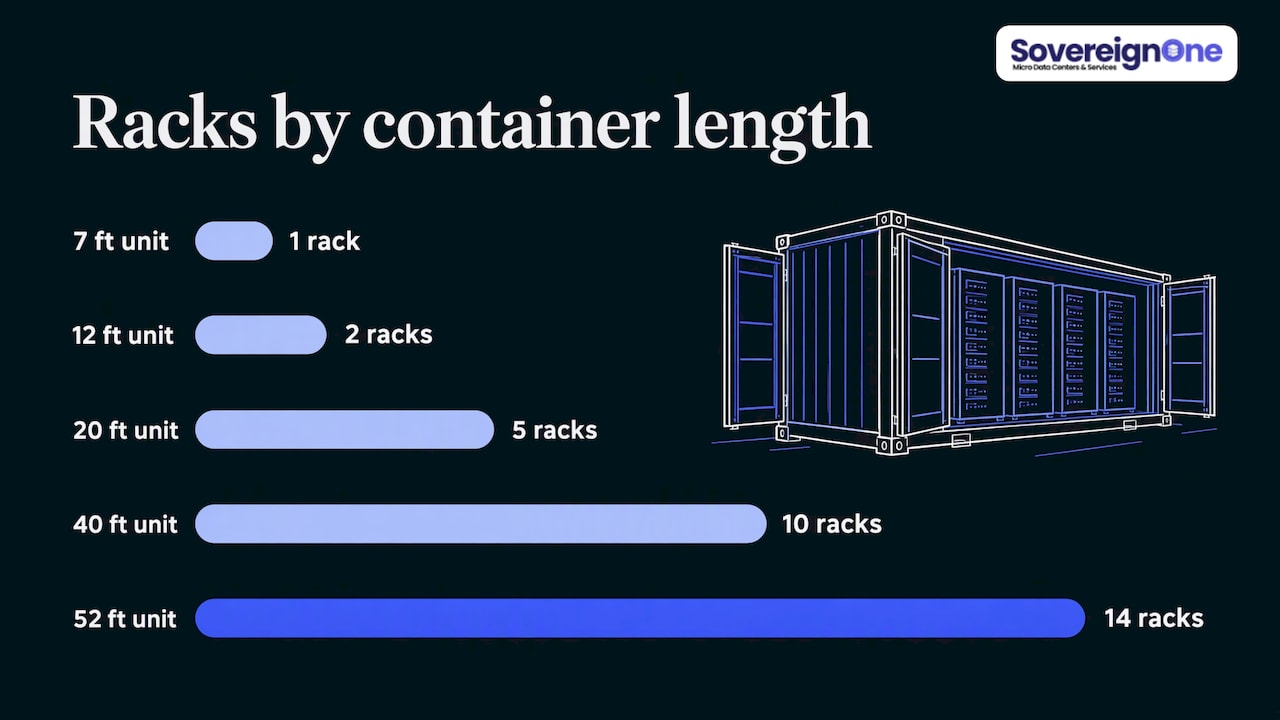
The usual objection to owning DR capacity is time and cost: a conventional build takes 2 to 5 years, and much of that is utility work, such as a new substation or a place in an interconnect queue. SovereignOne’s modular data center (MDC) containers are built and pre-tested in a factory, deploy on an existing grid connection with no new substation and no interconnect queue, and reach live load 4 to 6 months after site survey.
The lineup is one platform in five container lengths, at a nominal 125 kW per rack:
| Unit | Racks | Capacity |
|---|---|---|
| 7 ft | 1 | 125 kW |
| 12 ft | 2 | 250 kW |
| 20 ft | 5 | 625 kW |
| 40 ft | 10 | 1.25 MW |
| 52 ft | 14 | 1.75 MW |
That range lets you size a recovery site to the workloads you must restore first, not to the whole estate. A hospital system might recover its clinical systems on a small unit. A county might host emergency dispatch and records on a mid-size one. A GPU operator can add capacity by adding units. The capacity planning guide explains how to work out that first number.
Two design points matter for DR specifically:
- Familiar equipment. The units are integrated from established hardware platforms, so your own team can maintain and operate them without learning a new platform. In a recovery event, nobody should be reading a manual for the first time.
- Lower cooling overhead. The cooling design cuts power and water use for cooling by 30%, which reduces what a standby or partly loaded site draws from the grid and from backup generation.
Because the site is yours and on your own grid connection, it is not competing with other tenants for capacity during a regional event. If you want the container format explained in full, read what containerized data centers are and how to deploy one.
Set RTO and RPO before you pick hardware
Two numbers drive every DR decision. The recovery time objective (RTO) is how long a service can be down. The recovery point objective (RPO) is how much recent data you can afford to lose.
An IJERT framework paper makes three points that help here:
- RPO is bounded by how you replicate. Asynchronous replication gives an RPO equal to the worst-case lag plus the time to detect the failure. Synchronous replication pushes RPO toward zero, but it adds write latency and is feasible only within metropolitan-area latency budgets.
- RTO is bounded by the slowest failover step, which is usually a human step unless it is automated.
- A target nobody measures is not a target. Give each one a definition, an owner and an alarm threshold.
The second point has a site-planning consequence. If you need near-zero RPO, the DR site has to be close enough for synchronous replication. If your threat is a regional event, such as a hurricane or wildfire, it has to be far enough to be outside it. Many organizations resolve this with two tiers: a nearby site for synchronous protection of the most critical systems, and a distant site for the rest.
Rank workloads into tiers before you buy anything. Tier 1 systems, such as dispatch, clinical records, network core and authentication, get hot capacity. Lower tiers can wait for warm recovery. The size of your Tier 1 and Tier 2 load, in racks and kilowatts, is then the specification for the recovery site.
Deploying recovery infrastructure fast
Speed is the main reason organizations look at modular recovery. The ITU’s Recommendation L.392 on disaster management with movable and deployable ICT units gives a useful sequence: prepare as much as possible during routine operations, then move through disaster-specific preparation, transport, installation, service setup and operation. It advises automating service setup and running independent tasks concurrently. It also notes that if internet access is down, the unit can provide local data center services and migrate them to internet service when access returns.
Translated into a procurement plan:
- Define the workload and the load in kilowatts. This sets the container size.
- Choose the site. Confirm the grid connection, space, and exposure to flood, fire and lightning. Our site preparation checklist covers nine checks to make before ordering.
- Order a factory-integrated unit. Pre-testing in the factory moves risk out of the field. SovereignOne’s schedule runs 4 to 6 months from site survey to live load.
- Commission it. Commissioning is the structured test that proves power, cooling and controls work together before production load arrives. See data center commissioning levels and steps.
- Pre-stage the recovery. Build and store deployment templates, replication targets and access credentials in advance, as ITU recommends, so service setup is automated when it counts.
- Drill it. Covered below.
If your recovery site needs to be somewhere with no existing facility, such as a remote operation, see the guides on portable data centers and edge data centers.
Design factors that decide whether it survives
A DR site that fails with the primary is not a DR site. Singapore’s IMDA resilience guidelines for data centres list the physical items to assess: power and cooling redundancy, cable management, physical access controls, fire detection and suppression, lightning protection, and flood and site suitability. They also stress that resilience is more than redundant equipment. Monitoring, incident response, change management and recovery processes are part of it.
Two U.S. points deserve attention:
- Power. CISA’s Resilient Power Best Practices for Critical Facilities advises combining renewable generation, energy storage and a generator in a microgrid, which it says can extend fuel supply, reduce annual electricity costs and improve resilience. A site that draws less power for cooling, as the 30% reduction in our cooling design does, has less to cover.
- Communications. The same CISA document recommends communications diversity, from at least two independent services at its lowest resilience level to at least four at its highest. It also recommends testing backup communications on a maintenance plan and using the PACE model: Primary, Alternate, Contingency and Emergency paths.
Security belongs in the design from the start. Our guide on secure edge computing controls and site design covers the physical and network controls for a site like this.
Test it, then test failback
Until a recovery has been timed end to end, the plan is a guess. The IJERT paper argues DR plans decay as applications change, dependencies shift and credentials expire, so testing has to be continuous: tabletop exercises, component failover tests, scheduled full failover exercises that measure RTO end to end, and fault injection.
A practical routine:
- Measure RTO from declaration to usable service, not to servers powered on.
- Measure RPO from replication lag, and compare it with the policy number.
- Test failback. Returning to the primary is the other half of the exercise and often the part nobody has rehearsed.
- Record the results and act on them. If actual recovery keeps exceeding the target, change the infrastructure or revise the target honestly.
How SovereignOne supports recovery capacity
SovereignOne builds factory-integrated, pre-tested modular data centers in five sizes, from 1 rack and 125 kW to 14 racks and 1.75 MW. They deploy on an existing grid connection and serve defense, state and local government, healthcare, telecommunications, education and disaster response, among other sectors. Pricing is quoted per project. If you are sizing a recovery site, start with the modular data center containers page, and use the guide to 23 questions worth asking in a quote to prepare your requirements.
Healthcare teams can read how the approach applies to healthcare modular data centers.
FAQ
What is the difference between disaster recovery and backup?
Backup keeps copies of data. Disaster recovery restores the whole service: compute, storage, network and applications. A backup with nowhere to run it is only half a plan, which is why a recovery site is part of the design.
How fast can a recovery data center be in place?
It depends on the type. A hot site takes over in milliseconds to hours, but must already exist. SovereignOne’s modular units reach live load 4 to 6 months after site survey, against 2 to 5 years for a typical conventional build.
Can a modular data center serve as a disaster recovery site?
Yes. It is owned, on-site capacity that you size from 1 to 14 racks per unit and run on familiar vendor equipment. It deploys on an existing grid connection with no new substation and no interconnect queue.
How much does a modular recovery data center cost?
SovereignOne quotes pricing per project, based on the unit size and your requirements. The cost per rack guide lists the three numbers to ask for.
Sources
- disaster recovery (DR) site, TechTarget
- FFIEC IT Examination Handbook, Data Center Recovery Alternatives
- Cloud, co-location, on-premises and hybrid disaster recovery cost comparison, PubMed
- Choosing a disaster recovery site, Network World
- A Cloud-Enabled Disaster Recovery Framework, IJERT
- ITU-T Recommendation L.392, Disaster management with movable and deployable ICT
- IMDA Advisory Guidelines for Resilience and Security of Data Centres
- CISA Resilient Power Best Practices for Critical Facilities and Sites