
Data center commissioning is the documented, staged testing that proves every power, cooling, controls and life-safety system works as designed, alone and together, before live IT load moves in. The schedule risk sits in the stages that happen on site. A factory-integrated modular data center (MDC) moves much of that work into a controlled factory setting, which is why SovereignOne units go from site survey to live load in 4 to 6 months, against 2 to 5 years for a typical conventional build.
This guide explains the levels, what each one verifies, what paperwork you should require, and where commissioning time is won or lost. It is written for owners and buyers: IT leaders, agency program managers, healthcare and telecom operators, and GPU compute teams who must accept a facility, not engineer its test scripts.
TL;DR
- Commissioning verifies, level by level, that components, subsystems and finally the whole facility meet the owner’s design intent. ASHRAE’s framework runs from L1 factory testing to L5 integrated systems testing.
- Many owners add a Level 0 for design review and a Level 6 for closeout and handover, giving seven stages in total.
- Staged testing exists to catch faults early: at the factory, at delivery, at start-up, and only then in the full-system test.
- The fastest route is fewer site-built systems. A factory-integrated, pre-tested MDC arrives as a finished unit, so site work centers on placement, connection and the later levels.
- Require an owner’s project requirements document, written acceptance criteria, test scripts, a final report and operator training before you sign off.
Table of Contents
- What data center commissioning is
- The commissioning levels, step by step
- How testing proves behavior under failure
- What to require before go-live
- Why commissioning takes so long on a conventional build
- How to make commissioning faster without cutting steps
- How a factory-integrated modular unit changes the commissioning path
- Planning an MDC project with commissioning in mind
- Where SovereignOne fits
- FAQ
- Sources
What data center commissioning is
Commissioning is a quality process, not a single test. ASHRAE’s AI data center framework describes commissioning as phased verification that components and facility systems meet design intent and operate reliably, progressing from factory tests through integrated systems testing.
Three documents anchor the process:
- Owner’s project requirements (OPR): what the facility must do, including performance and acceptance criteria.
- Basis of design (BOD): how the design meets those requirements.
- Commissioning plan: scope, roles, schedule and testing standards.
This division of documents is laid out by one engineering consultancy that also advises that the OPR should set the acceptance criteria up front. If you cannot point to the line in your OPR that a test is meant to prove, the test has no pass or fail standard.
For an owner, the practical meaning is simple. Commissioning is how you turn “the contractor says it works” into recorded evidence that it works under normal load, during maintenance and during credible failures.
The commissioning levels, step by step
Level names vary a little between firms, but the structure is consistent. ASHRAE’s framework identifies five levels: L1 factory acceptance testing, L2 delivery and installation verification, L3 pre-functional checks, L4 full functional performance testing and L5 integrated systems testing. A 2019 ASHRAE chapter presentation describes full life-cycle commissioning as starting earlier, with programming and owner requirements, and ending with acceptance, training, closeout and deferred or seasonal testing. That is where Level 0 and Level 6 come in.
| Level | Name | What it verifies | Where it goes wrong |
|---|---|---|---|
| L0 | Planning and design review | Requirements are written and the design meets them | Vague acceptance criteria that cannot be tested |
| L1 | Factory acceptance testing | Equipment performs before it ships | Skipping owner witnessing, so defects travel to site |
| L2 | Delivery and installation verification | Equipment arrived undamaged and is installed correctly | Transit damage found late |
| L3 | Start-up and pre-functional checks | Components and subsystems are ready to operate | Installation errors surface during start-up |
| L4 | Functional performance testing | Each system performs across its sequences and modes | Controls not ready, so tests stall |
| L5 | Integrated systems testing (IST) | Power, cooling and controls work together, including failures | An improvised test with no advance planning |
| L6 | Closeout and handover | Documents, training and acceptance are complete | Missing as-built drawings and manuals |
Level 0: design review and requirements
This is the cheapest place to prevent a failed test. Write the OPR, define the capacity, redundancy and cooling targets, and set acceptance criteria in measurable terms. For an MDC project, this is also where you confirm utility capacity and placement. Our site preparation checklist covers the nine checks to complete before ordering.
Level 1: factory acceptance testing
Factory testing checks equipment such as generators, switchgear, UPS systems and cooling units before they leave the manufacturer. The 2019 ASHRAE chapter presentation frames staged testing as early-error detection: factory checks catch faulty equipment before shipping, installation checks catch damage, and start-up checks expose installation errors. Fixing a fault at the factory costs far less than fixing it in an energized building.
Levels 2 and 3: delivery, installation and start-up
Level 2 confirms what arrived is what was ordered, is undamaged and is installed to specification. Level 3 is the pre-functional stage. ASHRAE describes L3 as pre-functional checks confirming components and subsystems are ready for operation. Think of it as the point where individual pieces are powered up and checked one at a time, before anyone asks them to work together.
Level 4: functional performance testing
Here each system is exercised through its full range: setpoints, alarms, sequences, transfers and shutdowns. Controls must be working by now. ASHRAE notes that early controls commissioning can aid troubleshooting and provide baseline trend data.
Level 5: integrated systems testing
IST is the test most owners remember. It proves the whole facility behaves correctly as one system. How it is run matters. According to one commissioning engineer’s conference presentation, IST planning needs coordinated participation and disciplined advance preparation, not an improvised final event. The same presentation recommends including operations staff, the mechanical and electrical engineers of record, a general contractor representative and key equipment vendors in planning.
Level 6: closeout and handover
The job is not finished when the last test passes. Closeout includes the final report, training and formal acceptance. We cover the documentation below.
How testing proves behavior under failure
A facility that works on a sunny day proves little. The purpose of functional and integrated tests is to see what power, cooling, controls and life-safety systems do in normal operation, in maintenance configurations and in credible failure scenarios. One commissioning provider’s service description states that approved scripts name each action, expected result, safety control and responsible party. It also says results and deficiencies are recorded, and affected tests are repeated after correction.
As an owner, check three things in any test script:
- Expected result: a number or a state, not “operates normally.”
- Safety control: what protects people and equipment during the test.
- Responsible party: one named person for each action.
Before a facility is built, some teams also rehearse risky scenarios in simulation. Hardware-in-the-loop testing, as one 2025 article describes it, connects real control systems to real-time digital simulations so complex failure cases can be exercised in a lab before field testing.
What to require before go-live
Owners who are not engineers still control the outcome through the documents they insist on. A practical list, drawn from the sources above:
- A written OPR with acceptance criteria, and a BOD showing how the design meets it.
- A commissioning plan with scope, roles, schedule and testing standards.
- An IST planning plan with purpose, goals, meeting schedule, milestones and a roles-and-responsibilities matrix, which the SERBCA presentation recommends preparing before IST planning sessions.
- A final report documenting tests, issues and OPR compliance, plus operations and maintenance review, operator training, and tracking of seasonal and deferred items, as recommended by one consultancy.
- Handover deliverables: approved as-built drawings, O&M manuals, test results and final reports, plus training and formal transfer to operations, as listed in a contractor’s white paper.
For government and regulated buyers, also confirm which standards your contract references. Common frameworks in this field include ASHRAE, TIA-942 and Uptime Institute guidance, which one international inspection group lists among references for data center design, commissioning, safety and operations. Name the standard in the contract, not just in the brochure.
Why commissioning takes so long on a conventional build
On a site-built facility, almost everything is assembled in place. That creates two schedule problems.
First, the levels cannot all run in sequence at full speed. ASHRAE’s framework notes that inactivity between some levels can be expected while enough infrastructure is assembled for the next tests. Testing waits on construction.
Second, faults are found late. Every defect discovered during site testing means a corrective action, a repeat test and often a vendor visit, all of which are scheduled around a live construction site.
These delays add to the 2 to 5 years a typical conventional build takes. They are not the only cause, since design, permitting and utility work also take time. But commissioning is the final gate, and anything unresolved lands there.
How to make commissioning faster without cutting steps
Speed should come from running the same levels earlier and in smaller pieces, never from skipping them. ASHRAE’s framework suggests two moves:
- Bring monitoring and controls online early, which speeds data capture and analysis during L4 and L5.
- Use smaller infrastructure blocks and more granular milestones, so testing can begin sooner, with close coordination and careful risk review. See the framework for its full recommendations.
One further point follows from the staged logic. If the goal is to catch faults before they reach site, then the more integration and testing completed under factory conditions, the fewer surprises remain for L2 through L5. A well-run L1 is the best schedule insurance an owner can buy.
Other habits that save time without lowering the bar:
- Agree acceptance criteria before design is frozen.
- Witness factory tests in person or by remote review.
- Plan IST months ahead, with every responsible party named.
- Keep one issues log, with each deficiency retested after correction.
How a factory-integrated modular unit changes the commissioning path
A modular data center is a finished unit built and integrated in a factory, then shipped to site. That changes where the work happens. Power, cooling and IT infrastructure are assembled together in a controlled setting instead of piece by piece in a field. SovereignOne MDCs are factory-integrated and pre-tested, and they deploy on an existing grid connection with no new substation and no interconnect queue. Fewer site-built systems mean fewer systems waiting on construction before the later levels can start.
In practice, an owner buying an MDC still needs the full discipline above: an OPR, acceptance criteria, scripts, a final report and trained operators. What changes is the proportion of effort. More verification is front-loaded into factory work, and site activity concentrates on placement, utility connection, installation checks and the integrated tests.
SovereignOne units also use familiar vendor equipment, so your own team can maintain and operate them without learning a new platform. That helps at Level 6, where training and operator readiness decide whether handover is real or only on paper.
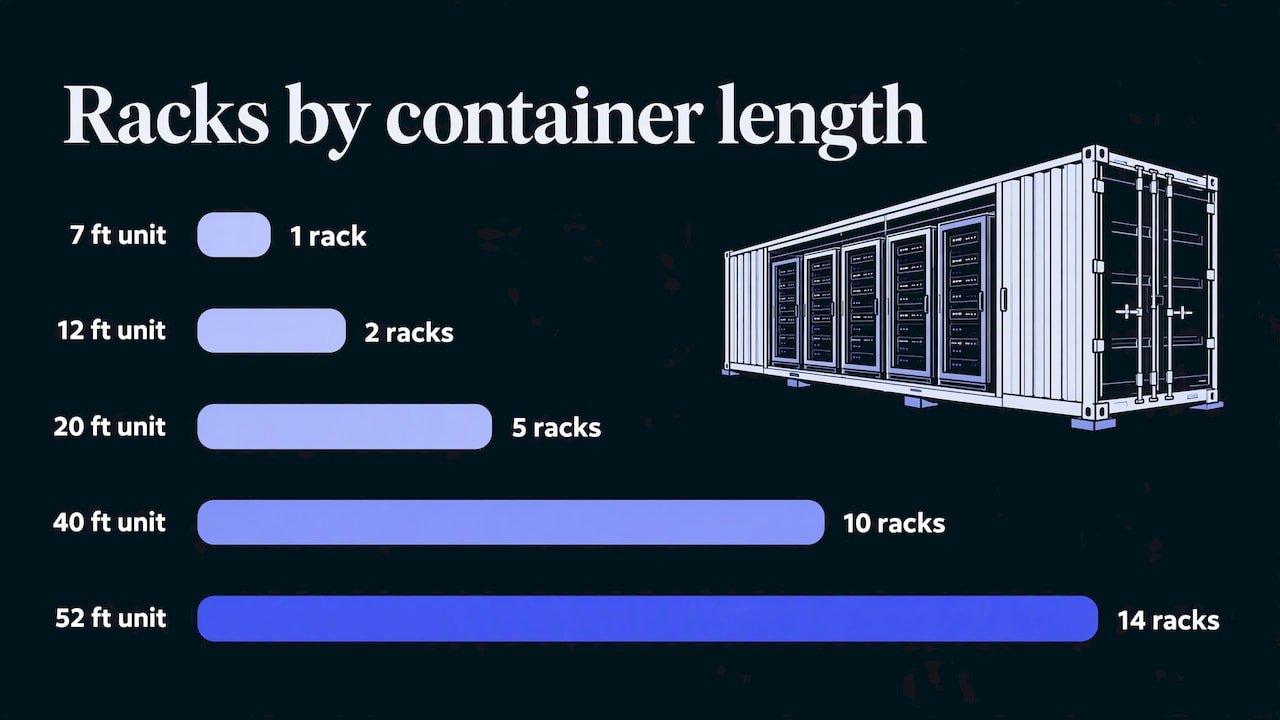
The range spans five container lengths on one platform at a nominal 125 kW per rack:
| Unit | Racks | Capacity |
|---|---|---|
| 7 ft | 1 | 125 kW |
| 12 ft | 2 | 250 kW |
| 20 ft | 5 | 625 kW |
| 40 ft | 10 | 1.25 MW |
| 52 ft | 14 | 1.75 MW |
Smaller blocks also fit ASHRAE’s suggestion of testing infrastructure in smaller increments, since capacity is added in discrete, repeatable units.
Planning an MDC project with commissioning in mind
The commissioning outcome is largely set before the unit ships. Four decisions matter most:
- Define the workload and density. The OPR should state rack count, power per rack and growth plans. Our guide to containerized data centers walks through how to size and deploy one.
- Prepare the site. Pad, power connection, access and network paths should be confirmed early, using the nine pre-order checks.
- Put commissioning scope in the quote. Ask what is tested before shipment, what is tested on site, and what documents you receive. Our list of 23 quote questions is a starting point.
- Name the acceptance authority. For federal and state buyers, decide who signs, against which criteria, and how funding timelines interact with acceptance. The MILCON funding guide covers appropriation paths for defense projects.
Where SovereignOne fits
If your timeline matters as much as your test record, a factory-integrated, pre-tested unit is built for that. SovereignOne’s modular data center containers go from site survey to live load in 4 to 6 months, and the cooling design cuts power and water use for cooling by 30%.
Browse the modular data center containers from 1 rack to 14 racks, or see the GPU edge facilities for AI and GPU compute operators. Pricing is quoted per project, so the quote is the place to settle your testing scope and acceptance documents.
FAQ
What is the data center commissioning process in short?
It is a series of staged verifications, from design review through factory testing, installation checks, start-up, functional testing and integrated systems testing, ending in closeout and handover. Each stage catches a different class of fault. The result is documented evidence that the facility meets the owner’s requirements.
What is L3 commissioning in a data center?
Level 3 is the pre-functional stage. According to ASHRAE’s framework, it confirms that components and subsystems are ready for operation. It comes after delivery and installation checks and before full functional performance testing.
How many levels of commissioning are there?
ASHRAE’s framework names five, L1 through L5. Many projects add Level 0 for planning and design review and Level 6 for closeout and handover, which makes seven stages. Check which numbering your contract uses so every party means the same thing.
Can data center commissioning be made faster?
Yes, by testing earlier and in smaller blocks, bringing controls online early and completing more verification at the factory. Skipping levels is not the answer. A factory-integrated modular unit shifts more work off the site, which is how SovereignOne reaches live load in 4 to 6 months.
Sources
- Commissioning & Performance Validation, AI Data Center Energy Performance Framework (ASHRAE)
- Commissioning roles and responsibilities presentation, ASHRAE Dayton chapter, 2019
- Data Center Commissioning and Integrated Systems Testing, SERBCA Technical Summit, 2019
- Data Center / Mission-Critical Facility Commissioning, GAI Consultants
- Data Center Commissioning, Applus+ service sheet
- Data Center Infrastructure Services, Applus+ UAE
- The Commissioning Process of Data Centers, Weitz white paper
- Mitigating Risk in Data Center Commissioning with HIL Testing, OPAL-RT, 2025