
A telecom edge data center adds compute at the aggregation site or cell cluster, where latency budgets are decided and where there is rarely a building available to extend.
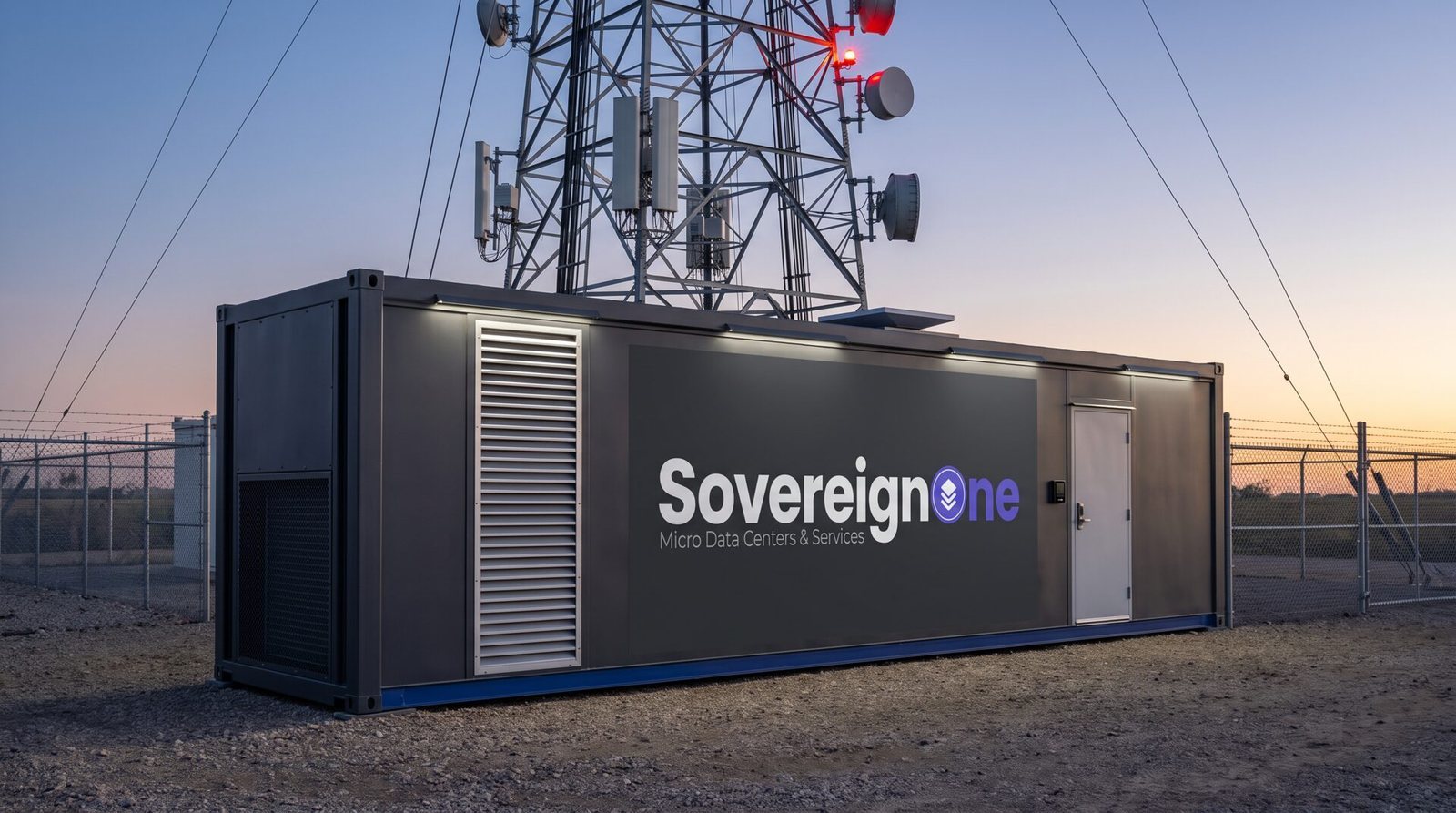
Existing sites were built for switching, not for racks of accelerators. Space, cooling and power at the aggregation point are all constrained, and the sites are numerous.
Low-latency services hosted at the aggregation site.
Centralised baseband for a cluster of cell sites.
Added capacity where the building itself is full.
A standard enclosure repeated across the footprint.
Edge sites are chosen for coverage, not for construction access. A telecom edge data center arrives as its own facility, set on a pad and energised from the power already there.
Lengths shown are indicative. The configuration for any site is set during the survey, against the actual load, the power available and the conditions on site.
Edge capacity has to appear where the network already is, and the usable sites are often yards, compounds and rooftops rather than buildings. A telecom edge data center makes those sites viable, because the facility arrives finished and needs ground and power rather than a construction programme.
The five lengths cover a wide range of telecom deployments without changing the underlying design: 7 ft with a single rack at a nominal 125 kW, 12 ft with two racks at 250 kW, 20 ft with five racks at 500 kW, 40 ft with ten racks at 1 MW, and 52 ft with fourteen racks at 1.25 MW. Every length shares the same cooling, power and security design, so an engineering review completed for one unit holds for the next.
Siting is a question of power and ground rather than construction. A conventional build runs two to five years from permit to energised; a SovereignOne unit runs four to six months from survey to live load. For telecom, that is the difference between capacity arriving inside the planning cycle and arriving after it.
Cooling is where most of the saving sits. The design reduces power and water used for cooling by 30% against a conventional air-cooled hall. On constrained sites, available utility capacity rather than floor space is usually what limits a telecom deployment, so that reduction often decides whether a site can host the load at all.
Operationally the unit behaves like any other facility on the site. It presents standard power and network interfaces, it is monitored the same way, and spares follow the original vendors’ support channels rather than a bespoke supply chain. Nothing inside the enclosure is unique to SovereignOne, which keeps sustainment of a telecom edge data center ordinary.
The same enclosure supports RAN and core functions, multi-access edge computing, content caching and delivery, subscriber analytics, and the low-latency services an operator wants to host close to the user rather than in a distant core site.
Capacity is added the same way it was installed. A second unit is specified against the same design, set beside the first and joined into one continuous white space, so growth stays a procurement decision rather than a new construction project, and the site keeps a single operating model as it scales.
Each unit is integrated from established platforms — CDW, Vertiv, Penguin Solutions, Motivair, Dell, Supermicro, Connected Power, NVIDIA — rather than bespoke hardware. SovereignOne is a Liberation Technology Services company, and Liberation Technology Services Inc. is a WEXMAC prime contract holder.
The most useful place to put compute in a mobile network is often the ground underneath a tower that is already standing. The site has power, backhaul and a secured compound, and it sits as close to the subscriber as the network ever gets. A telecom edge data center is set down at the base of the tower so traffic is handled there, rather than hauled back to a core site and returned.
Every kilometre of backhaul is latency the application never gets back. Serving the work at the tower removes the round trip for anything that can be handled locally, which is the difference between a latency-sensitive service being theoretically possible on a mobile network and being usable on one — interactive video, cloud gaming, AR, industrial control and vehicle telemetry all live or die on that margin.
Most of what a tower sees does not need to travel. Processing it at the base means the backhaul carries results instead of raw capture: lower transport cost, less load on the core network, and less subscriber data moving across the network than an architecture that ships everything upstream and sorts it later.
The same five lengths apply. A single-rack 7 ft unit fits a constrained tower compound; the longer units suit an aggregation site serving a cluster of towers, and both are specified against the same cooling, power and security design.
Yes. Putting edge compute at the tower is the deployment this page describes, so traffic is processed where it lands instead of behind backhaul.
Performance. Data is processed locally rather than carried to a central facility and back, which removes the round trip from every transaction that does not need one.
No. The unit is set on a pad at the tower base.
Send the site, the load and the timeline. We will come back with a length, a power plan and a delivery window.