
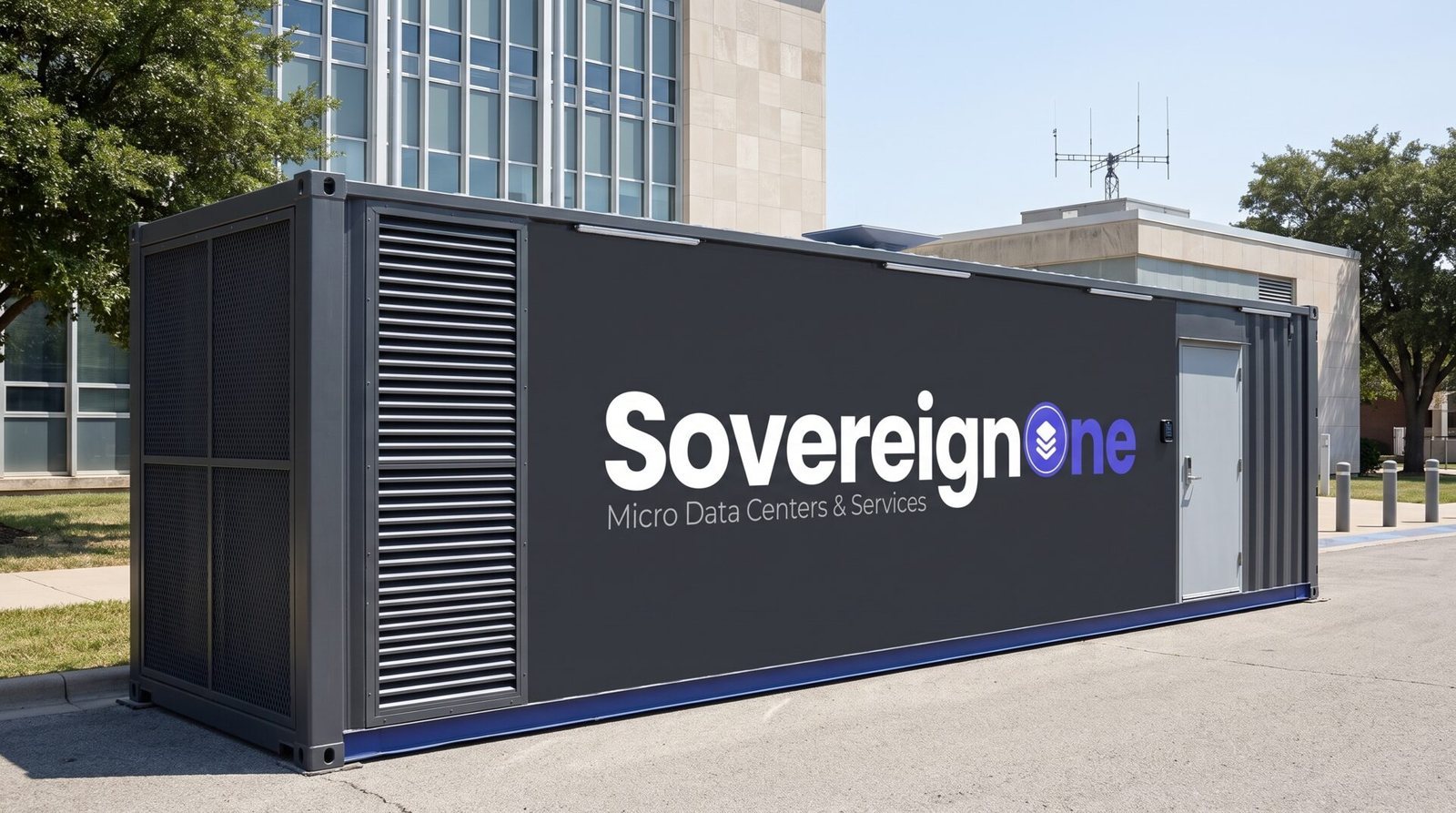
A government modular data center gives a state, county or city its own capacity, sited on land the agency already holds, without a capital construction programme in front of it.
By the time a facility clears design review, funding and construction, the system it was specified for has been replaced and the officials who approved it have moved on.
Compute for CAD and records that must stay available locally.
Retention and processing of video without hyperscale egress fees.
Departmental systems hosted on county premises.
Capacity that keeps an EOC running through an event.
Public sector capacity usually has to fit a budget cycle and an existing site rather than a new building. A government modular data center arrives as its own facility and is energised from the power already there.
Lengths shown are indicative. The configuration for any site is set during the survey, against the actual load, the power available and the conditions on site.
Agencies carry records they are obliged to keep and workloads they would rather not place in someone else’s region. A government modular data center puts that capacity on a site the agency controls, with a cost and a timeline that can be put in front of a council or a board as a single procurement rather than a multi-year build.
The five lengths cover a wide range of state and local government deployments without changing the underlying design: 7 ft with a single rack at a nominal 125 kW, 12 ft with two racks at 250 kW, 20 ft with five racks at 500 kW, 40 ft with ten racks at 1 MW, and 52 ft with fourteen racks at 1.25 MW. Every length shares the same cooling, power and security design, so an engineering review completed for one unit holds for the next.
Siting is a question of power and ground rather than construction. A conventional build runs two to five years from permit to energised; a SovereignOne unit runs four to six months from survey to live load. For state and local government, that is the difference between capacity arriving inside the planning cycle and arriving after it.
Cooling is where most of the saving sits. The design reduces power and water used for cooling by 30% against a conventional air-cooled hall. On constrained sites, available utility capacity rather than floor space is usually what limits a state and local government deployment, so that reduction often decides whether a site can host the load at all.
Operationally the unit behaves like any other facility on the site. It presents standard power and network interfaces, it is monitored the same way, and spares follow the original vendors’ support channels rather than a bespoke supply chain. Nothing inside the enclosure is unique to SovereignOne, which keeps sustainment of a government modular data center ordinary.
The same enclosure supports records and case management, public safety and dispatch systems, permitting and revenue platforms, GIS and planning workloads, and the continuity capacity an agency needs when its primary site is unavailable.
Capacity is added the same way it was installed. A second unit is specified against the same design, set beside the first and joined into one continuous white space, so growth stays a procurement decision rather than a new construction project, and the site keeps a single operating model as it scales.
Each unit is integrated from established platforms — CDW, Vertiv, Penguin Solutions, Motivair, Dell, Supermicro, Connected Power, NVIDIA — rather than bespoke hardware. SovereignOne is a Liberation Technology Services company, and Liberation Technology Services Inc. is a WEXMAC prime contract holder.
State, county and city agencies carry two obligations that pull in the same direction: keep operating when conditions are worst, and keep custody of records they are accountable for. A government modular data center addresses both with one piece of infrastructure the agency owns outright.
Disaster response is the moment an agency most needs compute and is least likely to have it. Primary facilities can be flooded, without power, or cut off, and commercial capacity in the region is contested at exactly the same time. A unit that can be sited where the response is being run means the capability arrives with the operation rather than depending on whatever survived.
Sited at the EOC, the unit puts processing next to the people directing the response. Damage assessments, resource requests, mapping and situational data are sorted locally instead of queuing behind a connection carrying everything else, so the operation keeps moving through the event and the recovery that follows.
Sovereignty is settled by where the hardware sits and who holds the keys to the room. Records an agency is obliged to retain stay on infrastructure it owns, on ground it controls, under its own access policy — not in a shared region operated by someone else under terms the agency did not write. The same unit that provides surge capacity in an emergency is the one holding the data the rest of the year.
Yes. A unit puts compute at the EOC itself, so sorting and processing continue during an incident rather than depending on a link to a central facility.
Yes. The hardware is yours and it sits on ground you control, which is what makes the residency claim checkable rather than contractual.
Four to six months from survey to live load, against two to five years for a conventional build — a difference that usually matters more than the price.
Send the site, the load and the timeline. We will come back with a length, a power plan and a delivery window.