
Data center site preparation is where modular projects go wrong, and almost always for the same reason: the pad, the access route and the utility tie-in were treated as details to sort out after the order rather than conditions that decide what you can order.
This is what to establish before you buy, in the order it usually matters.
What does data center site preparation actually cover?
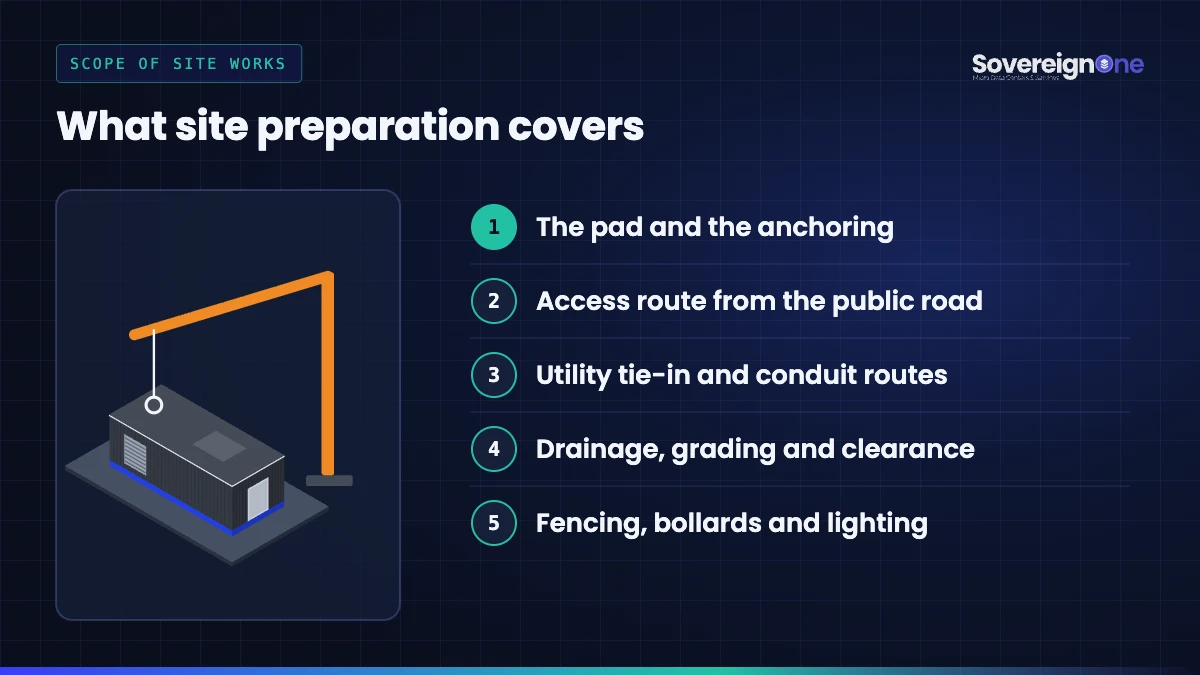
For a containerized deployment, site preparation is everything outside the unit:
- The pad or foundation, and the anchoring that holds the unit to it.
- The access route from the public road to the pad, including overhead clearance and crane standoff.
- The utility tie-in: service capacity, distance, conduit routes and stub-ups.
- Drainage, grading and clearance around the unit for service access and heat rejection.
- Any fencing, bollards, lighting and security the site requires.
Nearly all of this sits outside a typical vendor quote, which is why two quotes can look wildly different for the same unit.
Access comes first
A unit that cannot reach the pad is not a data center, so start here rather than with the slab. Confirm:
- The narrowest point on the route, with a measurement rather than an estimate.
- The lowest overhead clearance: power lines, bridges, tree canopy, building overhangs.
- Turning radii at gates and corners.
- Whether the ground will carry a loaded trailer and a crane in the season you plan to deliver.
- Crane standoff distance from the pad to the nearest hard standing.
- Site access hours, escort requirements and any base access procedure.
Container length drives most of this. A 7 ft or 12 ft unit ships on a standard trailer with no oversize permit. A 52 ft unit is a different logistics conversation.
The pad and anchoring
Good data center site preparation puts the pad decisions before the pour, because fixing them afterwards means breaking concrete:
- Soil bearing capacity, established or from a geotechnical report.
- Anchoring method matched to the local design wind speed and seismic category, which you can look up through the ATC Hazards by Location tool.
- Conduit routes and stub-ups planned into the pad design.
- Drainage falling away from the unit, so the pad does not sit in standing water. Check the site against the FEMA Flood Map Service Center before fixing the pad elevation.
- Service clearance preserved on every face that needs access.
The anchoring choice also carries a second consequence. A method designed for removal supports treating the unit as equipment rather than a permanent structure, which affects both permitting and, on federal projects, which appropriation funds it.
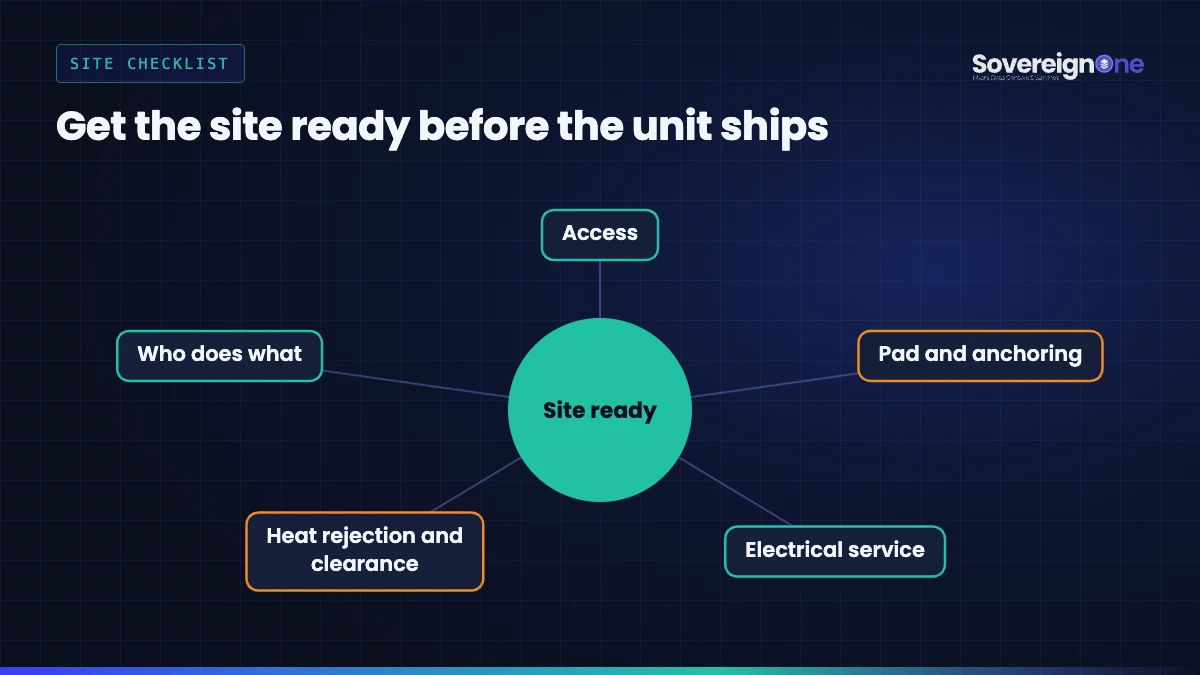
Electrical service
Sizing to the power a site already has is usually faster than a service upgrade, so measure before assuming. Establish the service voltage and phase, the rated capacity, the measured spare capacity over a real period rather than nameplate, the distance from the point of connection to the pad, and the grounding approach.
If an upgrade turns out to be necessary, ask the utility for the lead time in writing. That figure, more than anything in the data center site preparation scope, determines when the site goes live.
Heat rejection and clearance
Heat rejection equipment needs clear space and no recirculation from nearby walls or adjacent units. Establish the site design ambient temperature from local data rather than assuming a number, because it changes the cooling plant and therefore the price. Check noise limits at the property line while you are at it.
Who does what
The single most useful question in data center site preparation is also the simplest: who is scoped for each item, you, the manufacturer, or a third-party contractor? Get it in a table, in writing, before comparing quotes. Items that commonly fall between the parties are crane and rigging, utility tie-in labour, and the stamped drawings an authority may require.
Permitting sits alongside this and varies by jurisdiction. Our piece on whether a containerized unit counts as a building covers what to ask your authority having jurisdiction, and the cost guide covers the scope boundary in a quote.
Get the full checklist
We publish the complete site readiness checklist as a fillable document: eleven sections covering access, pad and foundation, electrical, heat rejection, connectivity, permitting, security, environmental hazards, operations and acceptance. Fill in what you know, leave the rest blank, and send it with your enquiry.
Frequently asked questions
What is included in data center site preparation?
The pad or foundation and its anchoring, the access route and crane standoff, the utility tie-in including conduit and stub-ups, drainage and service clearance, and any fencing, lighting and security. Most of it sits outside a typical vendor quote.
Who pays for site preparation on a modular deployment?
Usually the buyer, through a separate site works contract. Confirm item by item which party is scoped, because crane and rigging, utility tie-in labour and stamped drawings commonly fall between the manufacturer and the contractor.
What size pad does a containerized data center need?
It depends on the unit length and the service clearance required on each face. Establish the pad dimensions with the manufacturer before the pour, along with anchor positions and conduit stub-ups, because changing them afterwards means breaking concrete.
How long does site preparation take?
The groundwork itself is usually weeks. The schedule is normally set by permitting and by any utility service upgrade, which can run far longer. Ask the utility for lead times in writing early.
Do I need a geotechnical report?
You need established soil bearing capacity. A geotechnical report is the usual way to get it, and some authorities require one. If the figure is unknown, say so rather than assuming, because it affects the foundation design.
Can a unit be installed without a concrete pad?
Sometimes, depending on ground conditions, the unit, and what the authority having jurisdiction accepts. It is a question for the manufacturer and the AHJ together rather than an assumption to carry into a budget.
Where to go next
The container line runs from 7 ft to 52 ft, and length changes the access and pad conversation considerably. If you have a specific site, send us the checklist and we will scope it with you.