
A portable data center is a complete data center, with compute, power distribution and cooling, built inside a transportable steel container and finished in a factory instead of on your site. The same product is also called a mobile data center, a containerized data center or a modular data center. For most organizations the value is speed and placement: capacity arrives as a tested unit, lands next to the users or the data source, and goes live in months rather than years. SovereignOne builds factory-integrated, pre-tested modular data center containers that go from site survey to live load in 4 to 6 months, against 2 to 5 years for a typical conventional build.
TL;DR
- A portable data center is a prefabricated container holding IT racks, power and cooling, built and tested in a factory, then delivered and connected on site.
- Most of the time saving comes from parallel work: the unit is built while the site is prepared. Our units go from site survey to live load in 4 to 6 months.
- Before you buy, assess five things: rack count and power density, the power feed at the landing spot, cooling and heat rejection, connectivity, and physical and cyber security.
- Our five container lengths, 7 ft to 52 ft, hold 1 to 14 racks at a nominal 125 kW per rack and deploy on an existing grid connection.
- Pricing is quoted per project, so size the workload first and ask for a quote against that number.
Table of Contents
- What a portable data center is
- Who uses portable data centers and why
- What to assess before you deploy
- How deployment works, step by step
- Sizing a unit: the SovereignOne lineup
- Where SovereignOne fits
- Choosing well: a short checklist
- FAQ
- Sources
What a portable data center is
TechTarget describes a containerized data center as a fully functioning data center inside a trailer, freight box or shipping container that is set up in open space. It separates two kinds of product. One is the standard prebuilt unit, bought for immediate capacity. The other is a customized modular design, assembled on site from prefabricated components, that can be expanded later.
The common form factor is the intermodal shipping container. Reference descriptions of portable modular data centers put them in 20-, 40- or 53-foot containers that are weather-resistant and insulated. They are used to add capacity to an existing facility, to provide disaster backup, and for 4G and 5G edge computing, where proximity to users lowers latency.
“Portable” and “mobile” describe how the unit arrives, not how you plan to run it. Most buyers move a unit once, from the factory to a permanent pad, and then operate it like any other data hall. A smaller group, such as disaster response teams, plans to redeploy.
How it differs from a conventional data center
| Factor | Portable (containerized) data center | Conventional build |
|---|---|---|
| Construction | Built and tested in a factory | Built on site, trade by trade |
| Time to live load | 4 to 6 months with our units | 2 to 5 years, typical |
| Growth | Add units as demand grows | New halls or phases |
| Site work | Pad, power feed, connectivity | Full building, often new utility service |
| Placement | Near users, data sources or field operations | Usually a dedicated campus |
Conventional construction is also expensive. Park Place Technologies cites $7 million to $12 million per megawatt for a traditional data center build, and the timeline runs to years. That is the gap factory integration is meant to close.
Who uses portable data centers and why
The reader who benefits most is one who needs compute in a specific place, soon, and cannot wait for a building program. Typical cases:
- Defense and federal agencies that need on-premises compute close to operations. Sovereign cloud and data-residency requirements point the same way.
- State and local government and smart cities that want capacity at a municipal site without a new facility. See our page on smart city data centers.
- Healthcare systems that need local processing for imaging and clinical systems. Our healthcare modular data center page covers the use case.
- Telecommunications providers placing compute at the network edge. Our telecom edge data center page covers it.
- Universities and research labs that need dense compute without a new building. UCLA is a documented example: Campus Technology reports that an HP pod holding 1,500 nodes cost $2 million, while a conventional build-out for 1,600 nodes had been estimated at more than $7 million. See our campus modular data center page.
- AI and GPU compute operators that need high-density racks quickly.
- Oil, gas and mining operators, agriculture, and disaster response teams that need compute where the work happens, far from a data center campus.
The common thread is localized compute: the data is created at the site, and the processing belongs there too.
What to assess before you deploy
A container is only as useful as the site and workload around it. Work through these five areas before you ask for a quote.
1. Capacity and density
Start with the workload, not the container. Count the racks you need on day one and in three years, and the kilowatts per rack. Our platform is specified at a nominal 125 kW per rack, which suits high-density and GPU loads. A modest edge deployment may need one or two racks. A GPU cluster may need ten or more. Choosing a length that leaves room to grow is cheaper than adding a second unit later.
2. Power at the landing spot
Power is where most portable deployments stall. You need a feed of the right capacity and configuration at the exact spot where the unit will sit. A conventional build often waits on a new substation or a place in the utility’s interconnection queue. Our units deploy on an existing grid connection with no new substation and no interconnect queue, so the first question to answer is how much capacity your existing service has available.
Also decide on redundancy: whether you need a single feed or a second one, and what backup power and battery ride-through the workload demands. State the requirement in your specification.
3. Cooling and heat rejection
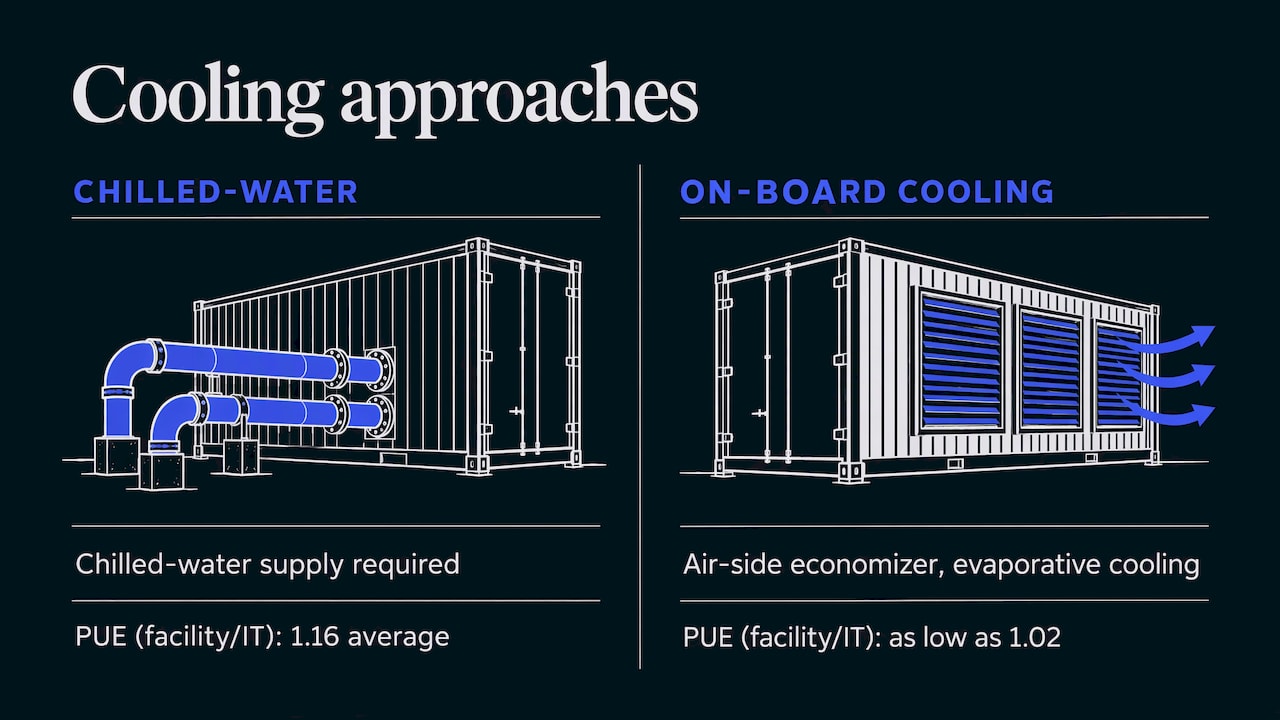
Cooling decides both your energy bill and your site needs. The U.S. Department of Energy’s Lawrence Berkeley National Laboratory reviewed modular units in its procurement guide. It reports an average PUE of 1.16 for units that need a chilled-water supply, and as low as 1.02 for second-generation units with on-board air-side economizers and evaporative cooling. PUE (power usage effectiveness) is total facility power divided by IT power, so a lower number means less overhead. The guide, published in 2011, also notes that designs which avoid a chilled-water supply can be deployed more quickly and less expensively, and it recommends that buyers drive efficiency through their procurement specifications.
Two practical points follow. Ask what the unit needs from the site, such as chilled water or clearance for heat rejection. And write a PUE target into the specification. Our cooling design cuts power and water use for cooling by 30%.
4. Connectivity
A container with no network is a heater. Confirm fiber routes to the pad, carrier diversity, and a failover path. Remote and field sites sometimes rely on satellite uplinks, which changes your latency and bandwidth planning. Decide who is responsible for the external fiber and power connections, since the customer often owns that boundary.
5. Physical and cyber security
A unit on open ground needs a security plan from the start: fencing, access control, cameras and monitoring. Government and defense buyers should list the security accreditation and compliance regime they must meet before design starts, because it shapes the whole project. Healthcare buyers should do the same for their data-protection requirements.
How deployment works, step by step
The sequence is similar across vendors. The figures below come from published industry guides and vary by project.
- Site survey and requirements. Confirm power availability, access routes, ground conditions and permitting. Check the delivery route too, including turning radii and any lifting equipment you will need on site.
- Permits and site agreement. Data Center Scouts’ deployment guide lists building, electrical and fire permits, and generator air permits where generators are used, along with agreement on land, power and access.
- Pad preparation. Xometry’s deployment overview describes a geotechnical assessment and a reinforced concrete slab or pier foundation, plus the medium-voltage feed, fiber conduits and security fencing, all in place before the unit arrives.
- Factory build and testing, in parallel. Data Center Scouts notes that the time saving comes from parallel work: the unit is built while the site is prepared. Xometry cites 4 to 10 weeks of manufacturing and 24 to 72 hours of full-load factory acceptance testing for a typical build.
- Delivery and placement. The unit travels by truck and is set on the pad, usually by crane.
- Connection and commissioning. Power, cooling and network are connected, then the unit is tested on site against the acceptance criteria you wrote. Xometry describes 1 to 5 days of utility connection and production launch within 3 to 10 days of arrival.
Your own team’s work is steps 1 to 3, and those usually set the schedule. Our 4 to 6 month figure runs from site survey to live load, so an early survey is the single best way to protect it.
Operations after go-live
Data Center Scouts warns that hands-on operation still needs a field team, so maintenance, spares, security and response times should be assigned in the contract. Our units use familiar vendor equipment, so your own team can maintain and operate them without learning a new platform. Facility management services are also part of what we offer.
Sizing a unit: the SovereignOne lineup
Our modular data center containers come in five lengths on one platform, at a nominal 125 kW per rack:
| Container | Racks | IT capacity |
|---|---|---|
| 7 ft | 1 | 125 kW |
| 12 ft | 2 | 250 kW |
| 20 ft | 5 | 625 kW |
| 40 ft | 10 | 1.25 MW |
| 52 ft | 14 | 1.75 MW |
A single platform means you can start with one length and add others later without changing the operating model. The smallest unit suits a single edge site, such as a clinic, a tower site or a municipal facility. The largest holds 14 racks for GPU and AI compute, and for campus or sovereign cloud workloads.
Where SovereignOne fits
We are a Tampa, Florida modular data center company, part of Liberation Technology Services, a WEXMAC prime contract holder operating since 2021. Our containers are integrated and tested in the factory, then delivered ready to connect. You can see the full range on our modular data center containers page. If your workload is GPU-heavy, our GPU edge facilities are covered under industry solutions.
Pricing is quoted per project, because it depends on container length, rack count, cooling configuration and site conditions. Our guide to 23 questions for a modular data center quote and our note on the three numbers to ask for on cost will help you write a specification that makes quotes comparable. For a wider walkthrough, read how to deploy a containerized data center.
Choosing well: a short checklist
Before you issue a request for quote, have these answers ready:
- Workload type, rack count today and in three years, and kW per rack.
- Available power at the landing spot, and whether you need a second feed.
- PUE and water-use targets, written into the specification.
- Fiber routes, failover path and who owns the external connections.
- Security, accreditation and compliance requirements.
- Who operates and maintains the unit, with response times in the contract.
- Your target live date, counted back from the site survey.
FAQ
What is the difference between a portable data center and a mobile data center?
The terms are used interchangeably. Both mean a self-contained data center in a container or trailer that is built elsewhere and delivered to site. Some buyers use “mobile” for units meant to be redeployed, but the product category is the same.
How long does it take to deploy a portable data center?
It depends on site readiness and permits. Our containers go from site survey to live load in 4 to 6 months, compared with 2 to 5 years for a typical conventional build. Pad preparation and utility work usually set the pace, so an early survey keeps the schedule intact.
Does a portable data center need new power infrastructure?
Our units deploy on an existing grid connection with no new substation and no interconnect queue. You still need a feed of the right capacity at the landing spot, so confirm the available capacity on your service early in planning.
How much does a portable data center cost?
Cost depends on container length, rack count, cooling and site conditions. SovereignOne pricing is quoted per project. Bring your rack count, power density and site details to get a quote that fits your workload.
Sources
- TechTarget: An overview of containerized data centers and their benefits
- Portable Modular Data Center (Wikipedia)
- Park Place Technologies: Modular Data Centers
- Campus Technology: Inside the Box, UCLA’s New Portable Data Center
- Lawrence Berkeley National Laboratory: Modular/Container Data Centers Selection Guide
- Xometry: Modular Data Center, Containers and Deployment
- Data Center Scouts: Pop-Up and Modular Data Centers