
Data center fire suppression in a container is a harder problem than in a data hall, and for a reason that surprises people: the envelope is small. Everything that makes a clean agent system work, including agent concentration, enclosure integrity and safe egress, gets more difficult as the volume shrinks, not easier.
There are five decisions to make, in order. Getting them in the wrong order is how deployments end up with a suppression system that cannot be commissioned or an insurer who will not write the policy.
Which standard applies to data center fire suppression?
The governing document for information technology equipment in the United States is NFPA 75, the standard covering fire protection of information technology equipment. If a clean agent system is used, its design follows NFPA 2001. Detection follows NFPA 72.
Those standards describe how to do data center fire suppression well. They do not by themselves tell you whether you must. That comes from three separate places, and they rarely agree:
| Who can require it | What they care about | Can they stop the deployment? |
|---|---|---|
| Adopted building and fire code | Life safety, by occupancy group and area | Yes, through permit denial |
| Property insurer | Equipment loss and business interruption | Effectively yes, by declining cover |
| Agency or corporate standard | Mission continuity, internal policy | Yes, internally |
The insurer is the one buyers forget. We have seen data center fire suppression added after a deployment was designed, because the code did not require it and the insurance underwriter did. Ask your broker before the design is fixed, not after.
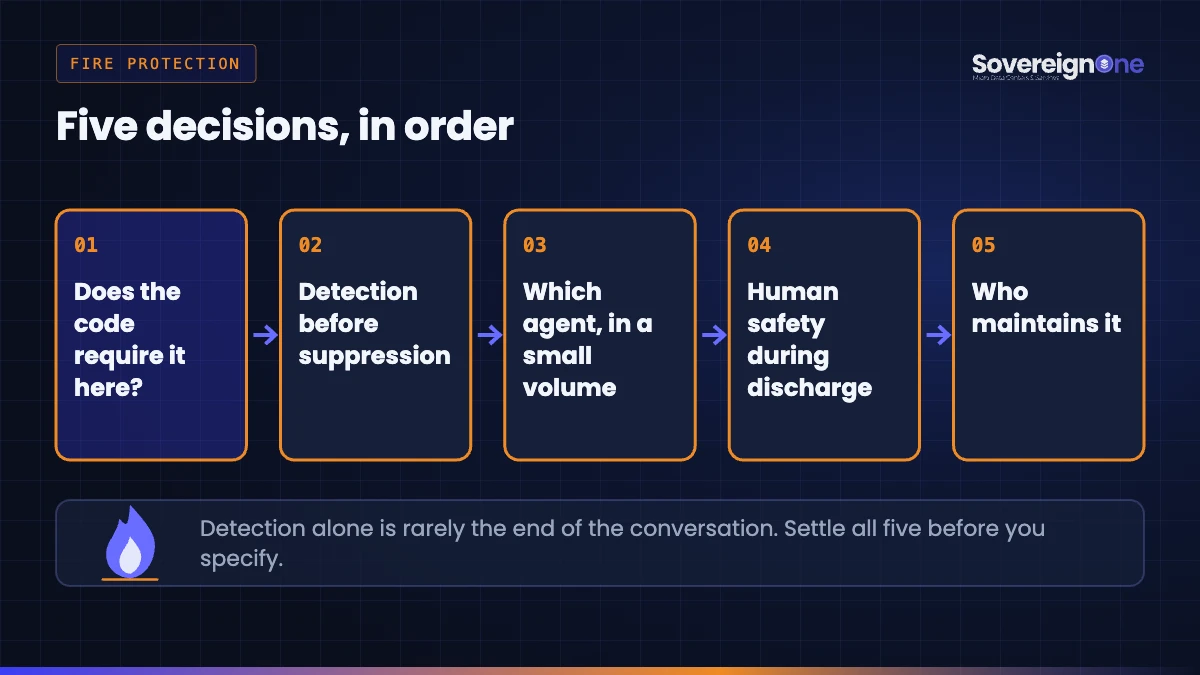
Decision one: does the code require it here?
This follows from the occupancy group and the area, both of which are determined locally. An unmanned enclosure classified lightly may fall below the thresholds that trigger sprinklers, while the same unit next door classified as a workplace may not. Our post on occupancy classification covers how that determination is made and why it varies.
Settle this before selecting equipment. Specifying a clean agent system and then learning the jurisdiction wants water, or the reverse, is a change with structural consequences for the enclosure.
Decision two: detection before suppression
Detection is the decision that earns its money, and it is independent of whether you suppress. Early warning gives a human a chance to intervene before anything discharges, and in a small space the intervention window is short.
Two broad approaches:
- Spot detectors. Smoke or heat devices at the ceiling. Cheaper, well understood, slower, and in a high-airflow environment the smoke may be diluted before it reaches them.
- Aspirating detection. A pipe network continuously samples air and tests it at a central detector. More sensitive, earlier, more expensive, and better suited to the airflow inside a container.
High airflow is the specific problem. The same air movement that cools the racks dilutes and disperses smoke, which is why detection designed for a still room underperforms in an equipment enclosure. Any data center fire suppression design that ignores the airflow is designed for a different building.
Decision three: which agent, and what the small volume does to it
The common options for data center fire suppression in a container are a clean agent, a water-based system, or detection with no automatic suppression at all. The third is a legitimate choice in some cases and should be priced rather than dismissed.
| Approach | Argument for | Argument against in a container |
|---|---|---|
| Halocarbon clean agent | No residue, fast, equipment survives | Discharge pressure in a small volume needs venting; agent cost |
| Inert gas clean agent | No residue, no decomposition concerns | Works by reducing oxygen, which matters more in a small occupied space |
| Pre-action water | Code familiar, inexpensive, insurer friendly | Water and electronics; freeze protection outdoors |
| Detection only | Lowest cost, no false-discharge risk | Insurer may decline; no automatic response at an unmanned site |
Two physical facts drive most of the engineering. First, a gaseous agent has to be held at concentration for a design period, which means the enclosure has to be reasonably tight and is verified by an enclosure integrity test rather than assumed. Second, discharging a gas into a small sealed box raises pressure quickly, so pressure relief venting is sized as part of the design. Neither of these is optional and neither is free.
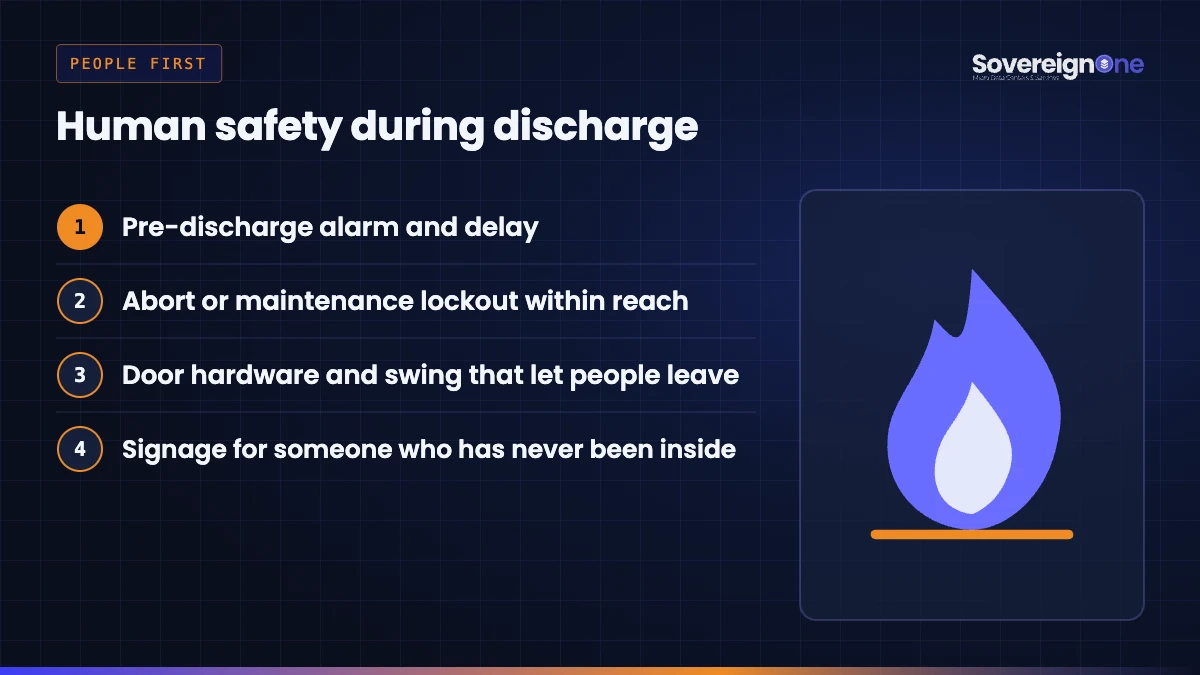
Decision four: human safety during discharge
This deserves its own decision because the small envelope changes the calculation. In a data hall, a technician has distance and time. In a container, the person servicing a rack is inside the protected volume, close to the discharge nozzles, with one or two doors.
What that implies for the design:
- Pre-discharge alarm and delay long enough for someone to actually get out of that specific enclosure.
- An abort or maintenance lockout that a technician can reach from where they work.
- Door hardware and swing that let a person leave without obstruction during discharge.
- Signage legible to someone who has never been inside the unit before.
For inert gas systems the oxygen reduction is the mechanism of extinguishment, so egress time is the controlling safety question and should be specified explicitly rather than inherited from a template.
Decision five: who maintains it
Data center fire suppression is not a product you install and forget. Agent cylinders are weighed or monitored, detection is tested, enclosure integrity can degrade as penetrations are added over the years, and the records are what an inspector asks for.
At an unmanned site this is the decision most likely to be left blank. Name the party, the interval and the record location in the contract. Our post on scope boundaries covers where this normally sits and why it is often missed.
Two things worth knowing before you specify anything. Adding a penetration through a tested enclosure after commissioning can invalidate the integrity result, so cable additions need a procedure. And a system that discharges on a false alarm at an unmanned site costs the agent fill plus a site visit, which is why detection quality is worth paying for.
The container specifications give the internal volumes these designs are sized against, and you can talk to us about what a specific jurisdiction and insurer will accept.
Frequently asked questions
Is data center fire suppression legally required in a container?
Not universally. It depends on the occupancy group and area under your adopted code, which is a local determination. Even where code does not require it, a property insurer often does, and that requirement is just as binding in practice.
Can a clean agent system work in a small enclosure?
Yes, and it is common, but the small volume adds two requirements: pressure relief venting sized for the discharge, and an enclosure integrity test to confirm the agent will hold at concentration for the design period. Both are part of the design rather than optional extras.
Is water acceptable in a data center?
Yes. Pre-action systems are widely used and well understood by code officials and insurers. The trade-off is water near electronics and, for an outdoor deployment, freeze protection for the pipe.
What does an enclosure integrity test prove?
That the space is tight enough to hold the agent at the required concentration for the design period. It is measured on the installed unit, which is why it is a commissioning activity and cannot be certified at the factory for an unknown site.
Is detection alone ever enough?
Sometimes, where code does not require suppression and the insurer accepts it. It is a real option and worth pricing. At an unmanned site, weigh it against the fact that nobody will be there to act on the alarm.
Who signs off the system?
The fire marshal or building official accepts it against the adopted code, usually on the basis of a commissioning report from the installing contractor. Factory testing of the unit does not substitute for that acceptance.