
Data center occupancy classification is the code official’s first question about a containerized unit, and the answer changes almost everything that follows: how many exits it needs, whether it needs a fire alarm, what the accessibility obligations are, and whether it is treated as a building at all.
There is no single right answer. Data center occupancy classification is assigned by the authority having jurisdiction under the adopted building code, and reasonable officials in neighbouring counties reach different conclusions about identical equipment. What follows is what they are actually deciding, so you can arrive with the right information instead of discovering the question at plan review.
Which code section governs data center occupancy classification?
In the United States it is Chapter 3 of the International Building Code, Occupancy Classification and Use, as adopted and amended by your state or local jurisdiction. The adoption matters. States amend the model code, and a county may be on an older edition than the state.
Chapter 3 sorts structures into groups by the hazard they present and the way people use them. Data center occupancy classification is not its own group. A data center gets slotted into one of the existing groups, and which one depends on how the space is used rather than what the equipment does.
Which occupancy groups come up for a containerized unit?
Four groups account for nearly every data center occupancy classification we see on containerized deployments.
| Group | What it covers | When it applies to a container |
|---|---|---|
| B, Business | Offices, professional services, spaces people work in | Staffed rooms, or where the AHJ treats the unit as a workplace |
| S-1 or S-2, Storage | Storage of goods, moderate or low hazard | Occasionally applied to equipment enclosures |
| F-1, Factory | Processing or manufacturing operations | Rare, but seen where the unit is read as process equipment |
| U, Utility and Miscellaneous | Accessory structures not classified elsewhere | Unmanned enclosures entered only for maintenance |
Group B is the most common data center occupancy classification for conventional data halls, because people work in them. The interesting case for containerized equipment is Group U, which carries the lightest requirements and is the classification an unmanned enclosure most plausibly fits.
Does an unmanned container qualify as Group U?
Sometimes, and it is worth pursuing, but you cannot assume it. Group U is intended for accessory structures that are not otherwise classified, and officials differ on whether a sealed equipment enclosure that someone enters monthly belongs there or belongs in a group that anticipates occupants.
The argument for Group U rests on how the space is used. If nobody is stationed inside, there are no workstations, entry is for maintenance only, and the unit is accessory to a primary use on the site, the case is reasonable. The argument against is that a person inside a locked metal box with energised equipment needs the protections a more demanding data center occupancy classification would require, whatever the frequency of entry.
What helps the Group U argument:
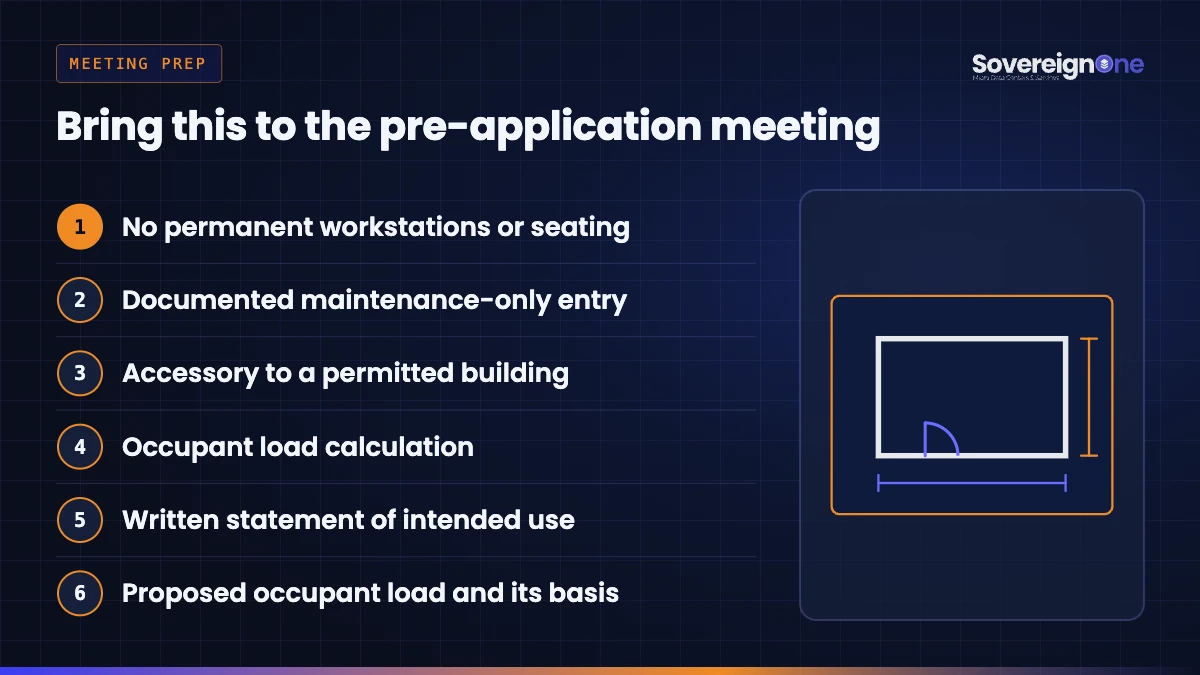
- No permanent workstations, seating or desks anywhere in the unit.
- Documented maintenance-only entry, with a stated expected frequency.
- The unit is accessory to a primary building or use already permitted on the site.
- An occupant load calculation that reflects maintenance access rather than continuous staffing.
Raise it early. A data center occupancy classification you negotiate during pre-application review costs nothing. The same conversation after you have submitted drawings built on a different assumption costs a redesign.
How does classification change what you have to build?
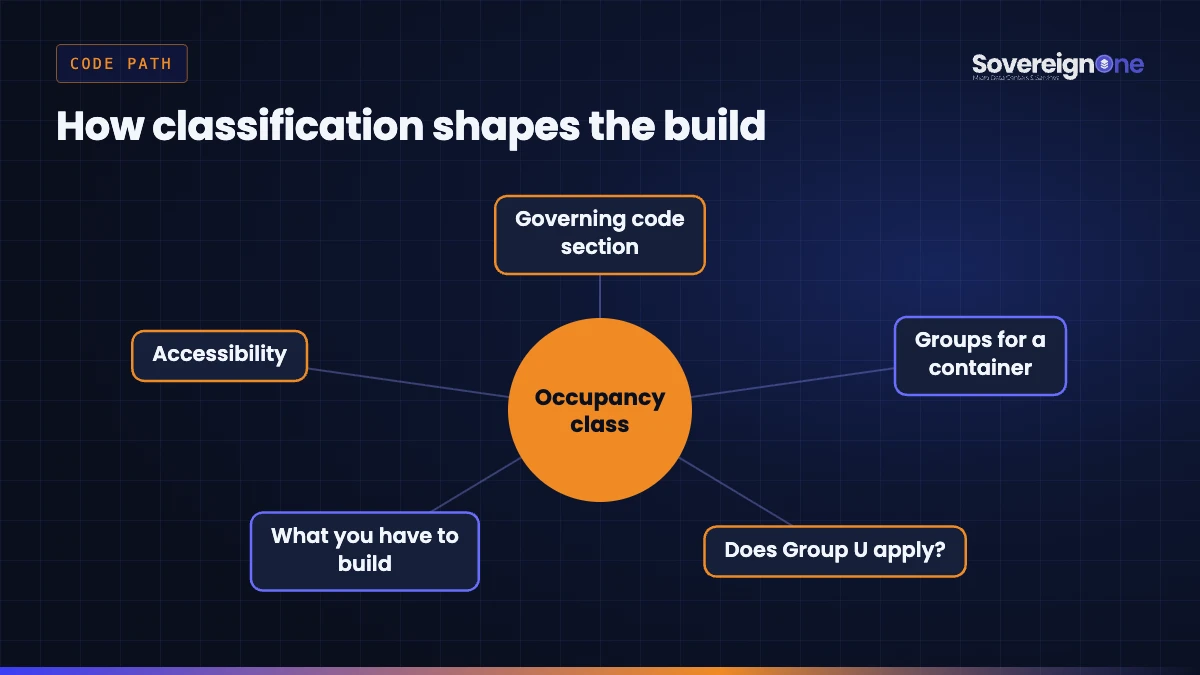
Data center occupancy classification drives the requirements that follow from it, and the differences are not marginal.
| Requirement | Driven by classification? | Why it matters |
|---|---|---|
| Number and arrangement of exits | Yes, via occupant load | A second door may be required, which changes the envelope |
| Fire alarm and detection | Yes | Thresholds differ sharply by group |
| Sprinklers or alternative suppression | Yes, with area and group thresholds | Often the largest single cost consequence |
| Accessibility provisions | Yes, with equipment-space exceptions | Determines whether a ramp and clearances are required |
| Structural design loads | No, governed separately | Wind, seismic and flood follow the structural standard |
| Energy code compliance | Partly | Equipment-only spaces are treated differently |
Suppression is usually where the money is. Our post on fire detection and suppression in a container covers how the standard applies in a small envelope.
What about accessibility for a space nobody occupies?
Accessibility obligations generally follow from the building code’s accessibility chapter and the referenced standard, and both contemplate spaces that exist to house equipment. Rooms entered only for maintenance, repair or monitoring of equipment are commonly excepted from the full set of requirements, which is why a mechanical room does not need the same treatment as an office.
Whether that exception reaches your unit depends on the data center occupancy classification assigned to it and on how the local jurisdiction reads the exception. If the unit is classified as a workplace, expect accessibility to be required, including an accessible route to the door and compliant clearances inside. Plan the site approach early, because retrofitting an accessible route to a unit already on a slab is unpleasant.
What to bring to the pre-application meeting
Walk in with the use case documented rather than the equipment specified. Officials decide data center occupancy classification on use, so a description of who enters, how often and why is more useful than a rack elevation.
- A written statement of intended use, staffing and entry frequency.
- The occupant load you are proposing, with the basis for it.
- Whether the unit is accessory to an existing permitted use on the parcel.
- How the unit is anchored, since that feeds the separate question of whether it is a building.
- The suppression approach you intend, so the group threshold is discussed with a design in view.
The related question, whether the unit counts as a building at all, is covered in our post on containerized data center permits. The two determinations interact, and jurisdictions do not always answer them consistently.
If you want help assembling that package for a specific jurisdiction, the container specifications give you the physical facts to put in front of a plans examiner, and you can contact us with the site.
Frequently asked questions
Is there a data center occupancy classification group of its own?
No. The building code has no group specific to data centers. A data center is assigned to an existing occupancy group based on how the space is used, most often Group B for staffed halls and sometimes Group U for unmanned equipment enclosures.
Who decides the data center occupancy classification?
The authority having jurisdiction, normally the local building department, applying the code edition your jurisdiction has adopted. A vendor cannot assign it and no certification carries it with the product.
Can two counties classify identical units differently?
Yes, and they do. Code editions, state amendments and local interpretation all vary. Treat every jurisdiction as a separate determination rather than assuming a precedent travels.
Does Group U mean no fire protection is required?
No. Group U carries lighter requirements than most groups, not an exemption. Detection and suppression may still be required by the adopted code, by the applicable standard for information technology equipment, or by the insurer, which is a separate matter from the code entirely.
Does a unit on a trailer avoid the question?
Sometimes, temporarily. A unit that remains on wheels and is treated as a vehicle or temporary structure may be reviewed differently, often under a temporary permit with a time limit. It is not a durable way to avoid data center occupancy classification for a permanent installation.
When should the classification question be raised?
Before any drawings are produced. Data center occupancy classification determines exits, detection, suppression and accessibility, so settling it first prevents a redesign. A pre-application meeting with the building department is the cheapest hour in the project.