
Almost every cost surprise on a containerized deployment traces back to the same thing: the modular data center scope of supply stopped at a line the buyer thought was further out. The unit arrives complete and correct, and then someone has to pay for the conduit, the pad, the crane, the fiber pull and the commissioning witness that nobody priced.
The fix is unglamorous. Write the modular data center scope as a matrix with three columns, make the vendor fill it in, and settle every row before award rather than after delivery.
What does modular data center scope of supply actually mean?
Modular data center scope of supply is the list of what the vendor delivers and the exact physical point where their responsibility ends. The phrase process engineers use is battery limit: the boundary where one party’s work stops and the next party’s begins. Every utility crossing that boundary needs a named owner on both sides.
The reason this is harder than it sounds is that a container is a product and a deployment is a construction project. The product has a clean boundary at the enclosure wall. The project does not care about the enclosure wall, it cares about whether the thing works on your site. The modular data center scope has to bridge those two views, and most quotes only describe the first one.
The six boundaries that cause the disputes
| Boundary | The question to answer in writing | Who usually ends up paying |
|---|---|---|
| Electrical | Where does the vendor conductor terminate, and in whose gear? | Buyer, for everything upstream |
| Mechanical | Is heat rejection inside the envelope or a separate package on the pad? | Buyer, if condensers sit outside |
| Civil | Who designs and pours the pad, and who stamps the anchoring? | Buyer, almost always |
| Network | Where is the demarcation, and who pulls to it? | Buyer, and often late |
| Commissioning | Who runs the tests, who witnesses, and what signature means accepted? | Disputed, so name it |
| Permitting | Who applies, who is the applicant of record, who pays fees? | Buyer, with vendor drawings |
Civil is the one buyers underestimate most. A stamped foundation design for a specific site, with that site’s soil report and seismic and wind criteria, is engineering work that nobody does for free, and it is rarely inside a modular data center scope as quoted. Our post on site preparation checks covers what that work involves.
What a usable scope matrix looks like
Three columns, one row per item, no blanks. If a row says “by others”, the matrix is not finished, because “others” is not a party to the contract.
| Item | In vendor scope | Buyer or buyer contractor |
|---|---|---|
| Enclosure, racks, internal distribution | Yes | No |
| Internal cooling equipment | Yes | No |
| External condensing units, if any | Confirm per design | Setting and piping, confirm |
| Foundation design and stamp | No, typically | Yes |
| Pad construction | No | Yes |
| Anchoring hardware | Confirm | Installation, confirm |
| Service conductor to the unit | No | Yes |
| Upstream protection and metering | No | Yes |
| Generator or UPS outside the unit | Confirm per design | Confirm |
| Fiber to the demarcation point | No | Yes |
| Transport to site | Confirm | Confirm |
| Crane and set | Confirm | Often yes |
| Factory testing | Yes | Witness optional |
| Site commissioning | Confirm scope and level | Confirm |
| Permit application | Drawings only | Applicant of record |
Notice how many rows say confirm. That is deliberate, and it is the honest state of a modular data center scope before a specific vendor and site are in view. Any matrix that answers all of those with a confident yes or no before the site is known is describing a product brochure rather than your project.
Three sentences that cause most of the arguments
These appear in real quotes. Each one looks like scope and is not.
“Turnkey solution.” This describes a commercial intent, not a boundary. Turnkey against what battery limit? Ask the vendor to state where their conductor lands and who pours the pad, and the word stops doing any work.
“Site works by others.” This is the single most expensive phrase in the category. It transfers an unbounded obligation to the buyer without quantifying it. Site works for a sub-megawatt deployment can run from modest to a multiple of the unit price depending on how far the power is.
“Plug and play.” Into what. A container with a 400 amp service requirement is plug and play once a 400 amp service exists at the pad. Creating that service is the project. Our write-up on what these deployments cost separates unit price from the rest.
How to settle the modular data center scope before award
Put the matrix in the solicitation rather than asking for it back. If you issue the rows, every vendor responds against the same boundaries and the proposals become comparable. If each vendor supplies their own modular data center scope description, you will be comparing documents that disagree about what is being bought.
Four practical steps:
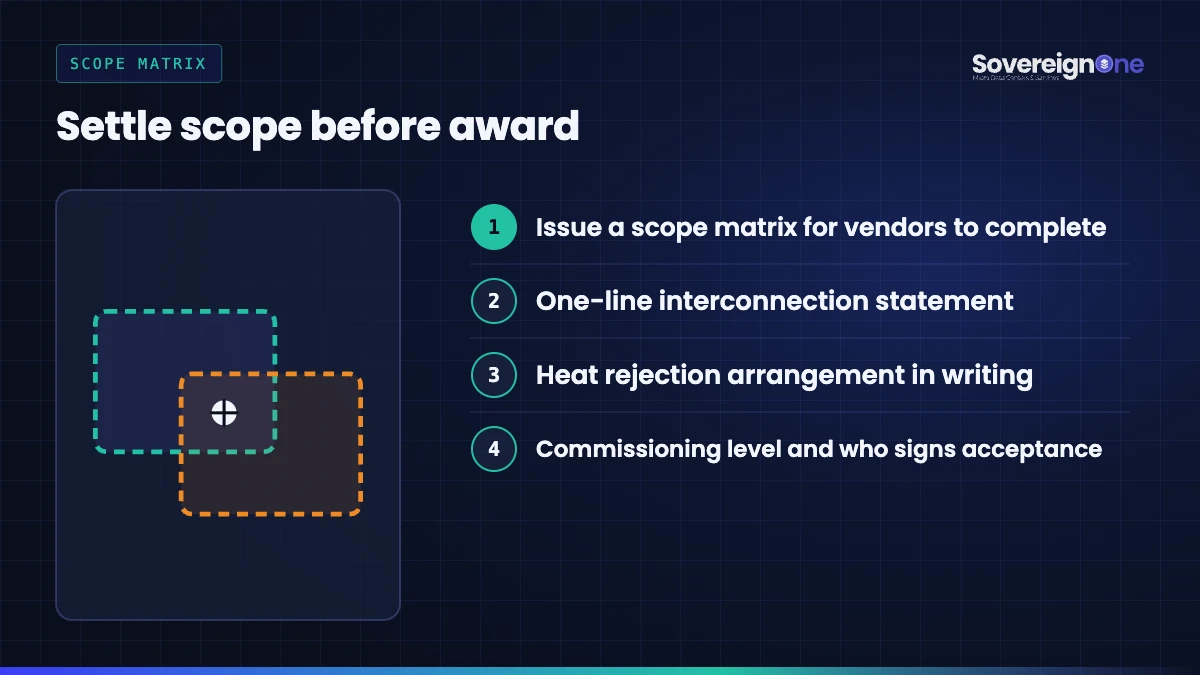
- Issue the scope matrix as an attachment vendors must complete and return, row by row.
- Require a one-line interconnection statement: the termination point, conductor size and protection assumed.
- Require the heat rejection arrangement in writing, including anything that sits outside the enclosure.
- Name the commissioning level and who signs acceptance, before price is discussed.
Products certified independently of a site are a useful signal here, because the certification itself forces a boundary to be drawn. The Uptime Institute runs a Tier-Ready programme for prefabricated modular designs that assesses the product separately from the facility it will land in, which is exactly the distinction a modular data center scope has to make.
Our quote review questions include the scope rows in a form you can hand to a vendor, and the container specifications give the physical facts the matrix refers to. If you want us to complete a matrix against your site, get in touch.
Frequently asked questions
What is normally inside a modular data center scope?
The enclosure, racks, internal power distribution, internal cooling equipment, monitoring, and factory testing. Everything that crosses the enclosure wall, including the service conductor, the pad, the anchoring installation and the fiber, is usually outside it and belongs to the buyer unless the contract says otherwise.
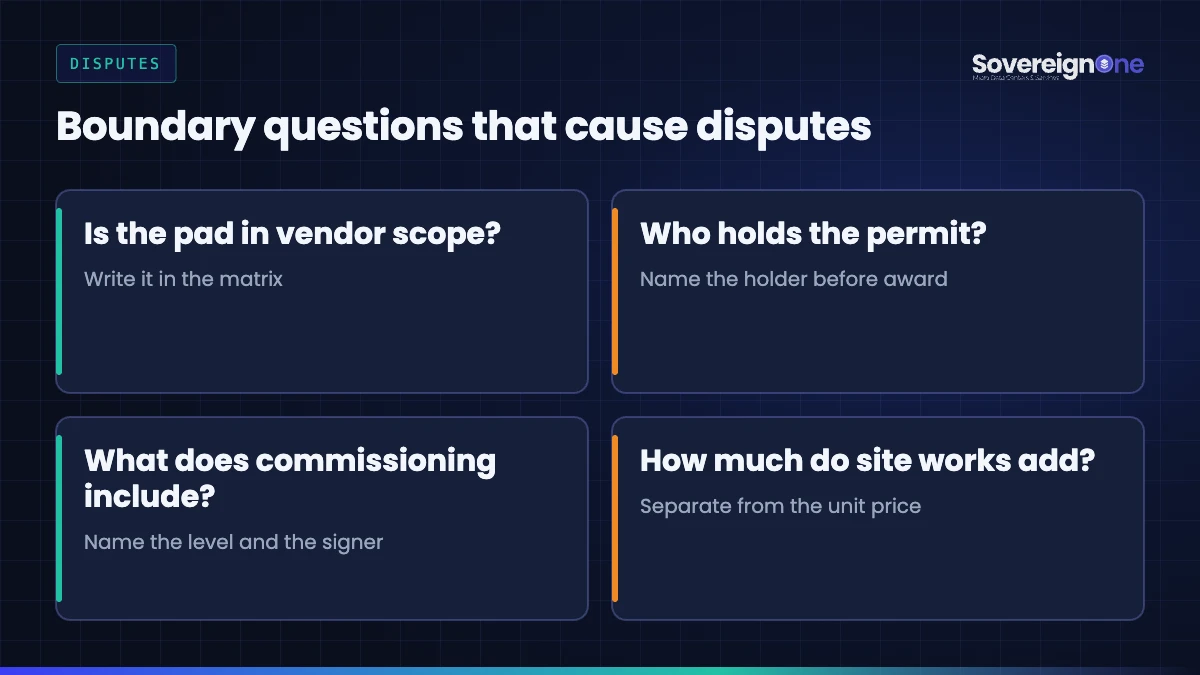
Is the concrete pad ever in the vendor scope?
Occasionally, as a priced option, and more often the vendor supplies loading and anchoring requirements while a local engineer designs and stamps the foundation for the site. Expect to own the pad and confirm in writing if a vendor claims otherwise.
Who should hold the permit?
Normally the buyer or the buyer’s contractor is the applicant of record, because the permit attaches to the property. The vendor supplies drawings and equipment data. Confirm it, because being told late that you are the applicant can cost weeks.
What does commissioning include?
It depends entirely on the level specified, which is why the level has to be named. Factory testing of the unit is not site commissioning, and site commissioning without an integrated test of the upstream service does not prove the deployment works.
How much do site works add?
There is no general figure, because it is driven by distance to power and the condition of the ground. The honest answer is that site works can range from a modest fraction of the unit price to a multiple of it, and the only way to know is a site assessment.
Can the modular data center scope be changed after award?
Yes, through a change order, at a price set when you have least leverage. That is the entire argument for settling the matrix before award rather than after.