
An unmanned data center is not a data center with the staff removed. It is a different design, because every failure mode that a person would normally notice and fix has to be either prevented, tolerated, or detected and escalated to somebody an hour away. Taking the staff out of a conventional design does not produce an unmanned data center, it produces an unattended one, which is a different and worse thing.
Six functions have to be handled explicitly. Below each is what honestly automates and what still needs hands.
What does an unmanned data center actually have to replace?
Start by listing what the person was doing. On a staffed site a technician notices a noise, sees a wet patch, smells something hot, reseats a cable, swaps a drive, resets a breaker and lets somebody know. An unmanned data center has to cover all of that without the noticing.
| Function | Automates well | Still needs a person |
|---|---|---|
| Environmental monitoring | Yes, thoroughly | Investigating a cause |
| Power monitoring and switching | Yes | Resetting a tripped device |
| Server power and console access | Yes, via out-of-band | Hardware replacement |
| Leak and smoke detection | Yes | Mopping, repairing |
| Physical security | Yes, detection and logging | Response |
| Consumables and wear parts | No | Filters, batteries, refrigerant |
That bottom row is the one business cases forget. An unmanned data center still has filters to change and batteries that age out, and nothing about remote management touches either.
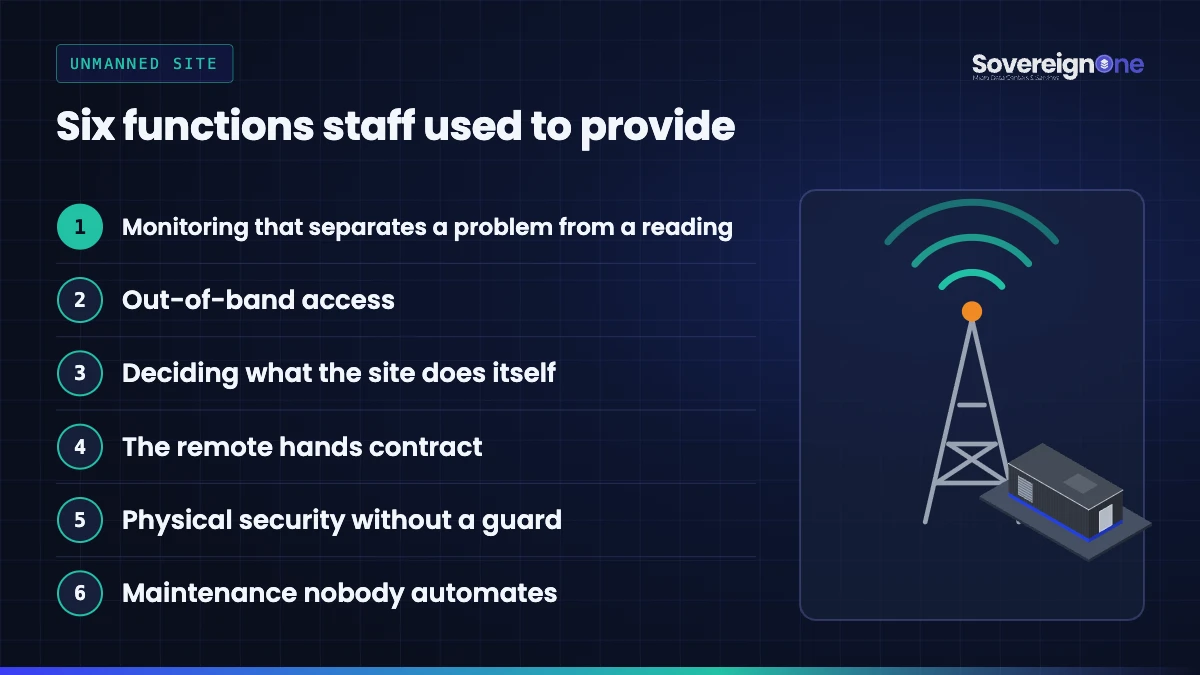
Function one: monitoring that distinguishes a problem from a reading
Instrument more than you think you need, then spend the effort on thresholds rather than on sensors. The failure pattern in an unmanned data center is not too little data, it is alarm fatigue: so many notifications that the one that mattered was indistinguishable from the forty that did not.
Worth instrumenting at minimum: inlet and outlet temperature per rack, humidity, differential pressure across filters, water presence at the floor, door position, and the electrical quantities at every level of distribution. Environmental limits should be set against a recognised reference rather than invented; ASHRAE’s Datacom series and TC 9.9 resources cover environmental guidelines for these spaces.
Function two: out-of-band access that survives the thing it manages
Out-of-band management is what makes an unmanned data center viable, and it only works if it is genuinely independent. If the management path depends on the production network, the production power or the production cooling, it will be unavailable in exactly the situations you built it for.
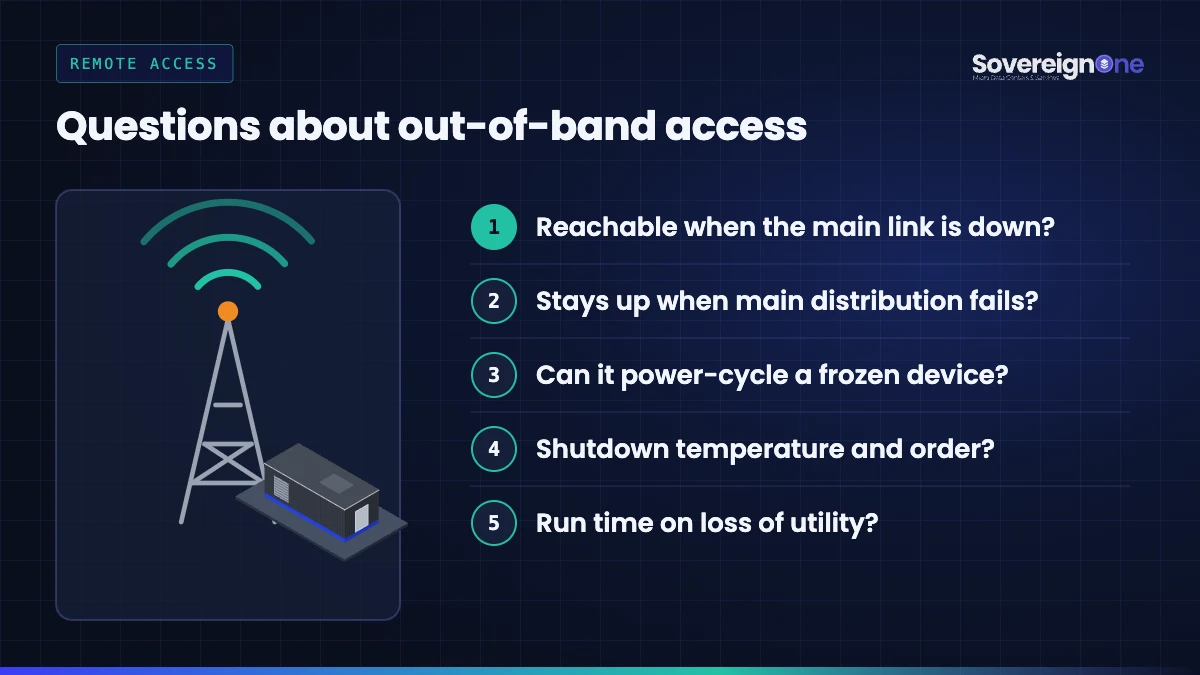
Three independence tests to apply to your own design:
- Can you reach the management plane when the primary network link is down? That usually means a cellular or satellite path.
- Does the management plane stay up when the main distribution does? It needs its own protected supply.
- Can you power-cycle a device whose operating system is unresponsive, from off site?
If any answer is no, the site will need a visit for a fault that should have been a remote action.
Function three: deciding what the site does on its own
This is the design decision that separates an unmanned data center from an unattended one. When something goes wrong and nobody is coming for an hour, what should the site do by itself?
The honest answer is usually to shed load and protect the hardware rather than to keep everything running. Define it in advance:
- At what temperature does non-critical load shut down, and in what order?
- On loss of utility, how long does the site run before an orderly shutdown?
- If cooling fails entirely, does the site shut down or run until it overheats?
- Who has authority to override a shutdown remotely, and how is that logged?
Write it down and test it. A documented load-shed sequence is the single most valuable artefact an unmanned data center has, and it is usually the one that does not exist.
Function four: the remote hands contract
Somebody has to be able to get there. For an unmanned data center that is a contract, and it needs more in it than a phone number.
| Term | Why it matters |
|---|---|
| Response time, and whether it is business hours only | Faults do not respect business hours |
| Who holds keys or credentials, and how access is logged | Security and accreditation both care |
| What they are qualified to touch | Electrical work needs a licensed person |
| Where spares are held | A four-hour response with a two-week part is a two-week outage |
| Escalation path when they cannot fix it | Prevents a stalled ticket |
Spares location is the term people skip and then regret. Local spares turn a response-time commitment into a repair-time commitment, which is the number that actually matters.
Function five: physical security without a guard
Detection and logging automate well. Response does not. An unmanned data center can know within seconds that a door opened and can record who opened it, and it cannot stop anybody.
That means the design leans on deterrence, delay and evidence: substantial locks, tamper detection, interior and exterior cameras with off-site recording, and an alarm path to somebody who will act. For deployments with an accreditation boundary, the requirements come from the accreditation rather than from good practice, and our sovereign deployment page covers that distinction.
Function six: the maintenance nobody automates
Filters, batteries, refrigerant, fan bearings, firmware. An unmanned data center needs a scheduled visit regime, and the schedule is set by the equipment rather than by convenience.
Name the party, the interval and where the records live, in the contract. Our post on scope boundaries covers why this row is so often left blank, and fire suppression has its own inspection regime that an unmanned site cannot skip.
One honest caveat about the economics. An unmanned data center saves salary, not effort. It moves cost into monitoring, out-of-band infrastructure, remote hands and scheduled visits, and for a small deployment that total is lower than staffing. It is not zero, and a business case that treats it as zero will be wrong by a predictable amount.
If you want to work through which of the six functions a specific site can cover, get in touch.
Frequently asked questions
Can an unmanned data center run with no site visits at all?
No. Filters, batteries, refrigerant and fire system inspections all need hands on site at intervals set by the equipment and by code. The realistic target is scheduled visits plus remote handling of everything between them, not zero visits.
What makes out-of-band management genuinely independent?
A network path that does not depend on the production link, usually cellular or satellite, its own protected power supply, and the ability to power-cycle an unresponsive device remotely. If any of those depends on the production systems, it will fail when you need it.
What should the site do if cooling fails?
Whatever you decided in advance and wrote down. For most deployments the right answer is a staged load shed followed by an orderly shutdown to protect hardware. The important thing is that the sequence is defined and tested rather than improvised by whoever is on the call.
How fast does remote hands need to be?
It depends on what the workload can tolerate, and response time matters less than repair time. A four-hour response with no local spares can still mean a multi-week outage, so negotiate spares location alongside response.
Is an unmanned data center less secure?
It is differently secure. Detection, logging and evidence automate well, and response does not. Security rests on physical hardening, tamper detection, off-site recording and an alarm path to somebody who will act.
Does removing staff make the business case work?
Partly. It removes salary and adds monitoring, out-of-band infrastructure, remote hands and scheduled maintenance. For small deployments the net is usually favourable, but it is not a saving of the full staffing cost and should not be modelled as one.