
Edge computing infrastructure is the set of physical and software resources placed at or near the users and machines that generate data, so applications run and store data locally. For organizations that need that capacity fast, the practical answer is a factory-built modular data center: SovereignOne’s containers go from site survey to live load in 4 to 6 months, against 2 to 5 years for a typical conventional build, and run on an existing grid connection.
TL;DR
- Edge infrastructure is anything from a single node to a small data center that runs workloads close to where data is created, connected to a larger cloud or data center.
- A physical edge site needs six things: racks, power feed and backup, cooling, cabling and network, monitoring, and physical security.
- Most failed edge projects stumble on the site, not the servers: floor load, power capacity, heat rejection and access routes.
- A pre-tested, factory-integrated container moves most of that work off the site and shortens the schedule to 4 to 6 months.
- SovereignOne’s five container sizes run from 1 rack (125 kW) to 14 racks (1.75 MW). Pricing is quoted per project.
Table of Contents
- What edge computing infrastructure is
- The components of an edge site
- Site requirements to settle before deployment
- How an edge deployment runs, step by step
- Why a modular unit fits edge deployment
- Who uses edge infrastructure
- Our offer for edge deployments
- FAQ
- Sources
What edge computing infrastructure is
The International Telecommunication Union defines edge computing infrastructure as the physical or software resources at or near a location close to users where applications run and store data. That covers single nodes, embedded devices, small data centers, containers and virtual machines. The same standard describes edge computing as processing data where it is generated or consumed, moving minimal data, and scaling when connected to a larger data center or cloud.
The difference from centralized cloud is mostly about constraints. The OpenStack Foundation notes that edge sites sit as close as possible to end users, may need specialized hardware such as GPUs, are often remote or unmanned and so need remote administration, and may be limited in space or power. There are also many of them, and the set of sites changes over time.
Why place compute there at all? A 2024 study of 50 companies in manufacturing, health and retail reported 40 to 60% lower data processing delay on average with edge computing. In a separate survey of 150 North American enterprises, reliable latency and reduced jitter were the top expected benefit, at 24% of respondents. Predictable response, more than raw speed, is what operators ask for.
The components of an edge site
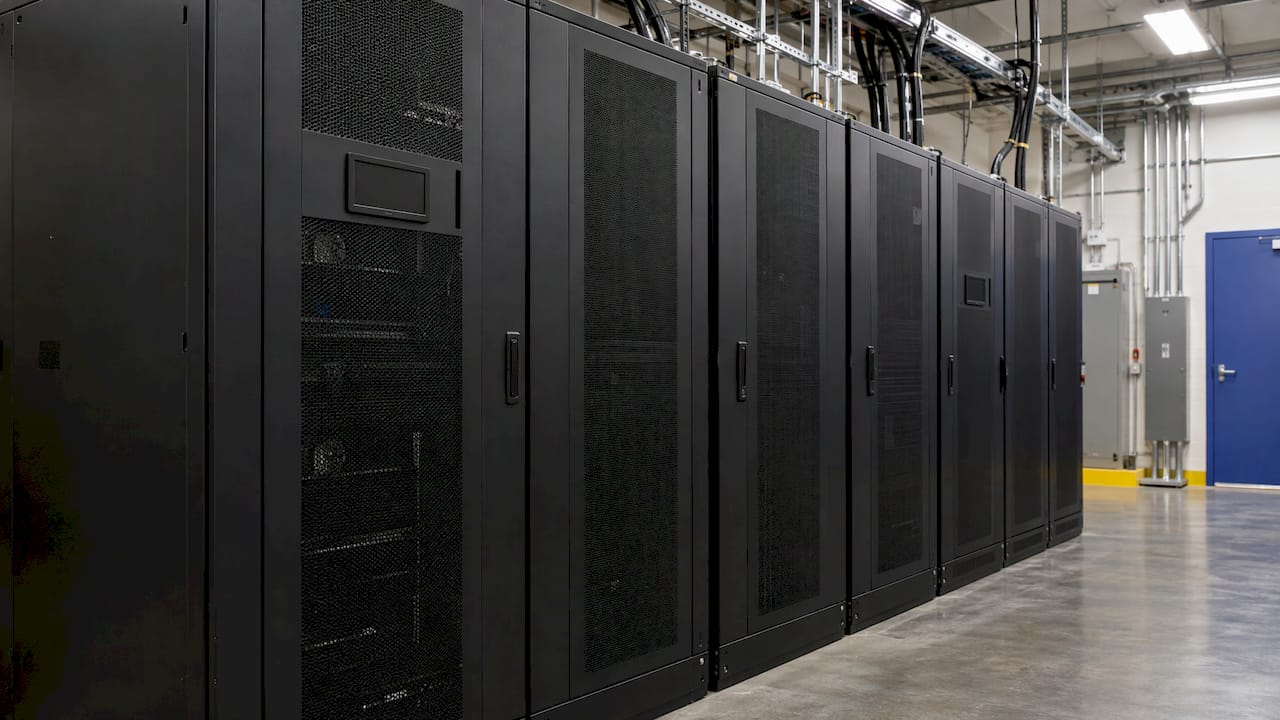
The software side (devices, gateways, analytics, edge servers and a link to a central cloud) is covered well by IBM’s overview of the edge model. The physical side is what decides whether the site stays up.
The ITU’s specification for edge data centres says one comprises a server cabinet system, monitoring, power feeding, cooling and cabling, plus aisle components. It recommends modular UPS systems, lithium-ion battery storage, and cooling designs that improve PUE (power usage effectiveness, the ratio of total facility power to the power used by IT equipment).
| Subsystem | What it does at the edge | What to specify |
|---|---|---|
| Racks and IT | Hold servers, storage, GPUs | Rack count, power per rack |
| Power | Feed and protect the load | Feed capacity, UPS, generator tie-in |
| Cooling | Reject the heat | Air, liquid or hybrid, by density |
| Network | Link to core and cloud | Fiber path, segmentation |
| Monitoring | Remote visibility | Power, temperature, leak, fire alarms |
| Security | Protect the site | Access control, cameras, cyber controls |
Density drives the cooling choice. Dense AI and GPU racks generally call for liquid or hybrid cooling, which is the design behind SovereignOne’s containers: our cooling design cuts power and water use for cooling by 30%.
Site requirements to settle before deployment
Edge sites are often small, remote and unstaffed, so the checks happen before delivery, not after. Field guidance from one edge integrator says a unit needs a level, load-rated floor, a correctly sized power feed at the landing spot, a heat-rejection path, and a verified access route. The same guide warns that the common miss is treating the site survey as a formality and learning on delivery day that the panel cannot feed the unit.
Work through these in order:
- Power. Confirm the feed capacity and configuration at the exact placement point. ASHRAE’s technical brief notes that a UPS may be needed, especially for edge deployments.
- Cooling and climate. The same brief points out that outdoor conditions raise the thermal load, for example from solar heat.
- Connectivity. Fiber is an important prerequisite for most edge nodes, and 5G backhaul suits only short distances, according to techUK.
- Physical security. The Telecommunications Industry Association lists environmental risk, physical protection, access control, video surveillance and cybersecurity among the distinct edge site issues.
- Remote operation. techUK expects edge data centers to run with no permanent on-site staff, monitored centrally for power, fire, leaks and security.
Our data center site preparation checklist turns these into nine checks to run before ordering, and our guide to secure edge computing covers controls, standards and site design.
Security and continuity also depend on people and communications. Planning for network outages, including how leaders and responders reach each other, belongs in the same plan; emergency communication plans for when networks go down is a useful companion to the technical resilience work.
How an edge deployment runs, step by step
A widely used sequence for small sites, published by APC in a guide to preparing edge sites, has six steps: assess site constraints, install the power circuit, install cooling, provide network connectivity, install the micro data center, and start up. It also treats pre-configuring the IT rack with an integrator as best practice. That guide is written for sites up to 10 kW. Where the load is larger, each step grows, and so does the schedule risk.
Here is where each step tends to go wrong, and what a factory-integrated container changes:
- Assess the site. Surveys that skip floor loading, panel capacity or access routes cause delivery-day surprises. Our schedule starts at the site survey, so this step is the first one done.
- Power. New substations and interconnect queues are what stretch conventional builds into years. SovereignOne units deploy on an existing grid connection with no new substation and no interconnect queue.
- Cooling. Field-built cooling plants are commissioned on site, late in the project. In a container the cooling is part of the unit that is integrated and pre-tested at the factory.
- Network. The fiber path and segmentation plan still need to be settled with your network team, ideally during the survey.
- Install. A container arrives as a finished unit, so on-site work is placement and connection, not construction.
- Start up. Pre-testing before shipment means the site team is commissioning a known system.
The hardware inside is built from established platforms, so your team can maintain and operate it without learning a new one.
Why a modular unit fits edge deployment
TechUK observes that many edge nodes are container-like solutions built off-site in factories and transported to site, and Cisco describes edge facilities ranging from a few racks to prefabricated shipping containers that install in days. The logic is simple: edge sites are many, remote and unstaffed, so the work that can be done once in a factory should not be repeated in the field.
The five sizes sit on one platform at a nominal 125 kW per rack:
| Container | Racks | Capacity |
|---|---|---|
| 7 ft | 1 | 125 kW |
| 12 ft | 2 | 250 kW |
| 20 ft | 5 | 625 kW |
| 40 ft | 10 | 1.25 MW |
| 52 ft | 14 | 1.75 MW |
A single rack suits a hospital wing or a telecom cell site. Ten to fourteen racks suit a campus, a research lab or a GPU compute site. Because the units share a platform, a first deployment can be followed by more of the same.
Who uses edge infrastructure
We build for defense and federal agencies, state and local government, healthcare, telecommunications, education, smart cities, sovereign cloud, disaster response, manufacturing, agriculture, transportation and logistics, mining, and oil and gas. The common thread is compute that must sit near the work: a mine, a clinic, a tower, a command post. See our pages on edge data centers by industry, telecom edge data centers and healthcare modular data centers. For a wider view, read our guide to edge data centers and how to deploy one.
Our offer for edge deployments
SovereignOne is a modular data center company based in Tampa, Florida, part of Liberation Technology Services, a WEXMAC prime contract holder operating since 2021. We supply modular data center containers in the five sizes above, and GPU edge facilities for AI compute operators.
Pricing is quoted per project. To prepare a useful conversation, read our 23 questions for a modular data center quote.
FAQ
What is the difference between edge and cloud infrastructure?
Cloud infrastructure is centralized in large data centers. Edge infrastructure sits near users and data sources, often at many remote sites, and connects back to a larger data center or cloud. It trades scale for proximity and predictable response.
What are the components of an edge data center?
An edge data center has a server cabinet system, power feeding, cooling, cabling, monitoring and security, according to the ITU specification. Larger sites add UPS and generator tie-ins.
How long does an edge data center deployment take?
It depends on the approach. A typical conventional build takes 2 to 5 years. SovereignOne’s factory-integrated containers go from site survey to live load in 4 to 6 months.
Who owns edge data centers?
Owners include enterprises, telecom providers, government agencies and colocation operators. Our business model covers direct sale of units, deployment contracts and facility management, and occasionally investor-owned facilities operated for clients.
Sources
- ITU-T Y.3540: Edge computing overview and high-level requirements
- ITU-T L.1306: Specification of an edge data centre infrastructure
- OpenStack: Cloud Edge Computing, Beyond the Data Center
- Optimizing Business Operations Through Edge Computing (2024)
- Spirent: Cutting Through the Edge Computing Hype
- IBM: What Is Edge Computing?
- Edge and micro data center deployment field guide
- ASHRAE TC 9.9: Edge Computing, Considerations for Reliable Operation
- techUK: Private network ecosystem management model
- TIA: A Future at the Edge
- APC: Practical Guide to Preparing Edge Sites
- Cisco: What is an edge data center?