
A sustainable data center cuts the energy, water and carbon it needs for each unit of compute, and it proves that with measured numbers. The biggest levers are cooling, siting, power supply and avoiding idle capacity. Modular, factory-built units address several of these at once. SovereignOne builds containerized data centers that deploy on an existing grid connection, with a cooling design that cuts power and water use for cooling by 30%.
TL;DR
- A sustainable data center is defined by measured results: energy (PUE), heat reuse (ERE), water (WUE) and carbon (CUE), not by a label.
- The U.S. Department of Energy ranks the steps: cut energy use first, then reuse heat, then reduce water, then maximize renewable supply.
- Cooling is the largest design lever. Liquid and hybrid cooling plus dry coolers cut both power and water.
- Modular design lets you add capacity in steps instead of building idle space, and it deploys faster than a conventional build.
- SovereignOne units go from site survey to live load in 4 to 6 months, and pricing is quoted per project.
Table of Contents
- What makes a data center sustainable
- The four metrics that show whether it is working
- Design choices that lower impact
- Siting and climate risk
- Where modular data centers fit
- A practical sequence for a sustainable deployment
- What good performance looks like in practice
- Modular units for your sector
- Plan a lower-impact deployment with SovereignOne
- FAQ
- Sources
What makes a data center sustainable
A conventional data center is sized for peak demand years ahead, cooled mostly with compressor-based systems, and judged on uptime and cost. A sustainable one adds environmental limits to those goals and manages them across its lifecycle. The ITU and World Bank guide on green data centers describes six dimensions: climate resilience, plus five mitigation areas: sustainable design and building, sustainable ICT, sustainable energy, sustainable cooling and e-waste management. It notes that data centers are energy intensive, use refrigerants and often use large amounts of water for cooling.
The practical question for a buyer is which of these you control. Energy efficiency, cooling design, equipment sizing and hardware disposal are yours. Grid carbon content and local water stress depend on where you build, which is why siting matters as much as engineering.
The four metrics that show whether it is working
The U.S. Department of Energy’s Best Practices Guide for Energy-Efficient Data Center Design (July 2024) ties each step to a metric:
| Metric | What it measures | DOE step |
|---|---|---|
| PUE (power usage effectiveness) | Total facility energy divided by IT energy | Reduce energy use: raise IT intake temperature, use free cooling, tune fans, pumps and UPS |
| ERE (energy reuse effectiveness) | Energy use after crediting reused heat | Reuse heat |
| WUE (water usage effectiveness) | Water used per unit of IT energy | Reject remaining heat to dry coolers |
| CUE (carbon usage effectiveness) | Carbon emitted per unit of IT energy | Maximize renewables, working toward 100% renewable energy 100% of the time |
The same guide recommends reading these together with total cost of ownership and a utilization metric such as transactions per watt, so you see the full picture.
Reading the numbers carefully
PUE only captures overhead from the building and its support systems. A 2022 Motiva report on Finnish data centers notes that new facilities can reach good values relatively easily and that heat-pump boundaries and energy-water trade-offs complicate interpretation. The Data Centre Alliance’s 2025 guide adds that WUE does not reflect water reuse and that low-carbon nuclear power can carry a high water footprint, so track your own internal indicators alongside the standard ones.
For targets, ITU-T L.1308 (December 2025) suggests new-build PUE of 1.3 in cool climates and 1.4 in warm ones, and says long-term CUE should trend toward zero.
Load also matters. A 2025 study on rack-level thermosyphon cooling found that outdoor wet-bulb temperature is the most significant driver of combined PUE, CUE and WUE. It also notes most data centers run at 20 to 50% load in their first 1 to 4 years, then settle near 60% of design capacity. A facility built for its final size spends years running well below its efficient point.
Design choices that lower impact
ITU-T L.1308 lists the design features of a low-carbon facility: green building principles, modular prefabrication, clean energy supply, optimized airflow, free cooling, zoned control, liquid cooling where appropriate, low-GWP refrigerants, efficient power delivery close to the load, right-sized IT equipment, reclaimed water and climate-resilient structures. It also recommends a 100% waste-diversion rate for e-waste and batteries.
A few of these carry most of the weight.
Cooling
Cooling can account for up to 40% of a data center’s energy use, according to an IEEE study of a modular facility in Sines, Portugal, which found hybrid air and liquid cooling beat a conventional chiller system on efficiency and CO2. A May 2026 UC Davis study modeled a chiller-less liquid loop with direct-to-chip cooling and a dry cooler for modular edge data centers. Cooling power fell to 2.1% of compute power at 40°C outdoor temperature, and below 1% in the best case.
Refrigerant choice also counts. The ITU and World Bank guide estimates that substituting alternative refrigerants for hydrofluorocarbons in data center cooling could avoid roughly 43.5 to 50.5 gigatons of CO2-equivalent between 2020 and 2050.
Water
The Data Centre Alliance guide, citing ASHRAE 2023, reports that adiabatic cooling and dry coolers can reduce water consumption by 50 to 70% compared with traditional cooling towers. Siting against local water-stress classifications is the other half of the answer.
Density and footprint
Higher rack density shrinks the building. An ARPA-E presentation describes a 126 kW rack operating at PUE below 1.04 that eliminates the chiller plant and air handlers, which take about half of facility footprint, and cuts white space by about 70%.
Siting and climate risk
The October 2025 Sustainable Data Centers Roadmap says smart siting can reduce energy, water and carbon impacts, and that places with additional low-carbon electricity and ample water are especially valuable. The ITU and World Bank guide adds that a cooler location within a country can lower cooling needs, and that floods and rising temperatures call for site-specific adaptation. Heat is a design input: for cooling during extreme temperatures or retrofits of existing rooms, temporary and fixed server room air conditioning is one way sites handle a hot-weather gap.
For most agencies and enterprises the siting choice is narrower than for a hyperscaler: the compute has to be near the users, the plant or the base. That is where avoiding new power infrastructure becomes the sustainability argument. Our site preparation checklist covers what to confirm before ordering.
Where modular data centers fit
Modular design answers three problems named above. It matches capacity to demand, so you do not build idle space. The ITU and World Bank guide notes modular design is increasingly used to allow expansion and avoid idle capacity. It deploys on existing infrastructure, avoiding new construction. And factory integration means the cooling system is designed and tested as one unit rather than assembled on site.
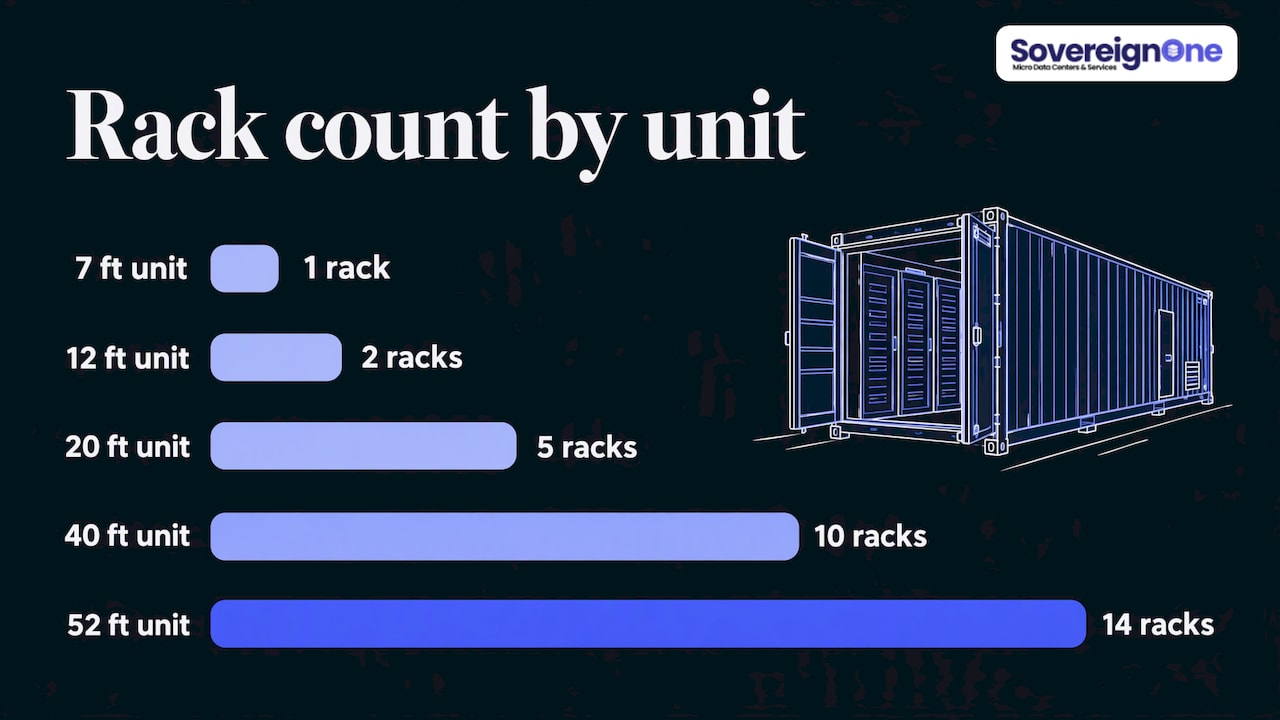
SovereignOne’s lineup runs on one platform at a nominal 125 kW per rack:
| Unit | Racks | Capacity |
|---|---|---|
| 7 ft | 1 | 125 kW |
| 12 ft | 2 | 250 kW |
| 20 ft | 5 | 625 kW |
| 40 ft | 10 | 1.25 MW |
| 52 ft | 14 | 1.75 MW |
Units deploy on an existing grid connection with no new substation and no interconnect queue. Our cooling design cuts power and water use for cooling by 30%. Delivery from site survey to live load takes 4 to 6 months, against 2 to 5 years for a typical conventional build. Because the units use familiar vendor equipment, your own team can maintain and operate them without learning a new platform.
For how these units are specified and shipped, see our guides to containerized data centers and edge data centers. Sizing in steps is covered in data center capacity planning.
Choosing cooling for dense and GPU loads
Single edge AI servers can now exceed 1,000 W, according to a 2026 ScienceDirect study, which also cites 55°C as the established upper ambient limit for uncontrolled outdoor deployment under MIL-STD-810H, NEBS GR-63-CORE Zone 2 and ETSI EN 300 019. Dense AI racks therefore point toward liquid or hybrid cooling. If you are planning GPU compute near the data source, our GPU edge facilities are built for that case.
A practical sequence for a sustainable deployment
- Define the load and growth path. Size the first phase to expected utilization, then add units. Idle capacity is wasted energy.
- Pick the site for power and water. Use an existing grid connection where you can, and check local water stress and heat.
- Choose cooling first. Liquid or hybrid cooling with dry heat rejection addresses PUE and WUE together.
- Set metrics before commissioning. Record PUE, WUE and CUE from day one, plus a utilization measure.
- Plan the power source. Work toward more renewable supply through your utility’s green tariff or on-site generation, since CUE depends on the grid mix.
- Plan end of life. Set a waste-diversion target for batteries and electronics.
What good performance looks like in practice
Public reports show the range. Tencent’s carbon neutrality report records an average PUE at or below its 1.250 target for owned data centers and an 82.9% renewable share in self-owned facilities in 2025. A peer-reviewed analysis of a 15 MW LEED Platinum data center found a CUE of 0.03, about 25 times lower than typical, mainly because of the local utility’s clean electricity mix. Both show that the grid and the climate shape results as much as the hardware does.
Heat reuse is the next frontier. A 2026 Energy Strategy study estimates that pairing treated wastewater cooling with heat recovery could cut about 84 million tonnes of CO2e a year globally.
Modular units for your sector
SovereignOne serves defense, state and local government, healthcare, telecommunications, education, smart cities, sovereign cloud, disaster response, mining, and oil and gas, among others. See the pages for healthcare, smart city and telecom deployments.
Plan a lower-impact deployment with SovereignOne
If your next data center has to be live in months, run on the grid you already have and use less power and water for cooling, start with our modular data center containers. Pricing is quoted per project. Our guide to modular data center quotes lists what to ask for.
We are based in Tampa, Florida, and part of Liberation Technology Services, a WEXMAC prime contract holder operating since 2021. Our company page has the background.
FAQ
What is a key feature of a sustainable data center?
Efficient cooling is the most important single feature, since cooling can take up to 40% of facility energy. Free cooling, liquid cooling and dry heat rejection reduce both energy and water. Clean power supply and right-sized capacity follow.
How do you make a data center more sustainable?
Follow the DOE order: reduce energy use, reuse heat, cut water use, then raise the renewable share. Measure PUE, ERE, WUE and CUE continuously. Build capacity in phases to avoid idle equipment.
What PUE should a sustainable data center target?
ITU-T L.1308 suggests 1.3 for new builds in cool climates and 1.4 in warm climates. Dense liquid-cooled designs can go lower, and PUE should be read with WUE and CUE.
Can a modular data center be sustainable?
Yes. Modular units match capacity to demand, use factory-integrated cooling and can run on an existing grid connection. SovereignOne’s cooling design cuts power and water use for cooling by 30%.
Sources
- ITU and World Bank: Green data centers, towards a sustainable digital transformation
- U.S. DOE: Best Practices Guide for Energy-Efficient Data Center Design
- Motiva: Energy Efficiency of Data Centers in Finland
- Data Centre Alliance guide (2025)
- ITU-T L.1308 (12/2025)
- Thermosyphon cooling index evaluation (2025)
- IEEE study of the Sines facility
- UC Davis WCEC modular cooling study
- ARPA-E hyperefficient data centers presentation
- Sustainable Data Centers Roadmap (Oct 2025)
- ScienceDirect: self-contained hybrid liquid cooling for edge AI
- Tencent Carbon Neutrality Mid-Term Report
- Analyzing the Efficiency of a Green University Data Center
- Global data-water symbiosis study (Energy Strategy, 2026)