
For most organisations weighing an on-premise data center against colocation, colocation is the better answer, and it is worth saying that plainly on a site that sells containers. The on-premise case is real but narrow. These four tests tell you within an afternoon which side of the line you are on.
Run them in order. The first one that comes back negative usually settles it, and there is no point modelling cost until it does.
Test one: does the workload have to be at this location?
An on-premise data center only makes sense when something forces the compute to a specific place. If nothing does, colocation almost always wins on cost, resilience and staffing, and you should stop here.
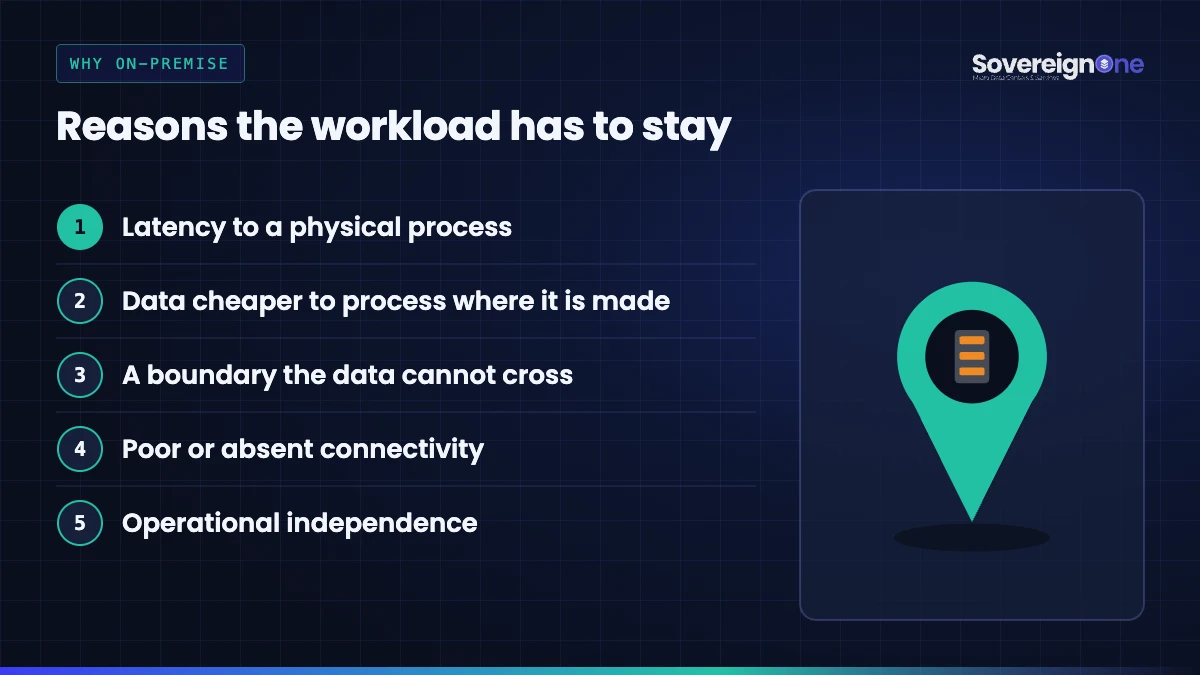
Things that genuinely force location:
- Latency to a physical process, such as a production line, a sensor array or a control system.
- Data volume that is cheaper to process where it is generated than to move.
- A boundary the data cannot cross, whether a security accreditation, a residency obligation or a classification.
- Connectivity that is poor or absent, which rules out depending on a remote facility.
- Operational independence requirements, where the site must keep working while disconnected.
Things that feel like they force location and usually do not: a preference for owning hardware, a belief that on-premise is inherently more secure, and an existing server room that someone wants to keep using. None of those survive a cost comparison on their own.
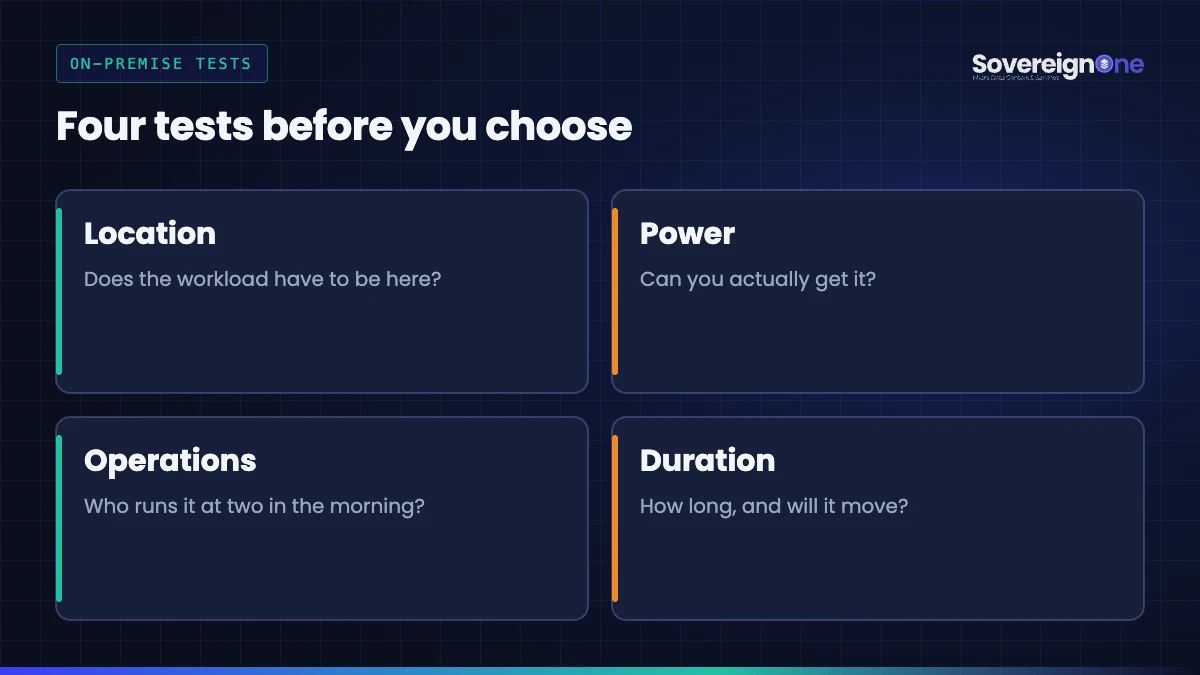
Test two: can you actually get the power?
An on-premise data center is an electrical project before it is an IT project. The question is not whether the building has power, it is whether there is capacity at the point you need it, and what the utility will do about it if there is not.
| What you find | What it means for an on-premise data center |
|---|---|
| Spare capacity in existing service | Viable, and the strongest case for on-premise |
| Service upgrade needed, utility willing | Viable, add the utility timeline to your schedule |
| Service upgrade needed, long utility queue | Usually fatal, and the reason to look at colocation |
| No practical path to the capacity | Fatal, unless you are generating on site |
Get the number from the utility rather than from the panel schedule. Available capacity on paper and available capacity the utility will commit to in writing are different quantities, and the gap between them has killed more on-premise data center projects than any other single factor.
Test three: who operates it at two in the morning?
Colocation includes people. An on-premise data center does not, unless you hire them or contract them. This is the cost line that is most often left out of the comparison, and it does not go away because the deployment is small.
Be specific about the answer. Remote hands within an hour is a service you buy. A facilities technician who also covers HVAC for the building is not a data center operations function. Our post on running a site with no data center staff covers what can honestly be automated and what cannot.
Test four: how long, and will it move?
Duration decides the financial shape. Colocation is recurring cost with low commitment. An on-premise data center is capital with low recurring cost. Over three years colocation usually looks better. Over ten, ownership usually does, provided the requirement stays put.
The move question is the one people skip. If there is a realistic chance the site closes, the lease ends or the mission relocates, a relocatable asset holds its value and a fitted-out room does not. That is the honest case for a containerized on-premise data center over a conventional build, and it only applies if movement is genuinely plausible.
Putting the four together
| Scenario | Better answer |
|---|---|
| No location requirement, no spare power | Colocation |
| Location requirement, spare power, staff available | On-premise, conventional build if permanent |
| Location requirement, spare power, no staff | On-premise with a managed service, or colocation plus edge |
| Location requirement, requirement may relocate | On-premise, relocatable unit |
| Location requirement, no power path | Neither works yet; solve power first |
| Above several megawatts, permanent site | Conventional build or colocation, not containers |
The last row matters. A containerized on-premise data center is a poor fit above a few megawatts at a permanent site, and we would rather tell you that than sell into it. Our write-up on the conditions that disqualify a modular deployment is the longer version.
Where to get neutral numbers
Before you accept any vendor’s comparison, including ours, build your own baseline. The Department of Energy’s Center of Expertise for Data Center Energy at Berkeley Lab publishes assessment tools, air management estimators and an electrical power chain tool, along with a business case resource and practitioner training. It is vendor-neutral and free, which makes it a better starting point than a supplier spreadsheet.
Once you have a baseline, our cost breakdown and scope matrix let you check a quote against it. If you want the four tests run against a specific site, send us the details.
Frequently asked questions
Is an on-premise data center cheaper than colocation?
Over a long enough horizon at a site you will keep, usually yes, because the recurring cost is lower. Over three to five years, colocation is usually cheaper once staffing and resilience are priced honestly. The crossover depends mostly on how much power you need and how far it is.
Is on-premise more secure?
Not inherently. A good colocation facility has physical security, access logging and surveillance that most organisations cannot match on their own site. On-premise wins on security only when the controlling requirement is a boundary the data cannot cross, which is a different thing from being harder to break into.
Can you run a hybrid?
Yes, and it is the most common outcome. Bulk capacity in colocation, with a small on-premise data center handling the workload that has a genuine location requirement. Treating the two as mutually exclusive is usually the mistake.
What capacity is too small for colocation?
Colocation works down to a single rack or part of one, so there is no lower bound that pushes you on-premise. What pushes you on-premise is location, connectivity or a boundary, not small size.
How long does an on-premise deployment take?
If the power exists, weeks to months for a containerized unit. If a utility service upgrade is needed, the utility’s timeline becomes your timeline and can run to a year or more. Ask the utility before you ask a vendor.
Does an on-premise data center need a permit?
Usually yes, in some form, and what kind depends on how the local jurisdiction classifies the installation. Our post on containerized data center permits covers the determination and why neighbouring jurisdictions reach different answers.