
Federal data center procurement differs from the commercial version in three ways that decide the schedule: the money has a colour, the competition has a procedure, and the unit may or may not count as “equipment” depending on how it is attached to the ground.
This guide to federal data center procurement is written for the person running the acquisition. Where a path is slow or a rule is inconvenient, it says so.
What decides a federal data center procurement
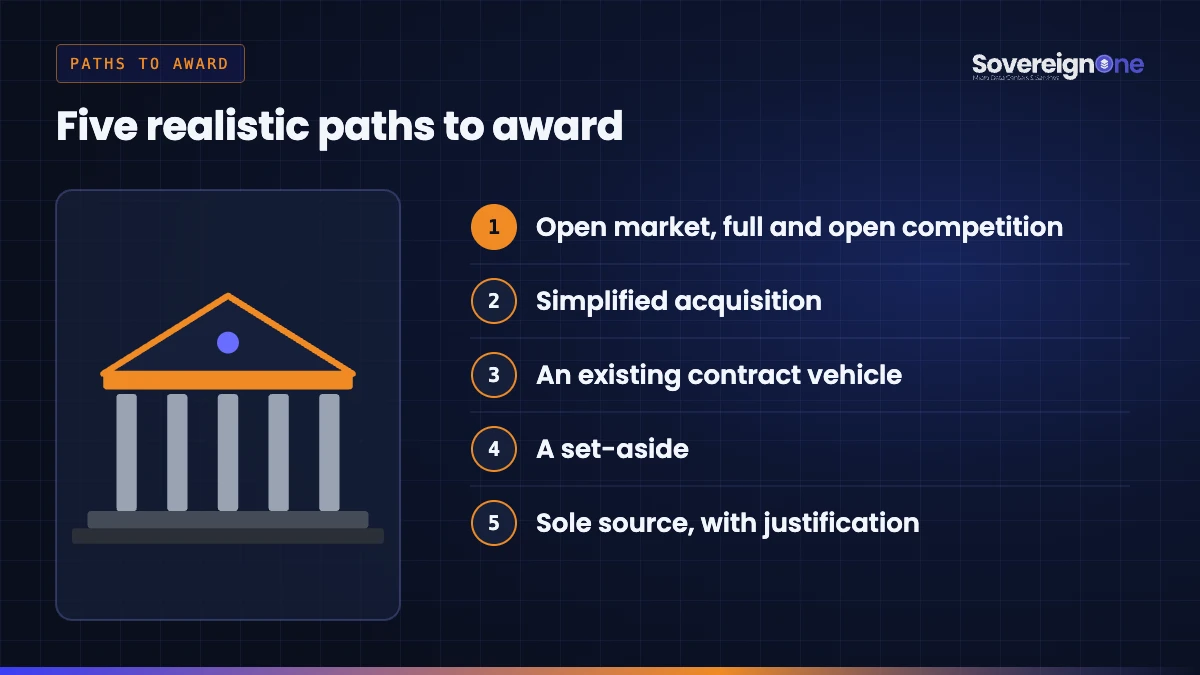
Four things, roughly in order of how much they move the schedule:
- Which appropriation funds it: equipment, construction, or service.
- The dollar value, which sets the procedure available under the FAR.
- Whether an existing contract vehicle already covers the category.
- Whether the site has power, which is usually the real constraint.
Which money are you spending?
Every federal data center procurement starts here. Establish the appropriation before anything else. A modular data center can be bought three ways, and they have different approval paths.
As equipment, using procurement or operations and maintenance funds. The unit is personal property. It arrives, it is installed, and it can be relocated or disposed of like any other equipment.
As construction, if the unit is permanently affixed and the acquisition is effectively a facility. That pulls the project toward military construction or a similar appropriation, with the authorisation thresholds that implies.
As a service, where you procure capacity rather than hardware and the unit stays on the vendor’s books.
The line between the first two is not a matter of opinion and the vendor does not get to decide it. It turns on how the unit is installed, whether the installation is meant to be permanent, and how the agency treats it for real property accountability. A unit on a pad with removable anchors and a quick-disconnect tie-in is a different proposition from one on a permanent foundation with hard-piped services.
Get this wrong and the project changes category, which can mean going back for an authorisation nobody requested.
What are the FAR thresholds for federal data center procurement in 2026?
The value of the acquisition determines the procedure available. As of 1 October 2025, the thresholds are (FAR Part 2 has the definitions):
| Threshold | Amount | What it allows |
|---|---|---|
| Micro-purchase | $15,000 | Purchase card, no competition required |
| Simplified acquisition | $350,000 | Simplified procedures, reduced documentation |
| Commercial products and services test programme | $9 million | Simplified procedures for commercial items |
For modular data centers these matter in a specific way. A single small unit can genuinely sit under the simplified acquisition threshold. A multi-unit deployment with site works will not. The $9 million commercial route, set out at FAR 13.003, is the one people overlook, and if the unit is a commercial item sold to the general public it can be considerably faster than a full negotiated procurement.
Whether a modular data center qualifies as a commercial item has a real answer. Resolve it with your contracting officer early rather than assuming either way.
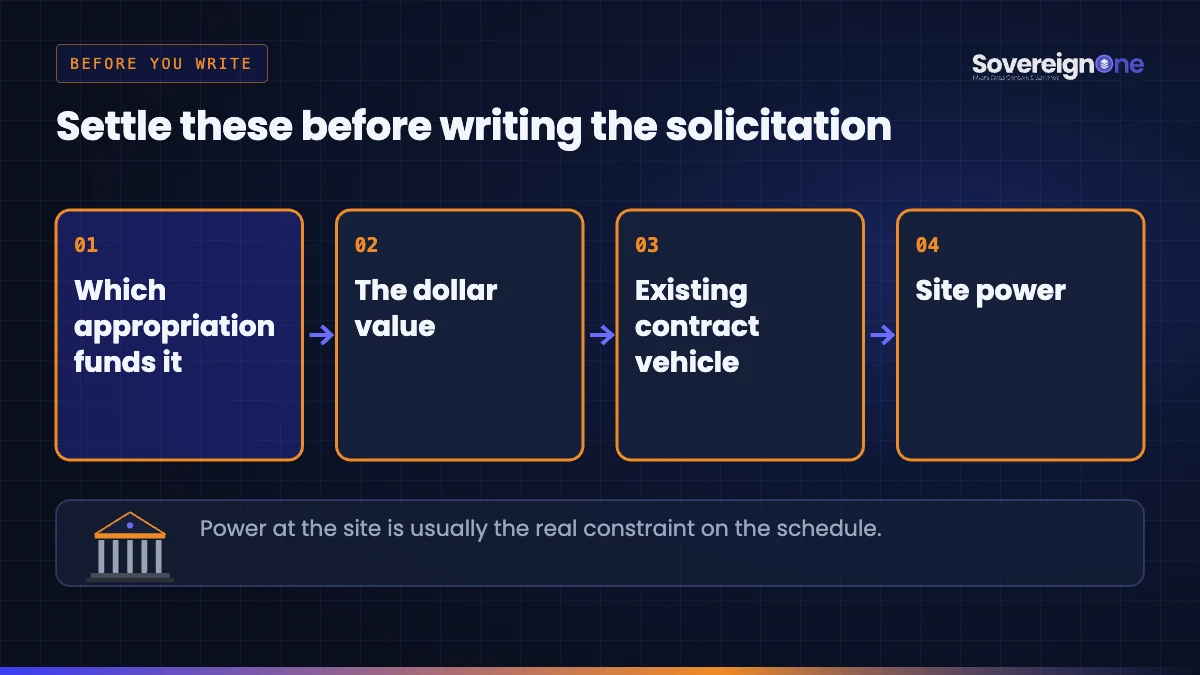
The five realistic paths to award in federal data center procurement
Open market, full and open competition
The default route in federal data center procurement: longest, most defensible, most documentation. Appropriate for large or novel requirements, and effectively mandatory above the simplified thresholds unless another route applies.
Simplified acquisition
Below $350,000, or below $9 million for commercial items. This is the fastest federal data center procurement route available on open market terms, with far less process. The constraint is the ceiling rather than the method, so this fits single units better than programmes.
An existing contract vehicle
GSA schedules, government-wide acquisition contracts, agency vehicles and cooperative agreements all let you buy from a pre-competed pool. Competition happened at the vehicle level, so your procurement becomes a task or delivery order instead of a new solicitation. This is usually the fastest legitimate route.
The question to ask early is not whether you can use a vehicle. It is which vehicles carry this category, and whether a supplier who can actually deliver sits on one of them.
A set-aside
Small business, and the socioeconomic categories within it, can limit competition to qualifying firms. This narrows the pool rather than shortening the process.
Sole source, with justification
Permissible, but the written justification has to survive review, and the bar is the requirement rather than the preference. “We like this vendor” will not do it. “Only one source meets a documented technical requirement, and here is why that requirement exists” might.
A justification built on a specification copied from one manufacturer’s datasheet is the most common way these procurements get protested. If only one product can meet the spec, be ready to defend why the spec is genuine.
What does a supplier need for a federal data center procurement award?
Four things, and none of the paths above work without them:
- Active registration in SAM.gov. Active, and not expiring mid-procurement. A lapsed registration stops payment as well as award.
- A Unique Entity ID, issued through SAM, which follows the entity through the award.
- A CAGE code, assigned through the same process.
- Current representations and certifications, including the supply-chain prohibitions covering telecommunications and video surveillance equipment.
Ask for all four before you spend time on a technical evaluation, because no federal data center procurement survives an unregistered supplier. A manufacturer that has never held a federal award may still build an excellent unit, but the registration work takes time and belongs on the schedule rather than turning up at award.
What actually delays these projects?
Rarely the acquisition itself. Three things hold up federal data center procurement, and only one sits with the contracting officer.
Power. Power is the constraint that ends more federal data center procurement schedules than any contracting rule. Interconnection queues now run years rather than months, and historically most requests filed between 2000 and 2019 were withdrawn rather than built. Data center projects under 20 MW reach operational status at a far higher rate than projects above 500 MW. If the requirement can be served by power the site already has, you have removed the most common cause of delay.
Long-lead electrical equipment. Transformers and switchgear have been quoted in years. A unit that arrives factory-tested with its power train integrated buys its way around a queue you would otherwise stand in.
Permitting and siting approval. Jurisdiction-specific, and covered in our piece on whether a containerized unit counts as a building. On a federal installation the equivalent question is the real property and siting approval path.
Settle these before writing the solicitation
- The appropriation funding the federal data center procurement: equipment, construction or service.
- Whether the unit is permanently affixed, which drives the answer above.
- The power position, measured rather than nameplate, and whether a service upgrade is in scope.
- Whether the requirement is commercial, which may open a faster path.
- Domestic content obligations for the enclosure, the power train and the IT, which are not necessarily the same answer.
- The accreditation boundary: what travels with the unit, and what has to be re-earned per site. A vendor claim of being “pre-certified” deserves a written explanation.
Frequently asked questions
Can a modular data center be bought as equipment rather than construction?
Often yes in a federal data center procurement, depending on how it is installed and how the agency treats it for real property purposes. A relocatable unit on a pad designed for removal makes a stronger equipment case than one on a permanent foundation with hard-piped services. Settle it with your contracting officer and real property staff before the solicitation is written.
What is the simplified acquisition threshold in 2026?
$350,000 as of 1 October 2025, rising to $9 million where the acquisition qualifies under the commercial products and services test programme. The micro-purchase threshold is $15,000. A single small unit may fit under the simplified threshold; a multi-unit deployment with site works will not.
Do I need a sole-source justification to buy a specific manufacturer’s unit?
Yes, if no other source meets the documented requirement, and it must be written and approved. The risk is that a specification drawn from one manufacturer’s datasheet will not survive review. Write the requirement around what the mission needs, then see who can meet it.
What registrations does a federal supplier need?
Active SAM registration, a Unique Entity ID, a CAGE code, and current representations and certifications. Ask for all four early, because registration takes real time if the supplier does not already hold them.
Does buying modular avoid a military construction authorisation?
It can, where the unit is genuinely procured and installed as equipment. It does not automatically. Permanence of installation and real property treatment decide it, not the fact that the enclosure arrived on a truck.
How long does federal data center procurement take?
The procurement itself can run from weeks under simplified procedures to many months for a full negotiated competition. Power availability, long-lead electrical equipment and siting approval usually take longer than the acquisition.
Where to go next
Federal data center procurement rewards settling these questions early. If you are scoping a requirement, the government deployment page covers the configurations most often specified, and the defense page covers installation-specific questions. If you would rather test it against a real site, get in touch and we will tell you honestly whether a modular unit suits it.