
Secure edge computing means running workloads close to where data is created while protecting the devices, network links, applications and the physical site itself. The strongest design starts at the physical platform: a defined, factory-integrated unit on your own premises, built from hardware your team already knows, gives you one standard footprint to secure instead of dozens of improvised closets. SovereignOne builds modular data center containers that go from site survey to live load in 4 to 6 months, so the secure platform exists before the exposure window opens.
This guide is for infrastructure, government and enterprise buyers who need to decide how to protect edge sites. It covers what changes in the threat model, which controls the standards bodies recommend, and how to turn them into a deployment plan.
TL;DR
- Edge computing moves processing outside the traditional cloud security perimeter, so network security, monitoring and encryption have to extend to every site.
- The main risks are exposed edge devices, inconsistent configuration, weak authentication and physical access to remote hardware.
- NIST, ETSI, ITU and CISA converge on the same core controls: zero trust, encryption, patch management, role-based access and a trusted physical platform.
- Standardized, pre-tested modular units reduce the variety of hardware and software you have to secure across sites.
- SovereignOne quotes pricing per project; start with the modular data center containers lineup.
Table of Contents
- What secure edge computing covers
- Why the risk changes at the edge
- The controls the standards agree on
- Start with the physical platform
- Edge devices and the network perimeter
- Standards worth tracking
- How to plan a secure edge deployment
- Where a modular data center fits
- Industry examples
- Talk to SovereignOne about your edge site
- FAQ
- Sources
What secure edge computing covers
Edge computing takes place at or near the physical location of the user or data source, which brings compute closer for faster, more reliable service. The AWS Security at the Edge whitepaper notes that edge networks are architected outside traditional cloud security perimeters. Extending security to them therefore takes network and application security, continuous monitoring, and encryption of data in transit and at rest.
In practice, “secure edge computing” spans four layers:
- The physical site and platform: the enclosure, power, cooling, and the hardware and firmware inside it.
- Devices and endpoints: sensors, gateways, cameras, controllers and anything that feeds data to the site.
- Network links: the paths between devices, the edge site and any upstream cloud.
- Workloads and data: the applications that run at the edge and the data they store.
A program that covers only one layer leaves the others to carry the risk. The rest of this article follows the layers in order.
Why the risk changes at the edge
Moving compute out of a central facility has real security benefits. RFC 9556, an IETF document on IoT edge challenges, explains that processing sensitive data closer to where it is generated preserves privacy, and that an edge cloud can anonymize or aggregate data before anything travels to a remote cloud. For a hospital, a municipality or a defense unit, keeping raw data on site is often the reason to adopt edge in the first place.
The same architecture adds exposure. An IEEE Technology and Society article from May 2024 calls the hierarchical edge topology a double-edged sword: spreading data across nodes provides protection, but it creates vulnerabilities at each communication layer between the end device, the edge and the cloud. It lists man-in-the-middle, eavesdropping, tampering, denial-of-service and waterhole attacks against lightweight IoT devices that traditional cloud security cannot fully deter.
Four problems recur across the literature.
Exposed and inconsistent devices
ISACA’s 2025 analysis of critical infrastructure in the IoT and edge era explains that edge devices often sit between trusted internal networks and the outside world and are reachable through public IP addresses. Misconfigurations, inconsistent updates, default settings, insecure protocols, open ports and poor segmentation make them targets. If one is breached, an attacker can intercept data, manipulate communications or launch denial-of-service attacks.
An IEEE systematic review from 2020 adds that each IoT device is often configured differently, with different versions and different vulnerabilities, and that end users and IoT devices are the main target of breaches because they cannot easily establish explicit trust with other devices.
Weak baseline controls
The same ISACA issue reports that many internet-connected IoT components lack baseline controls such as strong passwords, multi-factor authentication, encrypted communication and timely firmware patching. That gap enables botnet attacks, unauthorized remote control, lateral movement and data exfiltration.
Harder authentication
Cloud services rely on a centralized authenticator. The IEEE Technology and Society article notes that distributed edge services run in a multidomain environment, where authenticating against central upstream services is difficult across many stakeholders. Identity design therefore has to be decided per deployment, not assumed.
Physical exposure and many vendors
The ETSI white paper on multi-access edge computing (MEC) security identifies zero-day vulnerabilities from mixed container and virtual machine deployments, physical attacks on components in cell sites and isolated buildings, and the need for end-to-end security across multi-vendor ecosystems. A central data center has guards, badges and a single operations team. A remote edge site often has none of those.
The controls the standards agree on
No single standard covers everything, but the major documents overlap heavily. The table below maps each control to the body that recommends it.
| Control | What it means | Source |
|---|---|---|
| Zero trust | Strong authentication and “least access” policies; trust decisions based on who, what, when, where, why and how | ETSI MEC security white paper; NVIDIA security-architect guidance |
| Encryption | Encrypt stored data and critical data in transit | ITU-T X.1648 |
| Strong identity | Unique identity per application, only authenticated applications on edge nodes, at least two multi-factor authentication technologies for users, authenticated API callers | ITU-T X.1648 |
| Access control and audit | Role-based access control, periodic storage audits, real-time processing monitoring, data-outflow control | ITU-T X.1648 |
| Backup | Remote backup with availability and integrity verification | ITU-T X.1648 |
| Patch management | Continuous vulnerability and patch management, with automated patching to shrink the attack surface | ETSI MEC security white paper |
| Segmentation | Micro-segmentation, mutual TLS or HTTPS, device credentials in secure cryptographic elements | AWS Well-Architected IoT guidance |
| Platform trust | Hardware, firmware and software integrity established from the physical platform up | NIST IR 8320 |
The AWS guidance also states the shared responsibility point plainly: the customer is responsible for securing the edge network, perimeter, devices, updates, and logging and monitoring. Whoever hosts the hardware, those duties land on your team, so they belong in the design from the start.
Start with the physical platform
NIST’s 2022 report on hardware-enabled security says attack surfaces in cloud data centers and edge computing have shifted and in some cases significantly increased. Its authors argue that securing the physical platform comes first, so that controls in higher layers can be trusted even when physical security is lacking. Hardware-enabled security establishes trust in hardware, firmware and software integrity from the bottom of the stack.
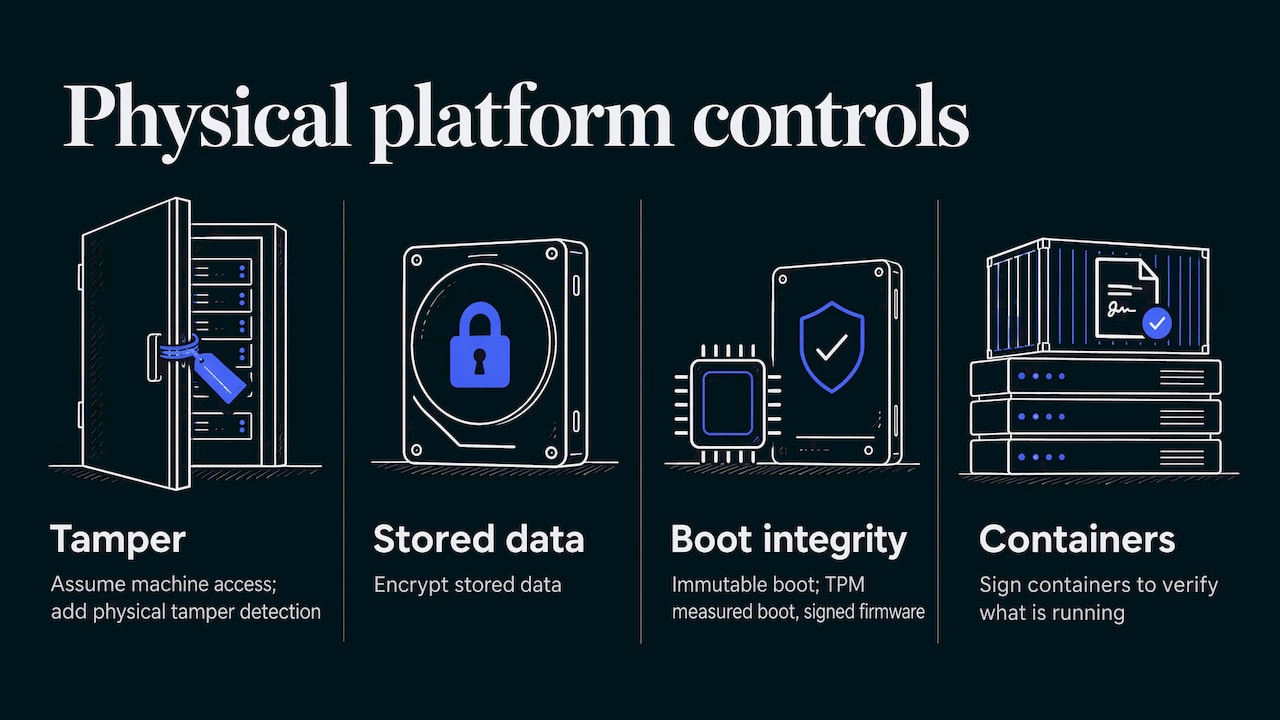
NVIDIA’s guidance for security architects makes the same point from the field. Assume a malicious person could reach the machine, for example an edge server in an unlocked office. Then encrypt stored data, make boot partitions immutable, add physical tamper detection, use a TPM for measured boot with signed firmware, and sign containers so you can verify what is running.
That has a design consequence. The more an edge site depends on ad hoc rooms, improvised racks and mixed hardware, the more of this you must rebuild at every location. A purpose-built unit gives you a defined footprint to apply the controls to, once, and repeat.
Edge devices and the network perimeter
Firewalls, routers, VPN gateways, IoT devices, internet-facing servers and internet-facing operational technology are the entry points attackers probe first. On 4 February 2025, CISA released joint guidance with Australia’s ASD and ACSC, Canada’s CCCS, the UK’s NCSC and other partners to help organizations protect these network edge devices and appliances.
The practitioner guidance tells organizations to prioritize their national cybersecurity authority’s recommendations when building an edge-device action plan. For US organizations, that points to CISA’s Cross-Sector Cybersecurity Performance Goals. Organizations that protect sites with a physical dimension can also read about critical infrastructure protection alongside their network plan.
A workable perimeter checklist for each edge site:
- Inventory every internet-facing device and remove what does not need to be reachable.
- Replace default settings and credentials before the device goes live.
- Segment the edge network so a compromised sensor cannot reach management systems.
- Terminate encrypted tunnels at defined points and enforce policy at firewalls and API gateways, as the AWS whitepaper advises.
- Centralize logs from every site so one team can see all of them.
Standards worth tracking
Edge security guidance is still being written. These are the documents a buyer should know:
- ITU-T X.1648, the guideline on edge computing data security, was approved on 17 April 2025 and is in force.
- ITU-T X.1819, on network-layer security capabilities for IMT-2020/5G edge computing, was approved on 6 September 2024 and is in force. It matters most to telecom operators.
- ISO/IEC 25545 is a work item for guidelines on edge computing security and privacy covering the lifecycle of edge systems, platforms and services. Watch its progress rather than waiting for it.
- ETSI’s MEC guidance argues that edge security must be handled end to end by combining standards from several bodies, since cloud-only approaches are not enough for heterogeneous, multi-stakeholder environments.
The ETSI white paper also notes that security assurance is increasingly required by 5G regulations through schemes such as GSMA NESAS alongside Common Criteria (ISO 15408). Telecom buyers should ask their equipment suppliers how those schemes apply to the hardware in scope.
How to plan a secure edge deployment
The sequence below works for a single site or a program of many.
- Define the workload and its data classes. Decide what must stay on site, what can be aggregated and sent upstream, and what is regulated. Healthcare records, citizen data and defense data each carry different handling rules.
- Choose the platform before the software. Settle the physical unit, power source and hardware families first, because every later control depends on them.
- Standardize. Fewer hardware and software variants mean fewer unique vulnerabilities and fewer patch paths. This answers the problem of devices that are each configured differently.
- Design identity first. Assign each application and user a verified identity, require multi-factor authentication, and apply least-access policies.
- Encrypt and back up. Encrypt stored and transmitted data, and verify the integrity and availability of remote backups.
- Plan patching and monitoring. Decide who patches, how fast, and how logs reach your security team. Automate where you can.
- Test the physical assumptions. Ask what happens if someone reaches the hardware, and make sure tamper detection, measured boot and signed software answer it.
- Document ownership. Under shared responsibility, write down who holds each duty: your team, your integrator, your carrier.
Where a modular data center fits
Most edge security problems trace to variety and delay. Sites built from mixed equipment in rooms never designed for compute are hard to patch consistently, and a build that takes years leaves workloads running in interim locations. A modular data center addresses both.
SovereignOne builds factory-integrated, pre-tested modular data center containers. Units go from site survey to live load in 4 to 6 months, compared with 2 to 5 years for a typical conventional build. They deploy on an existing grid connection with no new substation and no interconnect queue. The units are integrated from established hardware platforms, so your own staff can maintain and operate them without learning new platforms. That means your existing patching, monitoring and access practices carry over.
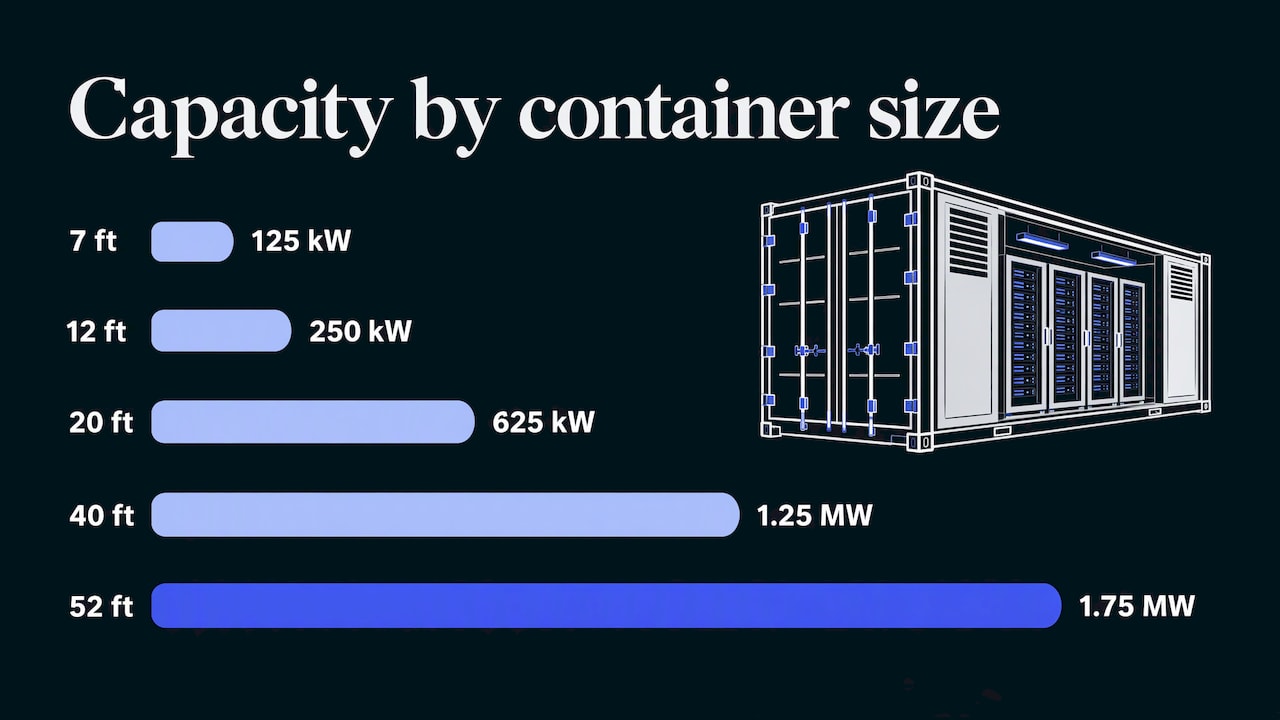
The lineup uses one platform in five container lengths at a nominal 125 kW per rack:
| Unit | Racks | Capacity |
|---|---|---|
| 7 ft | 1 | 125 kW |
| 12 ft | 2 | 250 kW |
| 20 ft | 5 | 625 kW |
| 40 ft | 10 | 1.25 MW |
| 52 ft | 14 | 1.75 MW |
A single platform across sizes helps with the standardization step above: a small remote site and a larger regional site can follow the same security baseline. The cooling design cuts power and water use for cooling by 30%, which also matters at sites with limited utility capacity.
Industry examples
Security priorities differ by sector, and the client’s industry pages go deeper on each:
- Healthcare: keeping patient data on site and under the health system’s own controls. See healthcare modular data centers.
- Telecommunications: 5G edge, cell sites and multi-vendor environments, where the ETSI and ITU documents apply most directly. See telecom edge data centers.
- Sovereign cloud and government: workloads that must remain under local jurisdiction and control. See sovereign cloud data centers.
- Education and research: campus compute for sensitive research data. See campus modular data centers.
- Hybrid environments: the on-site layer that connects to public cloud is covered in the hybrid cloud infrastructure guide.
Talk to SovereignOne about your edge site
If you are planning edge compute for a government agency, health system, telecom network, university or industrial operation, SovereignOne can scope a unit to your rack count and power envelope. Pricing is quoted per project. Review the modular data center containers or GPU edge facilities, then use the 23 questions for a modular data center quote to prepare your security and operations requirements.

For background on the format itself, read what containerized data centers are and how to deploy one.
FAQ
What is secure edge computing?
It is edge computing with security designed in at every layer: the physical site, devices, network links, applications and data. Because edge sites sit outside the traditional cloud perimeter, they need their own network and application security, continuous monitoring, and encryption in transit and at rest.
Is edge computing more secure than cloud?
It depends on the design. Processing data near its source can preserve privacy and reduce what travels over networks, as RFC 9556 explains. It also creates more sites and communication layers to protect, so the result rests on controls such as zero trust, patching and a trusted physical platform.
Which standards should I follow?
Start with your national authority’s guidance; in the US, that means CISA’s edge device guidance and its Cross-Sector Cybersecurity Performance Goals. Add ITU-T X.1648 for edge data security and ETSI’s MEC security guidance if you run telecom or multi-vendor edge environments. Track ISO/IEC 25545 as it develops.
How fast can a secure edge site go live?
SovereignOne units go from site survey to live load in 4 to 6 months and deploy on an existing grid connection with no new substation or interconnect queue. Timing for your project is confirmed in the project quote.
Sources
- AWS: Security at the Edge whitepaper
- AWS Well-Architected IoT Lens: security design principles
- RFC 9556: IoT Edge Challenges and Functions
- IEEE Technology and Society: Edge Computing and IoT Data Breaches
- ISACA Journal: Safeguarding Critical Infrastructure in the IoT and Edge Era
- IEEE: Systematic Review on Security and Privacy Requirements in Edge Computing
- ETSI: White Paper on MEC security
- ITU-T X.1648: Guideline on edge computing data security (data controls)
- ITU-T X.1648: approval record
- ITU-T X.1819: network-layer security for 5G edge computing
- NIST IR 8320: Hardware-Enabled Security
- NVIDIA: Edge Computing, Considerations for Security Architects
- CISA: joint guidance on network edge devices, 4 February 2025
- Mitigation strategies for edge devices: practitioner guidance
- ISO/IEC AWI 25545: edge computing security and privacy guidelines