
An edge data center is a compact facility that processes data close to where it is created or used, so that latency-sensitive and bandwidth-heavy workloads do not have to travel to a distant core site. Modular construction is the fastest way to build one: SovereignOne delivers factory-integrated, pre-tested modular data center (MDC) containers that go from site survey to live load in 4 to 6 months, compared with 2 to 5 years for a typical conventional build.
This guide explains what edge data centers are, how they are designed, where they fit, and how to decide on size, power and cooling. It is written for infrastructure, government and enterprise buyers who need compute near the work.
TL;DR
- An edge data center is a small, local facility that runs workloads near users, devices or sensors, and offloads traffic from core and cloud sites.
- The design questions are the same as for any data center (power, cooling, connectivity, security, operations), but compressed into a footprint that fits a site you do not control.
- Modular units are built and tested in a factory, so the site work is limited to placement and connection. Our MDCs reach live load in 4 to 6 months and deploy on an existing grid connection with no new substation and no interconnect queue.
- One platform covers five container lengths, from 1 rack and 125 kW to 14 racks and 1.75 MW. Pricing is quoted per project.
Table of Contents
- What an edge data center is
- Why organizations build at the edge
- Edge data center architecture and design
- Modular edge data centers
- Choosing a size: five container lengths on one platform
- Where edge data centers fit: use cases by sector
- How to deploy an edge data center
- What to look for in an edge data center solution
- Our modular edge data centers
- FAQ
- Sources
What an edge data center is
A traditional data center concentrates thousands of servers in one large building, often far from the people and machines that use them. An edge data center takes the opposite approach. It is a smaller facility placed at or near the point where data is generated: a hospital campus, a cell tower aggregation site, a mine, a city operations center, a university research cluster, a forward military location.
The word “edge” refers to the edge of the network, not to a particular size or product. What makes a facility an edge data center is its purpose: it reduces latency (the delay between a request and a response) and takes work off the primary or core data centers. The same logic explains the other names you will see: micro edge data center, edge DC, edge computing data center, and edge data center solution. They all describe local compute housed in a purpose-built enclosure.
The reason this matters is the volume of data created away from central sites. Gartner has estimated that around 10 percent of enterprise-generated data was created and processed outside a traditional data center or cloud, with a forecast that the share would reach 75 percent by 2025, as summarized in this overview of edge computing. Whatever the exact figure in a given organization, the direction is clear: more sensors, cameras, instruments and AI models produce data where there is no hyperscale campus nearby.
Edge, core and cloud compared
| Core or hyperscale facility | Edge data center | |
|---|---|---|
| Location | Chosen for land, power and fiber; often far from users | Chosen for proximity to users, devices or sites |
| Scale | Tens or hundreds of megawatts | One rack to a few megawatts |
| Main job | Bulk storage, large-scale training, general cloud services | Low-latency processing, local control, local data retention |
| Build route | Years of construction and utility interconnection | Factory-built modules, placed and connected on site |
| Operations | Staffed campus | Often lightly staffed, remotely monitored |
The two are complementary. Edge sites handle what must happen locally and pass summarized or non-urgent data back to the core.
Why organizations build at the edge
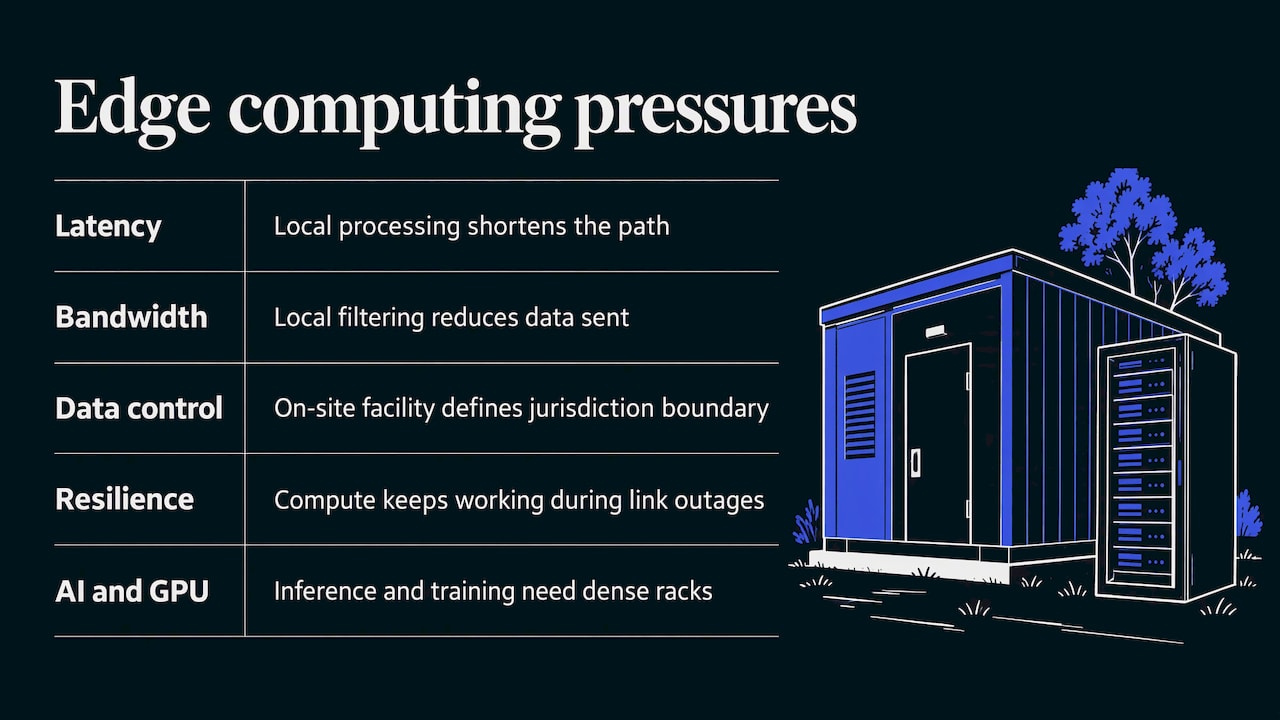
Four pressures push compute to the edge, and most projects involve more than one.
Latency. Real-time video analytics, industrial control, telehealth imaging, and traffic or public-safety systems cannot wait for a round trip to a distant region. Local processing shortens the path.
Bandwidth. Sending every raw camera or sensor stream to the cloud is expensive and often unnecessary. Filtering, compressing and analyzing locally reduces what has to travel.
Data control. Defense, state and local government, healthcare and sovereign cloud programs often need data to stay inside a defined location or jurisdiction. A facility on your own site makes that boundary physical and easy to describe to an auditor.
Resilience. Sites with unreliable backhaul, such as mines, oil and gas fields, farms and disaster zones, need compute that keeps working when the link to a central facility is slow or down.
A fifth pressure has grown quickly: AI and GPU workloads. Inference near the data source, and training on sensitive local datasets, need rack densities that ordinary server rooms cannot supply. This is where the power and cooling design of the enclosure decides what is possible.
Edge data center architecture and design
Design for the edge is the same discipline as any data center, with tighter constraints. Work through these five areas in order.
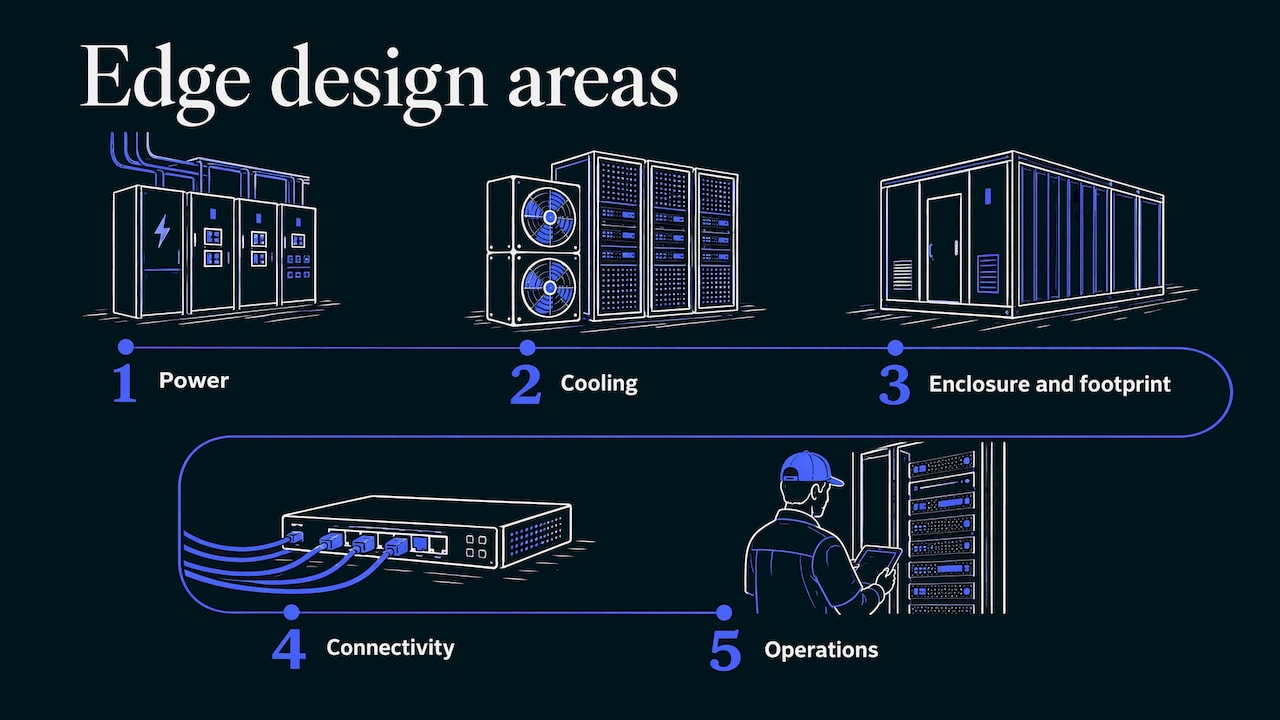
1. Power
Power is usually the limiting factor. A building that was never meant to host high-density compute often cannot supply it, and a new substation or interconnection request can take years. Define the load per rack first, then the total, then how it reaches the site.
SovereignOne units are sized at a nominal 125 kW per rack and deploy on an existing grid connection, with no new substation and no interconnect queue. For many edge projects that single point removes the longest item from the schedule.
2. Cooling
Cooling decides how many racks fit in a given footprint and what the site pays to run them. High-density racks need liquid or hybrid cooling, because air alone struggles at those loads. Our cooling design cuts power and water use for cooling by 30%, which matters most at remote sites where water and spare capacity are scarce.
3. Enclosure and footprint
An edge site rarely has a spare building. A containerized enclosure turns the site requirement into a pad, a power feed and a network connection. Because the unit is integrated and tested in a factory, the interior (racks, power distribution, cooling) arrives as one finished system instead of being assembled around the site’s constraints.
4. Connectivity
Plan the network paths into and out of the site: primary and secondary carriers, links to the core or cloud, and links to the local devices the facility serves. Resilience here is as important as redundancy in power.
5. Operations
Edge sites multiply the number of places that need maintenance. Equipment from established hardware platforms keeps the operating model familiar. Our MDCs are integrated from familiar vendor equipment so your team can maintain and operate them without learning a new platform.
Modular edge data centers
There are two ways to build an edge facility. You can convert or construct a building, or you can place a factory-built module. Conventional construction involves design, permitting, trades on site and commissioning of each system after installation. A typical conventional build takes 2 to 5 years.
A modular edge data center moves most of that work into a controlled factory setting. The unit is integrated and tested before it ships, so the work left on site is siting, placement and connection. SovereignOne’s process runs from site survey to live load in 4 to 6 months.
The practical gains for an edge buyer:
- Schedule. Months instead of years, with the grid connection already in place.
- Repeatability. Several sites can use the same platform, spares and procedures.
- Scalability. Start with one unit and add more as demand grows, or choose a larger container up front.
- Fit with existing infrastructure. No new substation and no interconnect queue.
For more detail on how containerized units are specified and deployed, see our guide to containerized data centers and how to deploy one.
Choosing a size: five container lengths on one platform
Our lineup uses one platform in five lengths, at a nominal 125 kW per rack.
| Container | Racks | Capacity | Typical fit |
|---|---|---|---|
| 7 ft | 1 | 125 kW | Single-site edge node, remote or space-limited location |
| 12 ft | 2 | 250 kW | Small branch, clinic network or field deployment |
| 20 ft | 5 | 625 kW | Campus, municipal or regional edge hub |
| 40 ft | 10 | 1.25 MW | Larger GPU edge cluster or telecom aggregation site |
| 52 ft | 14 | 1.75 MW | Highest-density single-unit deployment |
The “typical fit” column is a starting point, not a specification. The right size depends on the workload, the available grid capacity at the site and your growth plan. When two units on the same platform meet the need better than one large unit, the common platform makes that straightforward.
Where edge data centers fit: use cases by sector
Edge data centers serve different needs depending on who runs them. We build for defense, state and local government, healthcare, telecommunications, education, smart cities, sovereign cloud, disaster response, manufacturing, agriculture, transportation and logistics, mining, and oil and gas. A few examples show how the requirements differ.
Telecommunications. Carriers place compute near the network edge to support low-latency services and to process traffic locally. See our page on telecom edge data centers.
Healthcare. Health systems keep imaging, records processing and clinical analytics close to the facilities that use them. See healthcare modular data centers.
Smart cities. Cameras, traffic systems and public-safety platforms generate data that cities want to process locally. See smart city data centers.
Education and research. Universities need local capacity for research computing and AI work. See campus modular data centers.
Agriculture. Farms and processing operations use local compute for sensor and imaging data where connectivity is limited. See agriculture modular data centers.
Sovereign cloud. Organizations that must keep data inside a jurisdiction can host it on their own territory. See sovereign cloud data centers.
Defense and federal agencies. Forward and fixed sites need compute that can be placed quickly and run on existing power. Capital planning for these projects has its own funding rules; our guide to MILCON data center funding covers three appropriation paths.
Disaster response, mining, and oil and gas. These operators work where there is no data center and often little network capacity. A self-contained unit that runs on an existing grid connection and is tested before shipping suits sites like these.
How to deploy an edge data center
A deployment follows a sequence. Most delays come from skipping the early steps, so take them in order.
- Define the workload. List the applications, the latency each one needs, the data that must stay local, and the rack density. GPU workloads need a different power and cooling plan from general-purpose servers.
- Survey the site. Confirm where the unit will sit, the existing grid connection and its available capacity, and the network routes. In our process the site survey is the starting point for the 4 to 6 month timeline.
- Size the unit. Match the container length to the load, with room for growth. Check the rack count and kW against the table above.
- Specify the build. Decide the cooling approach, the hardware platform and the operating model. Using familiar vendor equipment keeps training needs low.
- Build and test in the factory. The unit is integrated and pre-tested before it leaves, so problems are found before they reach your site.
- Place, connect and go live. The on-site work is placement, power and network connection, then live load.
- Operate and expand. Monitor remotely, keep spares in common across sites, and add units on the same platform as demand grows.
Before you request quotes, it helps to know what to ask. Our list of 23 questions worth asking in a modular data center quote covers scope, power, cooling and acceptance, and three numbers to ask for on modular data center cost helps you compare proposals on the same basis.
What to look for in an edge data center solution
Whether you are buying a unit or comparing proposals, test each option against these criteria:
- Time to live load. Ask for the timeline from site survey to production, and what it assumes about power.
- Power path. Does it run on your existing grid connection, or does it depend on new utility work?
- Density and cooling. What load per rack does it support, and how is it cooled? What does cooling cost in power and water?
- Scalability. Can you add capacity on the same platform without redesign?
- Operability. Can your own staff run it on equipment they already know?
- Fit to the sector. Does the provider build for your type of site and compliance context?
On these points the modular approach we use is designed to answer each question directly: a 4 to 6 month schedule, no new substation, a nominal 125 kW per rack, a 30% cut in cooling power and water use, and familiar vendor equipment.
Our modular edge data centers
SovereignOne is a modular data center company based in Tampa, Florida, and part of Liberation Technology Services, a WEXMAC prime contract holder operating since 2021. We build factory-integrated, pre-tested containers in five lengths, from 7 ft (1 rack, 125 kW) to 52 ft (14 racks, 1.75 MW), for edge compute, GPU workloads, disaster recovery, education, smart city, telecom and government use. Pricing is quoted per project.
To see the full lineup and request a quote for your site, visit our modular data center containers page. If your project is GPU-driven, our GPU edge facilities are described by industry. You can also read more about our Tampa team.
FAQ
What does “edge data center” mean?
It means a smaller, local data center placed near the users, devices or sensors it serves. Its purpose is to cut latency and take workload off core or cloud facilities. It can be a room, a building or a factory-built container.
How big is an edge data center?
There is no fixed size. Edge facilities range from a single rack to a few megawatts. Our containers span 1 rack at 125 kW to 14 racks at 1.75 MW, so the unit can be matched to the site.
How is an edge data center different from a cloud data center?
A cloud or hyperscale facility is large and centralized, and serves many customers from a few locations. An edge data center is small and local, and serves a specific site, campus or region. Most architectures use both, with the edge handling real-time work and the core handling bulk processing and storage.
How long does it take to deploy a modular edge data center?
Our modular units go from site survey to live load in 4 to 6 months. A typical conventional build takes 2 to 5 years. Because our units deploy on an existing grid connection, with no new substation and no interconnect queue, utility work does not extend the schedule.
Can an edge data center run AI and GPU workloads?
Yes, provided the power and cooling are designed for the density. Our units are specified at a nominal 125 kW per rack and use cooling designed to reduce cooling power and water use by 30%. We also offer GPU edge facilities for operators who need local AI compute.