
A containerized data center is a complete, factory-built data center housed in a steel enclosure, usually the size of an ISO shipping container, and delivered to your site ready to connect. Instead of spending 2 to 5 years on permitting, construction and commissioning, you order a finished unit that is built, integrated and tested elsewhere. SovereignOne’s modular units can go live within 4 to 6 months, on your existing power grid, with equipment your team already knows how to run.
This guide explains what is inside a container, how it differs from “modular” and “prefabricated” designs, what your site must provide, and how to write a specification that gets you the result you need.
TL;DR
- A containerized data center packs racks, power distribution, cooling and monitoring into one factory-built enclosure that is shipped and set up on a pad, in a lot or inside a garage.
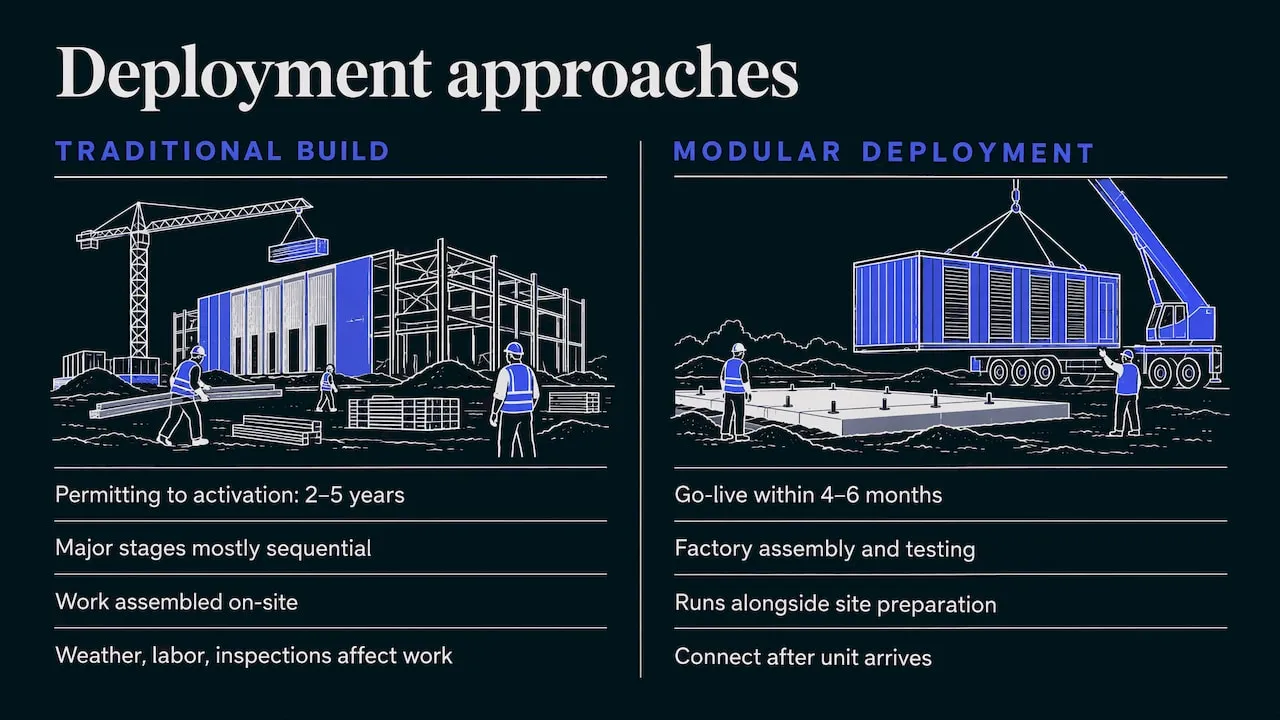
- Factory integration and testing replace most on-site construction, which is why deployment is measured in months. SovereignOne units go live in 4 to 6 months, against 2 to 5 years for a traditional build.
- Efficiency depends on the cooling design. Published figures for container units range from an average power usage effectiveness (PUE) of 1.16 down to 1.02 for second-generation designs, and SovereignOne’s advanced cooling cuts power and water use by 30%.
- Before you order, define rack count, power per rack, temperature limits, pad, network and local code requirements. The checklist below covers each.
- The format suits edge compute, government, healthcare, telecom, education, smart cities and disaster recovery, where compute has to sit close to the work.
Table of Contents
- What a containerized data center is
- Containerized, modular, prefabricated: the terms explained
- What is inside the container
- Why deployment takes months, not years
- Power and water efficiency
- Site, power, cooling and network: what you need to provide
- Where containerized data centers fit
- How SovereignOne approaches it
- A short specification checklist
- FAQ
- Sources
What a containerized data center is
A containerized data center is a data center inside a container. According to TechTarget’s overview, the container can be a trailer or a freight or shipping box, set up as a modular pod in an open space such as a parking lot or garage. It holds a fully functioning facility: computing capability, power resources and a cooling system.
To see why this matters, compare it with a conventional build. A traditional data center is a building. It needs land, permits, structural work, electrical rooms, mechanical plant and months of commissioning, and every piece is assembled on site by different trades. A container moves that work into a factory, where it is done once, under cover, to a repeatable design. DatacenterDynamics notes that modules built in a production facility finish faster because construction is not slowed by bad weather.
The enclosure itself is serious engineering. An engineering guide from structural specialists describes a containerized unit as typically a closed steel box built to ISO 668 dimensions, commonly 20 or 40 feet long and 8 feet wide, whose shell has to carry environmental loads on its own. That self-supporting shell is what lets a unit sit outdoors on a prepared pad without a building around it.
Containerized, modular, prefabricated: the terms explained
Search results use these words interchangeably, and the confusion is real. DatacenterDynamics’ terminology paper lists a dozen overlapping labels for factory-built data center blocks: containerized, self-contained, modular, prefabricated, portable, mobile, pod-based and skid-based among them.
A practical way to separate them:
| Term | What it means in practice |
|---|---|
| Containerized | The data center is engineered and delivered inside an ISO-style container, ready to place and connect |
| Modular | A deployment approach: you add capacity in repeatable building blocks as demand grows |
| Prefabricated | Pre-engineered, factory-integrated and pre-tested assemblies, mounted on a skid or in an enclosure |
| Mobile | A unit designed to be moved again, which adds transport and relocation requirements |
DatacenterKnowledge’s guide puts the relationship this way: a data center container is a product delivered in an ISO shipping container, while a modular data center is a method of assembling infrastructure from modular components. A container can be one of those components. In other words, a containerized unit is the most common building block of a modular strategy, and you can start with one unit and add more.
For a buyer, the useful question is not which label a vendor uses. It is whether the unit arrives integrated, tested and ready to connect, and how many racks and how much power it supports.
What is inside the container
A working unit includes everything a small data center needs:
- IT racks. Capacity is the first number to settle. SovereignOne units scale from 1 to 14 racks each, so a single unit can serve a hospital campus or a municipal edge site, and several units can be combined for larger loads.
- Power distribution. Feeds, switchgear, distribution to each rack and backup arrangements, all installed and wired at the factory.
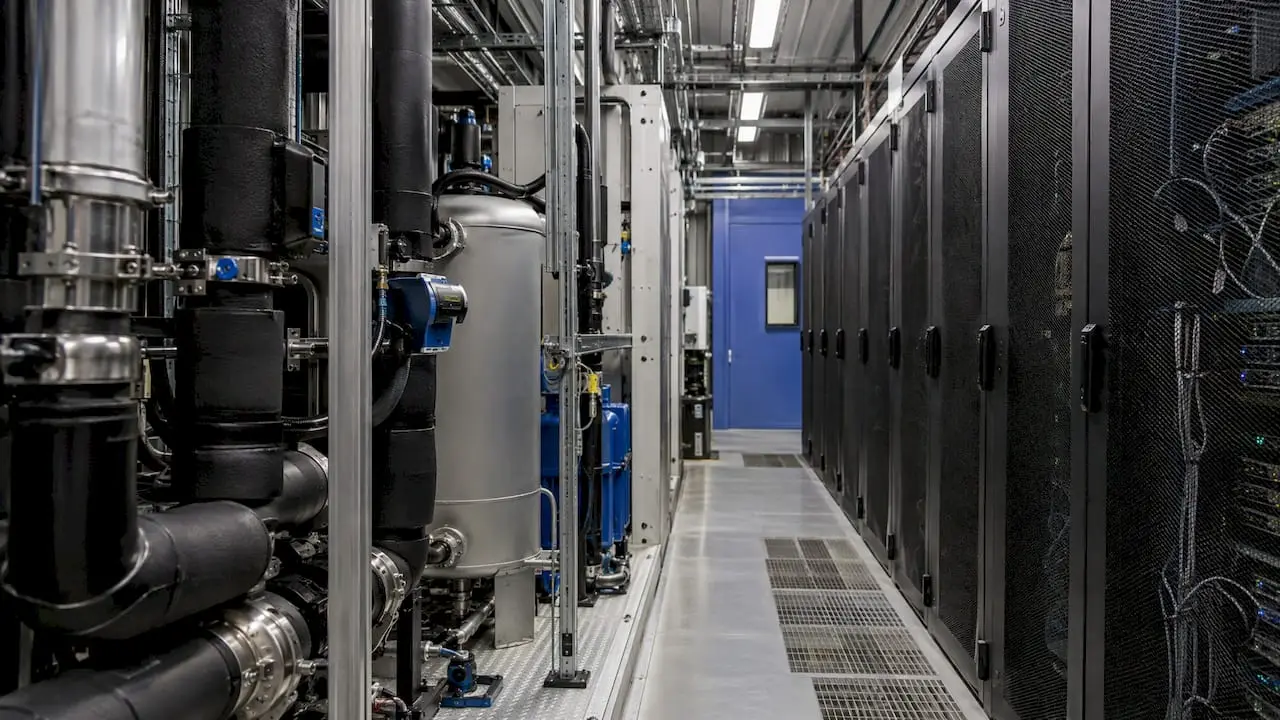
- Cooling. Anything from air-based systems to liquid and hybrid designs. SovereignOne uses advanced liquid and hybrid cooling.
- Monitoring and controls. Environmental sensing, alarms and management interfaces.
- Physical security and fire protection. Locking enclosures and suppression built into the shell.
DatacenterDynamics reports that a containerized data center can contain the same HVAC equipment a traditional data center would use, and that it is secure and able to handle dense loads. The container is a different way to package a data center, not a lesser one.
SovereignOne integrates its units from established hardware platforms. That has a practical benefit once the unit is running: your own staff can maintain and operate it using vendor equipment they already know, without learning a new platform.
Why deployment takes months, not years
The time saving comes from removing steps from the critical path.
In a traditional build, design, permitting, site work, construction, mechanical and electrical installation, and commissioning happen largely in sequence on the site. Each depends on the one before it, and each is exposed to weather, labor availability and inspection schedules. The owner’s description of the typical range is 2 to 5 years from permitting to activation.
In a factory-built approach, the unit is assembled, integrated and tested while your site is being prepared. Both streams run in parallel. When the unit arrives, it is set on its pad, connected to power and network, and brought into service. SovereignOne’s modular units can go live within 4 to 6 months.
The independent literature points the same direction. A white paper on containerized power and cooling modules reports 60% faster deployment and first-cost savings of 13% or more against a traditional build-out of the same infrastructure, and savings of 30% or more where a traditional facility would have been overbuilt. That last point matters for planning: a modular approach lets you buy the capacity you need now and add units as demand grows, rather than building a large shell for a load that arrives years later.
Speed also helps where there is no time to wait. Disaster recovery, a new telecom site, a campus expansion or a government program with a fixed launch window all need compute that exists soon, not compute that is approved soon.
Power and water efficiency
Power usage effectiveness (PUE) is the standard yardstick. It divides the total power a facility uses by the power that reaches the IT equipment, so 1.0 would be a perfect score and lower is better.
The Lawrence Berkeley National Laboratory’s procurement guide for modular and container data centers reports an average PUE* of 1.16 for container units that require chilled water, and as low as 1.02 for second-generation units. The asterisk matters: the guide defines PUE* as the module’s total power plus the power used to produce any externally supplied chilled fluid, divided by IT power. When you compare vendors, ask each to state PUE on that same basis, so a unit that relies on a separate chiller plant is not flattered by leaving that plant out.
Cooling design is where most of the gain comes from. Mitsubishi Heavy Industries reports a containerized data center with immersion cooling for multi-access edge computing that reached a PUE below 1.07 in a proof of concept at its Yokohama Hardtech Hub. It also explains that in that system a heat pump chiller producing low-temperature chilled water is not required in principle, which it identifies as a significant contributor to the low figure.
SovereignOne’s units use advanced liquid and hybrid cooling, and the company reports a 30% reduction in power and water consumption. Because the cooling system is designed together with the enclosure and tested at the factory, the efficiency is built into the product rather than depending on how a site team assembles it.
The LBNL guide makes one more point worth using. It suggests that procurement specifications that explicitly require energy-efficiency attributes can push the market toward more efficient units while helping limit operating costs and installation time. If power consumption is a priority for your organization, write it into the requirements.
Site, power, cooling and network: what you need to provide
A container removes construction, not planning. The LBNL guide recommends that a specification cover the following, and it is a good template for any request for proposal.
1. Define the IT load
State your initial and future rack space, the IT power per rack, the maximum allowable inlet air temperature, the cooling air exit temperature, the airflow type and the power connections needed per rack. These numbers size everything else. Dense AI and GPU workloads need a very different per-rack figure than general business servers, so decide this first.
2. Choose the cooling approach
The LBNL guide ranks cooling types by energy efficiency, from most to least efficient: outside-air cooled, then tower chilled water, then a water-cooled chiller combined with tower chilled water, then an air-cooled chiller, and finally DX compressor cooling. Liquid and hybrid designs are built to push efficiency further for dense racks. Ask which approach the unit uses, what it needs from the site (water, a chilled loop, nothing) and what it does to water consumption.
3. Prepare the pad and the surroundings
The guide asks you to consider pad requirements, condensation management, emergency power-off functionality and the existing supporting infrastructure at the site. In practice that means a level, load-rated base, drainage, crane or delivery access, clearances for service, and a clear route for power and fiber.
4. Confirm power
This is where a modular approach pays off for many organizations. SovereignOne units are designed to run on existing power grids, so the project does not wait for new utility infrastructure. Confirm available capacity at the point of connection, the voltage and the backup arrangement during planning.
5. Plan the network path
The white paper cited above notes that connections can be costly when a module sits far from the internal data center. Place the unit close to your network entry point and your users, or your cabling and fiber run stays short.
6. Check local code and transport
The same white paper lists varying local code compliance and transport restrictions among the planning items. Involve your permitting office early, and confirm the route for delivery, including weight and size limits. Because a container is set on a pad rather than built as a structure, permitting is typically simpler than for a new building, but the requirements vary by jurisdiction, and that review is a step for your local authority, not the vendor. SovereignOne’s role is the unit itself and its deployment.
7. Plan for the outdoor environment
A unit sits outside, so the enclosure has to handle wind, rain, heat and cold. That is why the steel shell is engineered to carry environmental loads on its own, as noted earlier. Share your site’s climate conditions with the vendor so the cooling and enclosure are matched to them. Airflow containment, such as cold aisle containment, can also materially affect cooling efficiency, so ask how the interior is arranged.
Where containerized data centers fit
The format is strongest where compute needs to be close to the source of the data or the users, and where waiting years for a building is not acceptable.
- Edge compute. Place processing next to sensors, cameras, machines or patients, so latency stays low and less data crosses the wide-area network. The Mitsubishi proof of concept above was built for exactly this multi-access edge case.
- Government and defense. Agencies can place secure, self-contained capacity on their own land, on existing power.
- Healthcare. Hospitals can add on-site compute for imaging and records without building a new wing.
- Smart cities and municipalities. Traffic, public safety and utility data can be processed locally.
- Telecom. Capacity can be added at the network edge as demand shifts.
- Education and research. Universities can add campus compute in stages.
- Disaster recovery. A pre-tested unit can come online quickly when continuity is at stake.
- GPU and AI workloads. Dense racks with liquid cooling in a standardized enclosure.
All of these appear in SovereignOne’s list of supported workloads, along with hyperscale deployments built from multiple units.
How SovereignOne approaches it
If your goal is capacity that is live in months, on the power you already have, SovereignOne builds it as a finished unit. Each modular data center container is factory-built, integrated and tested, scales from 1 to 14 racks, and uses advanced liquid and hybrid cooling to cut power and water consumption by 30%. Because it is integrated from established hardware platforms, your team can run it with equipment it already knows.
For dense, GPU-driven workloads close to where data is produced, see our GPU edge facilities. To see how the whole approach fits together, from the 4 to 6 month timeline to the deployment and facility management options, start at the SovereignOne home page and tell us your rack count, power and site.
A short specification checklist
Use this when you write your requirements, whichever unit you choose.
- Racks now and later. The count you need today and the count you expect to need, so you can add units rather than rebuild.
- Power per rack. Average and peak, and the number of power connections.
- Temperature limits. Maximum inlet and exit temperatures.
- Cooling method and its inputs. What the site must supply, and the expected power and water use.
- PUE on a stated basis. Total module power plus any externally supplied chilled fluid, divided by IT power.
- Pad, access and clearances. Dimensions, load rating, drainage and crane access.
- Utility connection. Capacity at the connection point, voltage and backup.
- Network entry. Fiber route and the distance to your users or core network.
- Safety. Emergency power-off, fire suppression and physical access control.
- Operations. Which platforms your team already supports, and who handles maintenance.
FAQ
How long does it take to deploy a containerized data center?
SovereignOne’s modular units can go live within 4 to 6 months. A traditional data center build can take 2 to 5 years from permitting to activation. The time saved comes from factory integration and testing running in parallel with your site preparation.
How big is a containerized data center?
The enclosure is typically built to ISO shipping container dimensions, commonly 20 or 40 feet long and 8 feet wide, according to a structural engineering guide. SovereignOne units hold from 1 to 14 racks, and you can combine units when you need more.
Is a containerized data center the same as a modular data center?
Not exactly. A container is a product delivered in an ISO-style enclosure, while modular describes the method of building capacity from repeatable blocks, and a container can be one of those blocks, as DatacenterKnowledge explains. Many buyers use the terms together because a containerized unit is the usual starting module.
Does it need new power infrastructure?
SovereignOne’s units are designed to run on existing power grids, so you can avoid building new infrastructure. Confirm the capacity and voltage at your connection point during planning, so the unit is sized to what the site can deliver.
What workloads is it suited to?
Edge compute, disaster recovery, education, smart city, telecom, government and hyperscale workloads, as well as GPU-based processing placed close to the data source. The common thread is a need for compute near where the work happens, quickly and efficiently.
Sources
- An overview of containerized data centers and their benefits, TechTarget
- What Is a Modular Data Center? A DCK Guide, DatacenterKnowledge
- Skid-Based Modular Data Centers: Structural Design Guide
- Types of prefabricated modular data centers, DatacenterDynamics
- Deploying at speed with prefab data centers, DatacenterDynamics
- Containerized Power and Cooling Modules for Data Centers, white paper
- Modular/Container Data Centers Procurement Guide, Lawrence Berkeley National Laboratory
- Data Center Power Savings to Achieve Carbon Neutrality, Mitsubishi Heavy Industries