
Modular data center disadvantages get very little airtime, because almost everyone writing about the category sells one. Here are seven conditions where a container is the wrong answer, from a manufacturer who would rather lose the enquiry than the customer.
If none of these apply to your site, modular is probably a good fit. If two or three do, read carefully before you spend anything.
1. You need heavy customisation
The economics of modular come from building a standard product in a factory. The moment a unit needs an unusual footprint, a bespoke internal layout or a non-standard service arrangement, you lose the cost and schedule advantages and keep the constraints. At that point a conventional fit-out of existing space is often cheaper and faster.
This is the most common of the modular data center disadvantages, and it tends to surface halfway through a quote cycle rather than at the start.
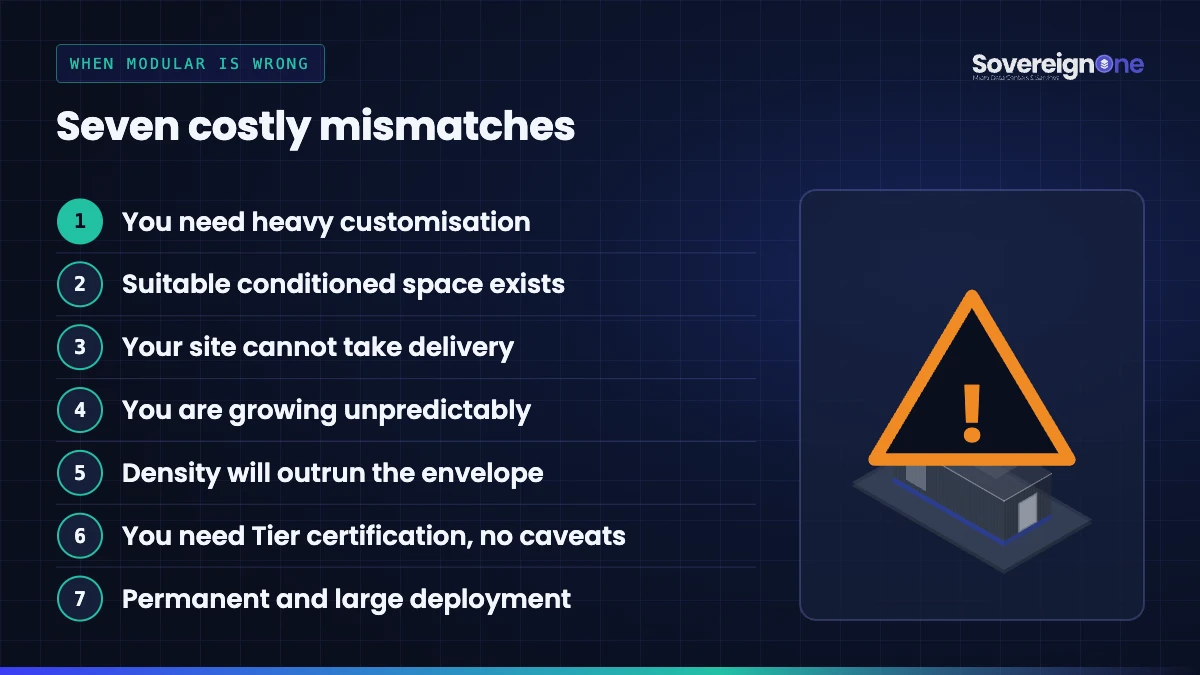
2. You already have suitable conditioned space
If you have a room with power, cooling capacity and a floor that will take the load, a container parked outside is usually the more expensive option. Retrofitting existing space avoids the pad, the crane, the transport and the permitting conversation entirely.
3. Your site cannot physically take delivery
A unit that cannot reach the pad is not a data center. Narrow site roads, low overhead clearance, tight turning radii, soft ground and no crane standoff are all genuine blockers. Larger units compound each of these, which is one reason the 52 ft size is not always the right answer even when the capacity figure says it is.
4. You are growing unpredictably
Modular scales in steps, not slopes. If your load grows smoothly and continuously, you will spend a lot of time either paying for capacity you are not using or waiting for the next unit. A facility with room to add racks incrementally handles that pattern better.
5. Your density will outrun the envelope
Rack power has climbed steeply and continues to. A unit specified for today’s density may not host hardware two generations out, and the enclosure outlives the IT inside it by years. Among the modular data center disadvantages this is the hardest to plan around, because the answer depends on roadmaps nobody controls.
Ask any manufacturer, including us, what density headroom the design actually has. Treat a vague answer as a no.
6. You need a Tier-certified facility with no caveats
Modular designs can be certified, and the Uptime Institute TIER-Ready programme exists specifically for prefabricated and modular products. But if your requirement names a certification the product does not hold, the gap is real and no amount of explanation closes it. Check the certificate rather than the claim.
7. The deployment is genuinely permanent and large
Above a few megawatts on a site you will hold for decades, the advantages that make modular compelling at small scale thin out. Relocatability stops mattering. The schedule advantage narrows as unit count rises. At that point you are comparing construction methods rather than categories, and conventional construction may win.
What the modular data center disadvantages have in common
Six of the seven are site or requirement conditions rather than product faults. That is the useful way to read this list: modular is a deployment model with a fit envelope, and most bad outcomes come from forcing a project outside that envelope rather than from the units themselves.
The two questions that catch most mismatches early are whether the site can take delivery, and whether the requirement is standard enough to buy a standard product. Our guide to sub-megawatt costs covers the scope boundary that surfaces the second one.
Frequently asked questions
What are the main modular data center disadvantages?
Limited customisation, step-wise rather than continuous scaling, physical delivery constraints, uncertain density headroom over time, and diminishing advantages at large permanent scale. Most are conditions of fit rather than product defects.
When is a modular data center the wrong choice?
When you need heavy customisation, when you already have suitable conditioned space, when the site cannot take delivery, when load grows smoothly rather than in steps, or when the deployment is large and genuinely permanent.
Can a site be too small for a modular data center?
Rarely too small in capacity terms, since units start at a single rack. The limiting factor is almost always access: road width, overhead clearance, turning radius, ground bearing and crane standoff.
Do modular data centers become obsolete faster?
The enclosure typically outlives the IT inside it by years. The risk is that rising rack density outruns the power and cooling the envelope was specified for. Ask what density headroom the design has before ordering.
Is modular always cheaper than building?
No. Modular is frequently cost-competitive, and its advantages are schedule, power flexibility and relocatability rather than headline price. At large permanent scale conventional construction can be the better answer.
How do I know if my requirement is standard enough?
If your specification can be met by a product in a manufacturer’s existing range without structural changes, it is standard. If it needs a bespoke footprint or internal layout, you are buying custom engineering and should price it as such.
Where to go next
If none of these seven conditions apply, the container line runs from 7 ft to 52 ft. If one or two do, tell us about the site and we will say plainly whether it is a fit.