
Every published modular data center cost figure is quoted per megawatt. JLL put global construction costs near $11.3 million per MW for 2026, and the Cushman & Wakefield development cost guide runs about 21% above its previous edition. Vendor guides, analyst notes and procurement benchmarks all use the same unit.
If you need one rack, or five, that number is worse than useless. It will make your project look far more expensive than it is.
Why modular data center cost per MW breaks below a megawatt
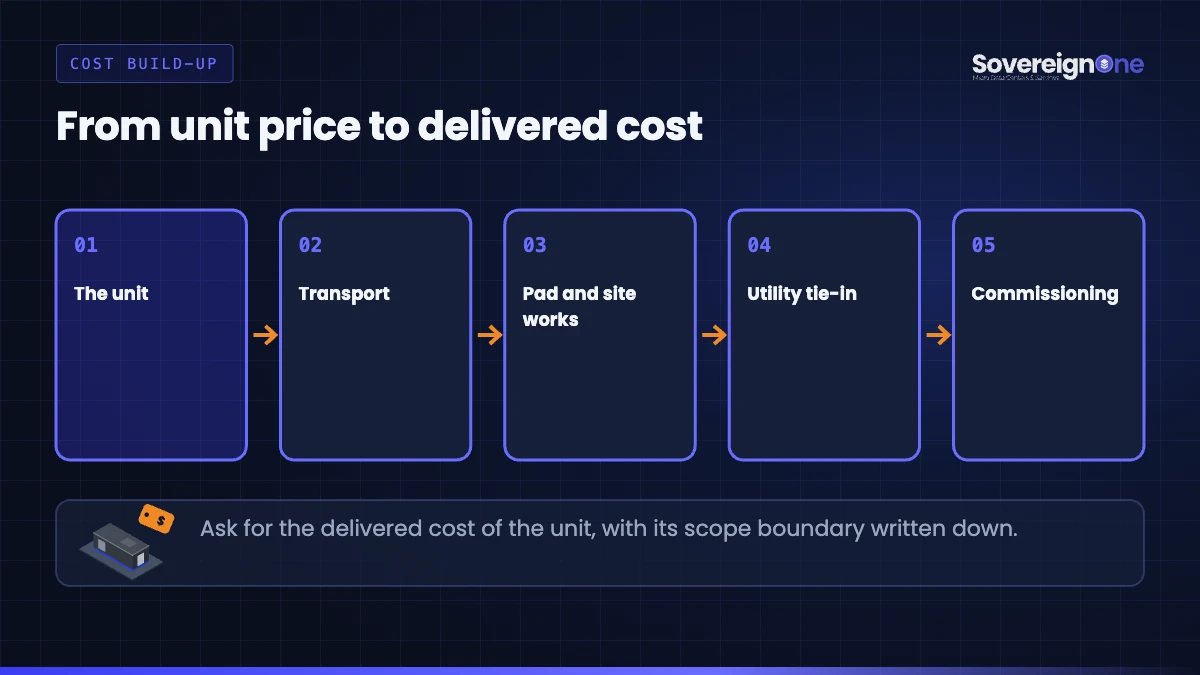
Cost per MW works when the costs it averages actually scale with capacity. At hyperscale they mostly do. Below about a megawatt, a large share stops scaling. These cost roughly the same whether the unit holds one rack or fourteen:
- Transport. A truck and a crane cost what they cost, whether they carry a 7 ft unit or a 40 ft one.
- The pad and site works. Mobilising a contractor, pouring concrete and running conduit has a floor price well above zero.
- The utility tie-in. Trenching 200 feet costs the same regardless of what sits at the end of it.
- Commissioning. Factory and site acceptance testing are procedures, not quantities.
- Design and engineering, which is largely fixed for a standard product.
Divide fixed costs by a small denominator and the per-MW figure inflates sharply. A single-rack deployment can show a modular data center cost several times the hyperscale benchmark while being, in absolute terms, a modest purchase. The number is arithmetically correct and practically meaningless.
This also explains why published figures disagree so wildly. Public sources span roughly $4.4 million to $30 million per MW for things all described as modular. That sevenfold spread is mostly disagreement about where the scope boundary sits and how big the denominator was.

What should you ask for instead?
Three numbers, for a sub-megawatt deployment:
- The delivered cost of the unit, with its scope boundary written down.
- The site works cost, separately, because it varies most by site.
- The modular data center cost per rack at your configuration, which is what makes two unlike proposals comparable.
Cost per rack stays roughly stable across the range at a given density, so it lets you compare a 2-rack and a 10-rack proposal honestly.
Where the money hides in a quote
Two quotes can differ by a factor of two and both be honest, because they drew the line in different places. Before comparing anything, establish for each quote whether these are in or out.
| Item | Usually included | Usually excluded |
|---|---|---|
| Enclosure, racks, internal distribution | Yes | |
| Cooling plant | Usually | External condensers sometimes separate |
| UPS | Sometimes | Often a line item |
| Switchgear and transformer | Rarely | Usually excluded |
| Generator and transfer switch | Rarely | Usually excluded |
| Foundation and pad | No | Nearly always site works |
| Crane and rigging | Sometimes | Often excluded |
| Utility tie-in labour | No | Nearly always excluded |
| Shipping | Varies | Varies |
| Acceptance testing | Varies | Varies |
| IT hardware | No | Almost always separate |
The transformer and the generator cause the most trouble, because they are large, they have long lead times, and a quote that leaves them out looks dramatically cheaper than one that includes them.
Three assumptions that move the price more than the box does
Design ambient temperature. A unit specified for a 95F design day and one specified for 110F are different machines with different cooling plant. Two vendors assuming different design ambients have not produced comparable quotes, and neither is wrong. Ask what each assumed.
Rack density. The kW per rack you expect decides whether air cooling is enough or liquid is required, and that is a step change in modular data center cost rather than a slope. Give your peak as well as your average.
Redundancy. N, N+1 and 2N are three different prices. At small scale 2N is disproportionately expensive, because you duplicate fixed plant across a small load.
Is modular cheaper than a traditional build?
Frequently it is not, and anyone saying otherwise without qualification is selling. Modular changes where the cost and the risk sit:
- Schedule. Factory build runs in parallel with site works rather than after them.
- Power. A unit sized to a site’s existing service avoids the interconnection queue. US projects under 20 MW reach operational status at a far higher rate than large ones, and most interconnection requests filed between 2000 and 2019 were withdrawn rather than built.
- Long-lead equipment. Transformers and switchgear have been quoted in years. Integrated plant routes around that queue.
- Relocatability. A building is a stranded asset when the workload moves. A container is freight.
Against that, customisation is bounded by what the manufacturer builds, and a unit specified for today’s rack density may not host two hardware generations from now.
Frequently asked questions
How much does a modular data center cost per rack?
It depends on density, redundancy, cooling approach and how much site work is in scope, which is why a credible answer arrives with its boundary conditions attached rather than as a single figure. Ask any vendor for cost per rack at your stated density and redundancy.
Why are published modular data center costs so inconsistent?
Public figures span roughly $4.4 million to $30 million per MW. Most of that spread is scope and denominator rather than real disagreement. Some figures include site works and utility connection and some do not, and some divide fixed costs by very small capacity.
Is a modular data center cheaper than a traditional build?
Not automatically. Modular is frequently cost-competitive, and its real advantages are schedule, power flexibility and relocatability rather than headline price per megawatt.
What is usually excluded from a modular data center quote?
Most often the transformer and switchgear, the generator and transfer switch, the foundation and pad, utility tie-in labour, and IT hardware. Crane, rigging, shipping and acceptance testing vary by vendor.
Does cost per MW ever make sense for a small deployment?
Only when comparing small deployments with identical scope boundaries. Comparing a two-rack unit against a hyperscale per-MW benchmark will always make the small deployment look expensive, because the fixed costs have nowhere to spread.
What is a reasonable modular data center cost for a single container?
Ask for a delivered unit price plus a separate site works estimate rather than a per-MW figure. The delivered price depends mainly on rack count, density, cooling method and redundancy level.
Where to go next
The container line runs from 7 ft to 52 ft, which is one rack to fourteen, so the scope conversation starts with what you need rather than with a megawatt. Permitting and site works sit outside most quotes, and our piece on whether a containerized unit counts as a building covers why that matters. If you want the scope boundary settled against a real site, tell us about it.