
A campus modular data center adds research and teaching capacity without waiting on a new building, and without displacing a machine room that is already full.
An award runs three to five years. A campus building runs longer than that before it opens, and competes with every other capital priority the institution has.
Shared cluster capacity for computational research groups.
Accelerator capacity for coursework and student projects.
Institutional systems hosted on campus premises.
Compute at a remote research site, away from the main campus.
Most campus machine rooms were sized before dense GPU computing arrived, and a new building is a multi-year capital project. A campus modular data center arrives as its own facility and is sited on existing power.
Lengths shown are indicative. The configuration for any site is set during the survey, against the actual load, the power available and the conditions on site.
Research computing grows in steps set by grants and intake rather than by construction schedules. A campus modular data center lets a university add a known block of capacity against a known timeline, which is far easier to write into a funding bid than a share of a building that does not exist yet.
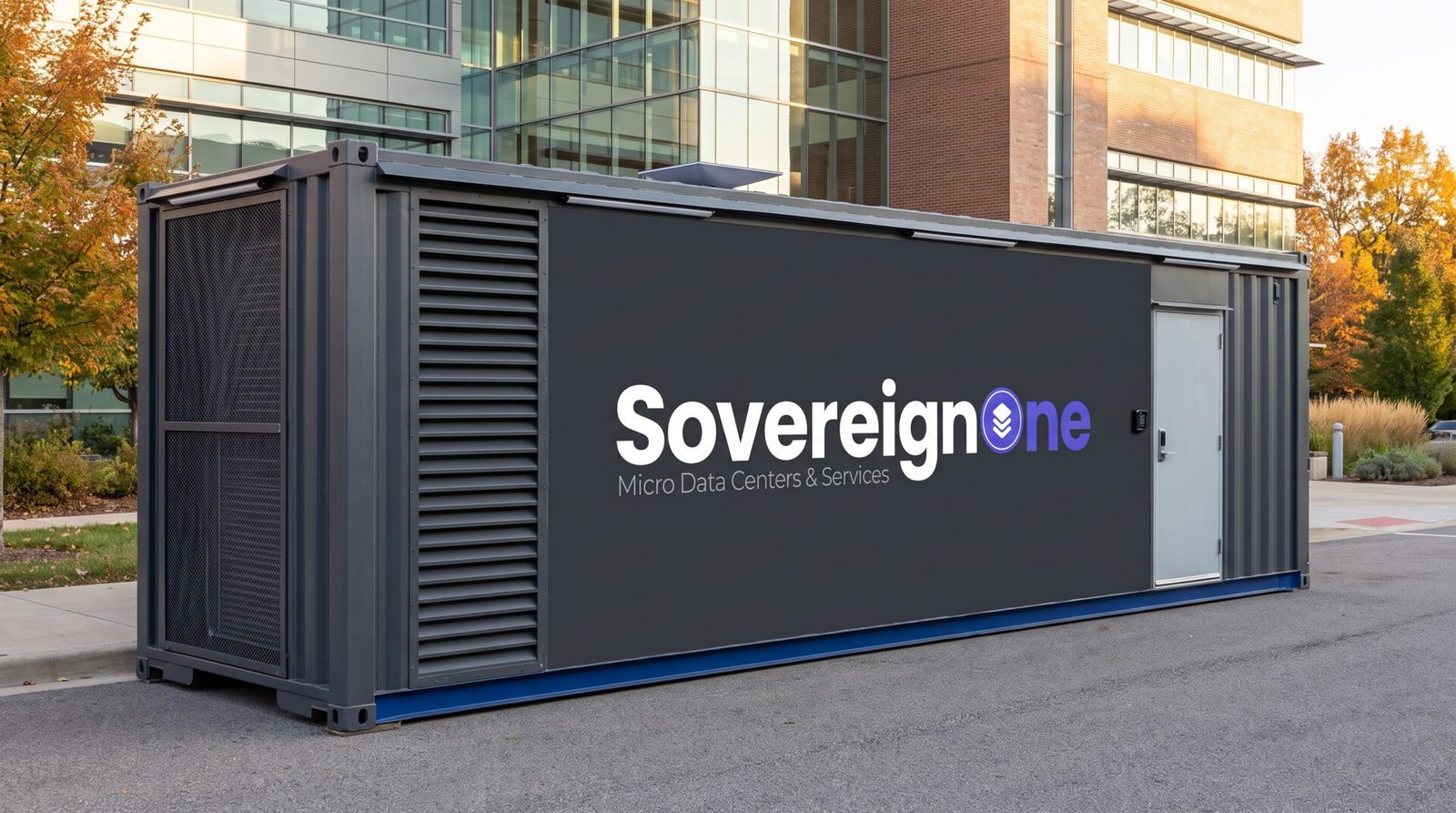
The five lengths cover a wide range of campus research deployments without changing the underlying design: 7 ft with a single rack at a nominal 125 kW, 12 ft with two racks at 250 kW, 20 ft with five racks at 625 kW, 40 ft with ten racks at 1.25 MW, and 52 ft with fourteen racks at 1.75 MW. Every length shares the same cooling, power and security design, so an engineering review completed for one unit holds for the next.
Siting is a question of power and ground rather than construction. A conventional build runs two to five years from permit to energised; a SovereignOne unit runs four to six months from survey to live load. For campus research, that is the difference between capacity arriving inside the planning cycle and arriving after it.
Cooling is where most of the saving sits. The design reduces power and water used for cooling by 30% against a conventional air-cooled hall. On constrained sites, available utility capacity rather than floor space is usually what limits a campus research deployment, so that reduction often decides whether a site can host the load at all.
Operationally the unit behaves like any other facility on the site. It presents standard power and network interfaces, it is monitored the same way, and spares follow the original vendors’ support channels rather than a bespoke supply chain. Nothing inside the enclosure is unique to SovereignOne, which keeps sustainment of a campus modular data center ordinary.
The same enclosure supports GPU clusters for research, high performance computing, teaching and lab environments, institutional data platforms, and the storage that long-running research projects accumulate and must keep on site.
Capacity is added the same way it was installed. A second unit is specified against the same design, set beside the first and joined into one continuous white space, so growth stays a procurement decision rather than a new construction project, and the site keeps a single operating model as it scales.
Each unit is integrated from established platforms — CDW, Vertiv, Penguin Solutions, Motivair, Dell, Supermicro, Connected Power, NVIDIA — rather than bespoke hardware. SovereignOne is a Liberation Technology Services company, and Liberation Technology Services Inc. is a WEXMAC prime contract holder.
A campus modular data center is not only a cost line on a facilities budget. Once an institution owns the capacity outright, it can be put to work in several directions at once.
Capacity an institution is not using is capacity it can sell. Research hosting for partner institutions, sponsored compute for industry projects, and colocation for local organisations all run on the same unit, so the investment earns against itself rather than sitting idle between grant cycles.
Computing, networking and facilities programmes are usually taught against diagrams or a cloud tenancy nobody is allowed to look inside. A unit on campus is real infrastructure — racks, cooling, power distribution and the operating practices around them — that students can be taught on and assessed against.
GPU clusters are dense, and most university machine rooms were sized for a previous generation of equipment. A campus modular data center takes that load without rebuilding the existing facility, which is what lets an institution stand up AI research and teaching capability on its own terms rather than renting it.
The same approach carries into emerging markets. A unit sited at a school or a regional education hub keeps course content, lecture video and assessment systems local, so e-learning does not depend on a link that was never sized to carry it. Delivery is governed by what is on site rather than by the quality of the connection back to a distant region.
Yes. Capacity beyond the institution’s own use can be offered to others, which turns a capital asset into something that earns against its own cost.
Yes. The same capacity serves as a teaching environment as well as production compute, so the hardware is not idle between research workloads.
It puts AI-capable compute on campus rather than renting it elsewhere, which matters when the dataset is one the institution would rather not move.
Yes — for bringing e-learning capacity to schools where the infrastructure needed to reach a central facility does not exist.
Send the site, the load and the timeline. We will come back with a length, a power plan and a delivery window.