
A smart city data center processes traffic, transit and camera data in the district that produces it, instead of backhauling every stream to a central site that has to be sized for all of them at once.
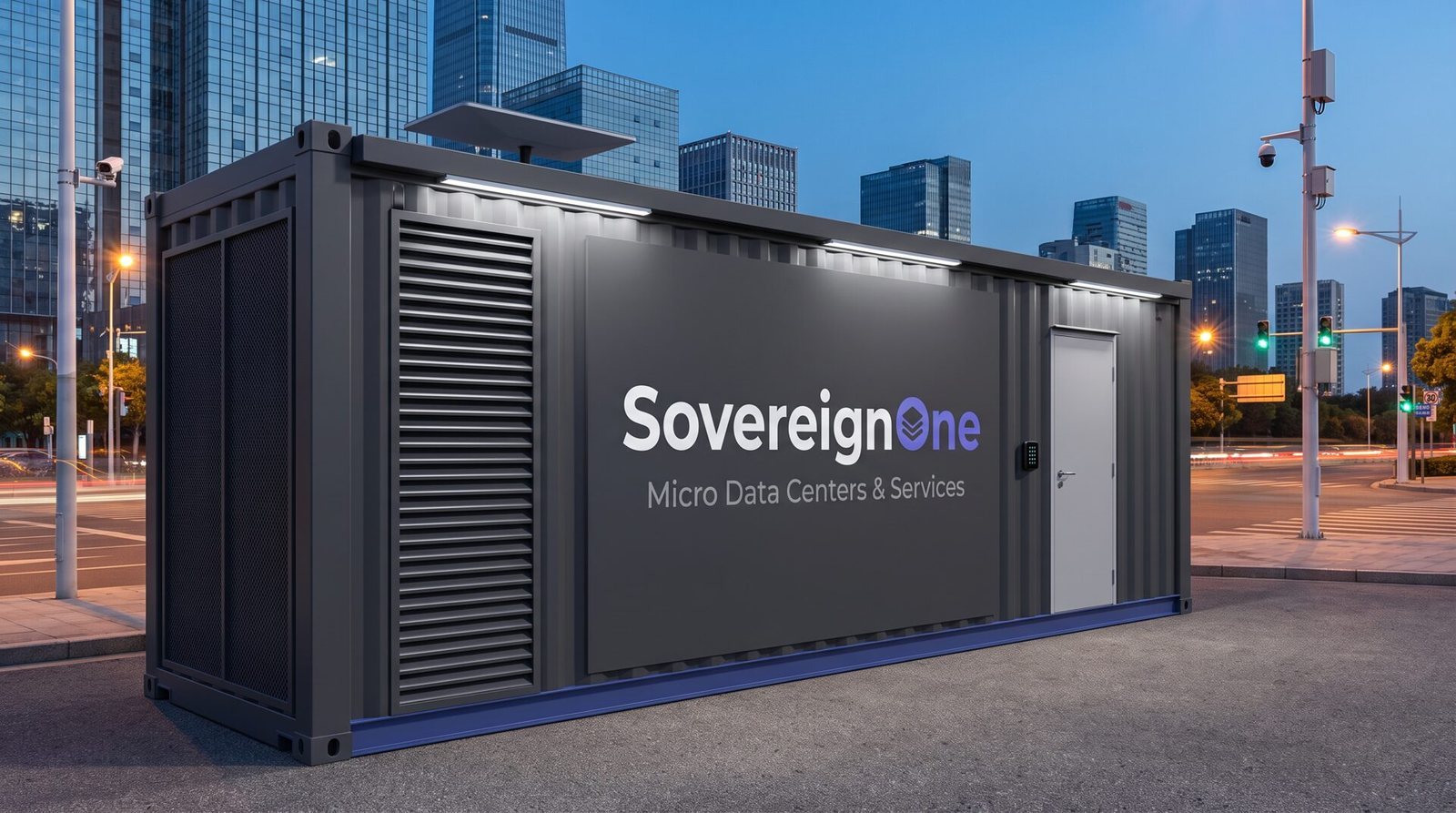
A corridor can carry hundreds of camera and sensor feeds. Backhauling all of it to a municipal data centre costs bandwidth the city does not have and adds latency the signal controller cannot absorb.
Adaptive control across an instrumented corridor.
Camera analytics processed locally, with events forwarded.
Air, noise and flood sensing aggregated at the district.
Roadside compute for V2X messaging and safety applications.
Cities rarely have spare buildings in the places where the data is densest. A smart city data center arrives as its own facility and can be sited at a depot, a substation yard or a municipal lot on existing power.
Lengths shown are indicative. The configuration for any site is set during the survey, against the actual load, the power available and the conditions on site.
Video is the workload that decides the architecture. Moving every camera stream to one central facility is expensive and fragile, and it puts latency in front of decisions that are supposed to be immediate. A smart city data center keeps analysis near the cameras and sends results rather than raw footage, which reduces both transport cost and the amount of personal data in transit.
The five lengths cover a wide range of smart city deployments without changing the underlying design: 7 ft with a single rack at a nominal 125 kW, 12 ft with two racks at 250 kW, 20 ft with five racks at 625 kW, 40 ft with ten racks at 1.25 MW, and 52 ft with fourteen racks at 1.75 MW. Every length shares the same cooling, power and security design, so an engineering review completed for one unit holds for the next.
Siting is a question of power and ground rather than construction. A conventional build runs two to five years from permit to energised; a SovereignOne unit runs four to six months from survey to live load. For smart city, that is the difference between capacity arriving inside the planning cycle and arriving after it.
Cooling is where most of the saving sits. The design reduces power and water used for cooling by 30% against a conventional air-cooled hall. On constrained sites, available utility capacity rather than floor space is usually what limits a smart city deployment, so that reduction often decides whether a site can host the load at all.
Operationally the unit behaves like any other facility on the site. It presents standard power and network interfaces, it is monitored the same way, and spares follow the original vendors’ support channels rather than a bespoke supply chain. Nothing inside the enclosure is unique to SovereignOne, which keeps sustainment of a smart city data center ordinary.
The same enclosure supports traffic signal optimisation and incident detection, transit and fleet operations, utility and metering analytics, public safety video, and the environmental and infrastructure monitoring a city runs continuously.
Capacity is added the same way it was installed. A second unit is specified against the same design, set beside the first and joined into one continuous white space, so growth stays a procurement decision rather than a new construction project, and the site keeps a single operating model as it scales.
Each unit is integrated from established platforms — CDW, Vertiv, Penguin Solutions, Motivair, Dell, Supermicro, Connected Power, NVIDIA — rather than bespoke hardware. SovereignOne is a Liberation Technology Services company, and Liberation Technology Services Inc. is a WEXMAC prime contract holder.
A smart city programme is a sensing problem before it is a software problem. Cameras, signals, meters, transit and environmental sensors all produce continuously, and the architecture that decides whether any of it is useful is simply where the processing happens.
Devices across a district generate small messages constantly and expect an answer quickly. Backhauling all of it to a central facility adds delay to every exchange and makes the whole estate dependent on one link. A smart city data center sited in the district keeps that loop local, so the response time a connected device sees is governed by the network inside the district rather than the path out of it.
Inference is the workload that decides the economics. Running models next to the cameras and sensors means the network carries detections and decisions rather than continuous raw video, which cuts transport cost, reduces how much personal data moves across the city’s network at all, and keeps analysis running when the link to a central site is degraded.
Siting follows the city’s own estate — a depot, a substation yard, a municipal lot — because the unit arrives as its own facility and needs ground and power rather than a building.
Because IoT and edge AI inferencing respond to events as they happen, and a round trip to a distant facility is time the system does not have.
Yes. It is general compute sited close to the sensors, not a single-purpose appliance, so new workloads can be added without new hardware.
Yes, by adding units as coverage grows, which keeps the first deployment small enough to fund and prove.
Send the site, the load and the timeline. We will come back with a length, a power plan and a delivery window.