
A healthcare modular data center puts imaging and clinical compute on the hospital campus, where the studies are produced and where clinicians need them back without waiting on a link to somewhere else.
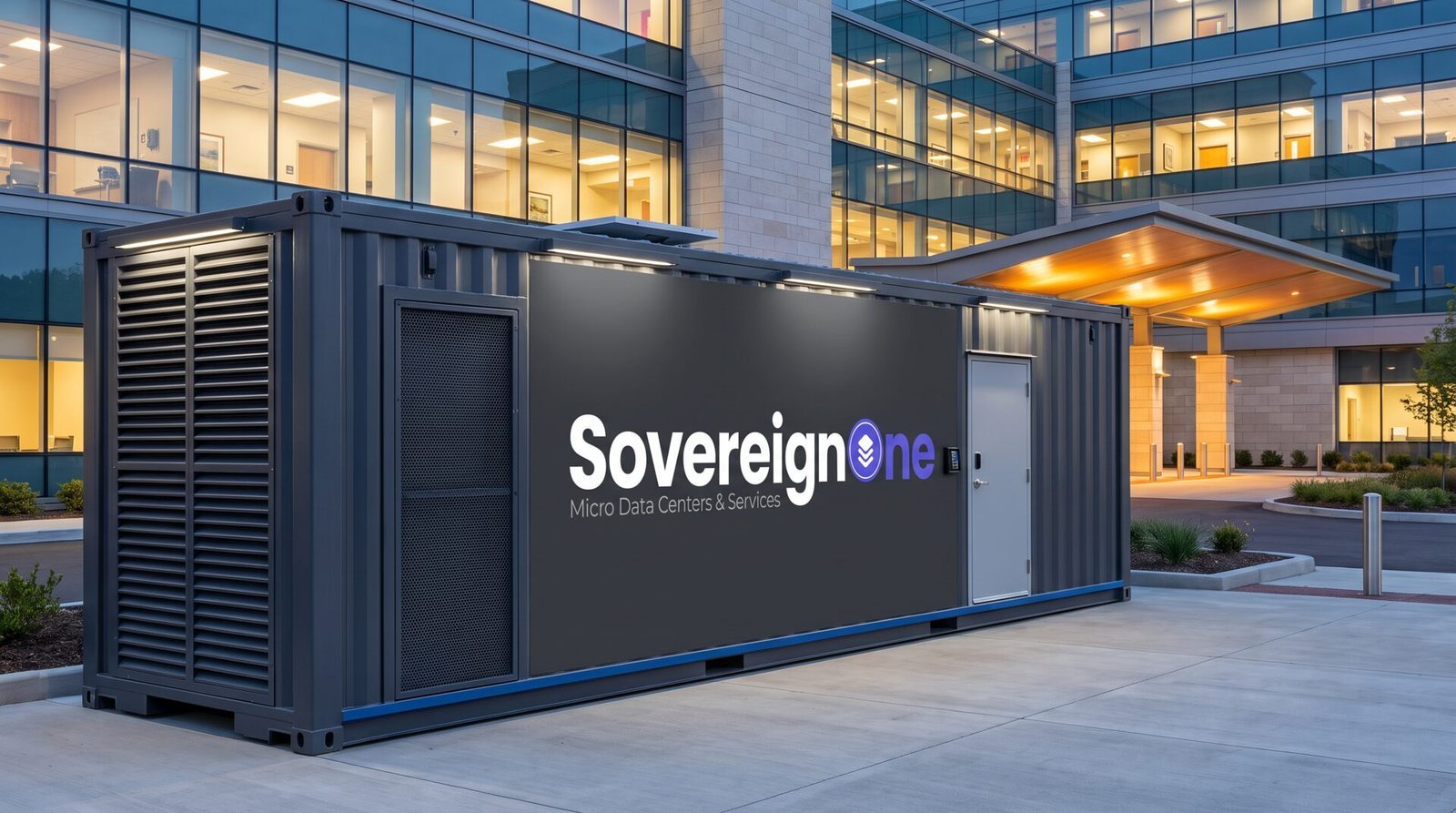
A single study can run to gigabytes, and a department generates them all day. Moving that volume off site is slow, expensive and drags every byte into another jurisdiction’s compliance surface.
Study processing and archive capacity beside the modalities.
Inference on imaging and pathology without sending studies off site.
Clinical systems hosted on the provider’s own premises.
Capacity at a site with no realistic link back to a main hospital.
Hospital campuses are short on floor space and long on constraints, and a construction programme beside a working ward is rarely welcome. A healthcare modular data center arrives as its own facility and is sited on existing power.
Lengths shown are indicative. The configuration for any site is set during the survey, against the actual load, the power available and the conditions on site.
Imaging is the workload that strains most hospital infrastructure: studies are large, they are produced continuously, and they are read under time pressure. A healthcare modular data center keeps reconstruction, archival and AI-assisted reading on campus, so turnaround is set by the clinical workflow rather than by a wide-area link.
The five lengths cover a wide range of healthcare deployments without changing the underlying design: 7 ft with a single rack at a nominal 125 kW, 12 ft with two racks at 250 kW, 20 ft with five racks at 625 kW, 40 ft with ten racks at 1.25 MW, and 52 ft with fourteen racks at 1.75 MW. Every length shares the same cooling, power and security design, so an engineering review completed for one unit holds for the next.
Siting is a question of power and ground rather than construction. A conventional build runs two to five years from permit to energised; a SovereignOne unit runs four to six months from survey to live load. For healthcare, that is the difference between capacity arriving inside the planning cycle and arriving after it.
Cooling is where most of the saving sits. The design reduces power and water used for cooling by 30% against a conventional air-cooled hall. On constrained sites, available utility capacity rather than floor space is usually what limits a healthcare deployment, so that reduction often decides whether a site can host the load at all.
Operationally the unit behaves like any other facility on the site. It presents standard power and network interfaces, it is monitored the same way, and spares follow the original vendors’ support channels rather than a bespoke supply chain. Nothing inside the enclosure is unique to SovereignOne, which keeps sustainment of a healthcare modular data center ordinary.
The same enclosure supports PACS and imaging archives, reconstruction and AI-assisted reading, electronic record and clinical system workloads, research and genomics compute, and the systems a site has decided to keep on its own premises.
Capacity is added the same way it was installed. A second unit is specified against the same design, set beside the first and joined into one continuous white space, so growth stays a procurement decision rather than a new construction project, and the site keeps a single operating model as it scales.
Each unit is integrated from established platforms — CDW, Vertiv, Penguin Solutions, Motivair, Dell, Supermicro, Connected Power, NVIDIA — rather than bespoke hardware. SovereignOne is a Liberation Technology Services company, and Liberation Technology Services Inc. is a WEXMAC prime contract holder.
Most hospital machine rooms were sized before current imaging volumes and AI-assisted tooling existed. The usual remedy is to renovate or to build, and both are expensive, slow and disruptive to run next to a working ward. A healthcare modular data center adds the capability as its own facility on the campus, energised from the power already there, so clinical capacity stops waiting on a construction programme.
Imaging is what strains hospital infrastructure hardest: studies are large, produced continuously and read under time pressure. Keeping reconstruction, archival and AI-assisted reading on campus means turnaround is governed by the clinical workflow rather than by a wide-area link, and higher-resolution or higher-volume protocols become practical without renegotiating bandwidth first.
Where data lives changes what happens on a bad day. Holding a copy on infrastructure the organisation physically controls, under separate administration from its primary systems, gives it somewhere to recover from if a production environment or a hosted tenancy is encrypted, corrupted or made unavailable by a malicious actor. Distributing data across more than one place, rather than concentrating it in a single system, is what makes that recovery path exist.
This is an architectural point rather than a security product: the unit provides the separate, physically controlled location. How it is segmented, monitored and access-controlled is set with the hospital’s own security team.
No. The unit is sited outside and commissioned there, so capacity is added without a construction project inside an operating building.
Yes — imaging data is processed on site rather than moved to a distant facility first, which removes the transfer from the critical path.
Decentralising storage and processing across units means no single location holds everything, so one compromised or lost site does not take the whole estate with it.
Yes. A unit can be configured and deployed to meet HIPAA requirements, and SOC 2 and ISO 27001 are addressed for each individual deployment rather than carried as a blanket product certification. Which controls apply depends on the workload and the environment the unit lands in, so they are agreed as part of the deployment rather than assumed.
Send the site, the load and the timeline. We will come back with a length, a power plan and a delivery window.