
A sovereign cloud data center keeps workloads on hardware you own, on ground you control, rather than in a shared region operated by someone else under terms you do not set.
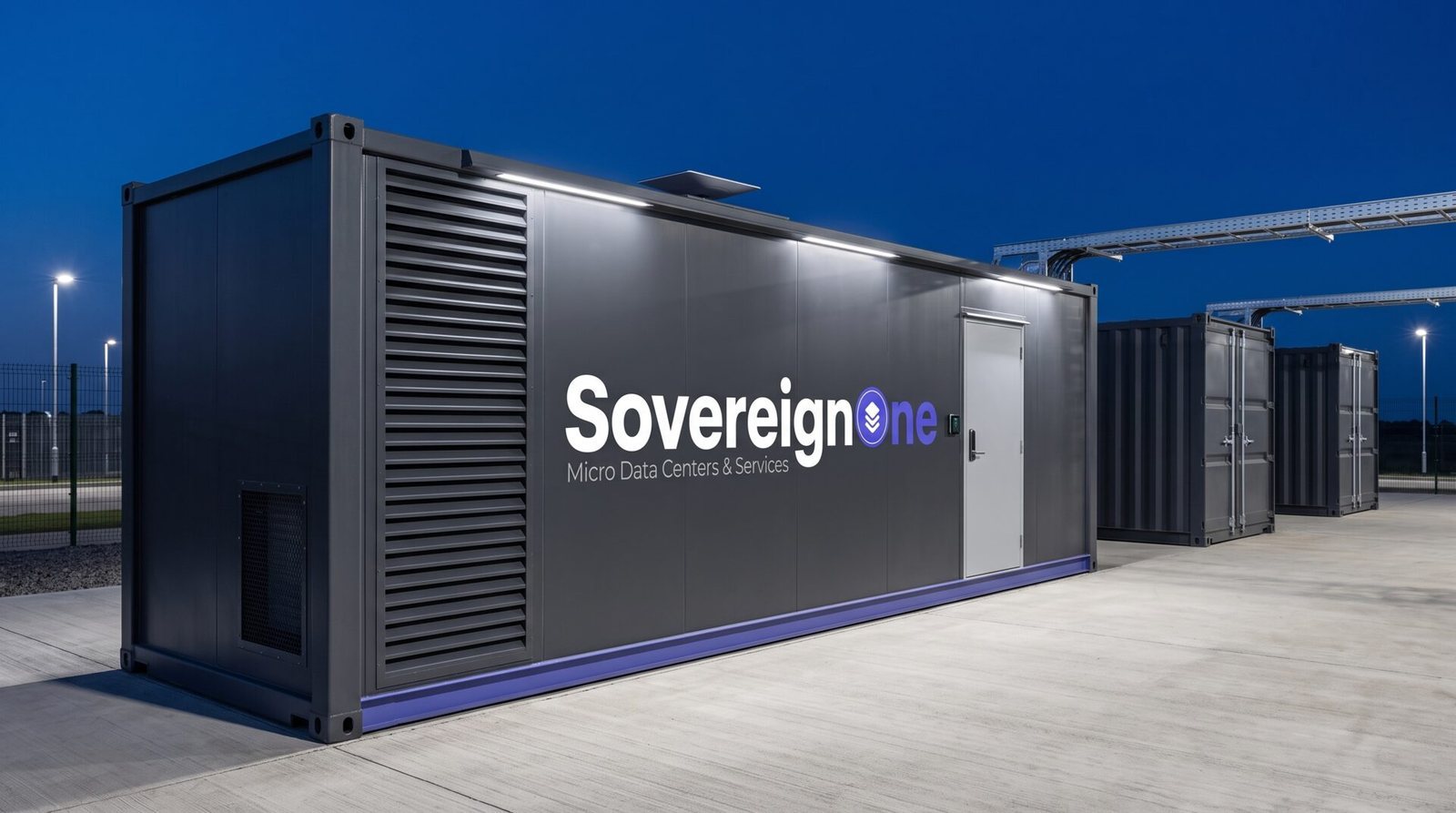
Regulated workloads increasingly require proof of where data physically sits, who can compel access to it, and which legal regime governs the operator. Hyperscale regions answer none of those cleanly.
Citizen or health records that cannot leave the country.
Processing under residency and audit obligations.
Model training and inference inside the jurisdiction.
A second site in-country rather than a foreign region.
Sovereignty is decided by where the hardware sits and who holds the keys to the room. A sovereign cloud data center arrives as its own facility and is sited wherever that answer needs to be.
Lengths shown are indicative. The configuration for any site is set during the survey, against the actual load, the power available and the conditions on site.
The questions behind sovereign cloud are ownership and location: who operates the hardware, where it physically sits, and who can reach it. A sovereign cloud data center answers all three by putting the infrastructure on a site you choose, under your own access control, with no dependency on a provider’s regional footprint.
The five lengths cover a wide range of sovereign cloud deployments without changing the underlying design: 7 ft with a single rack at a nominal 125 kW, 12 ft with two racks at 250 kW, 20 ft with five racks at 625 kW, 40 ft with ten racks at 1.25 MW, and 52 ft with fourteen racks at 1.75 MW. Every length shares the same cooling, power and security design, so an engineering review completed for one unit holds for the next.
Siting is a question of power and ground rather than construction. A conventional build runs two to five years from permit to energised; a SovereignOne unit runs four to six months from survey to live load. For sovereign cloud, that is the difference between capacity arriving inside the planning cycle and arriving after it.
Cooling is where most of the saving sits. The design reduces power and water used for cooling by 30% against a conventional air-cooled hall. On constrained sites, available utility capacity rather than floor space is usually what limits a sovereign cloud deployment, so that reduction often decides whether a site can host the load at all.
Operationally the unit behaves like any other facility on the site. It presents standard power and network interfaces, it is monitored the same way, and spares follow the original vendors’ support channels rather than a bespoke supply chain. Nothing inside the enclosure is unique to SovereignOne, which keeps sustainment of a sovereign cloud data center ordinary.
The same enclosure supports private cloud and virtualisation platforms, data platforms and analytics, AI training and inference on retained data, and the workloads an organisation has decided should not leave its own premises.
Capacity is added the same way it was installed. A second unit is specified against the same design, set beside the first and joined into one continuous white space, so growth stays a procurement decision rather than a new construction project, and the site keeps a single operating model as it scales.
Each unit is integrated from established platforms — CDW, Vertiv, Penguin Solutions, Motivair, Dell, Supermicro, Connected Power, NVIDIA — rather than bespoke hardware. SovereignOne is a Liberation Technology Services company, and Liberation Technology Services Inc. is a WEXMAC prime contract holder.
Repatriation is rarely about disliking the cloud. It is about cost that scales the wrong way, terms set by someone else, and data sitting in a region an organisation cannot point to on a map. A sovereign cloud data center gives companies and governments somewhere to bring those workloads back to that they own outright and site themselves.
Capacity is added in known increments rather than as an open-ended commitment. An organisation specifies the first unit against the workloads it is repatriating now, and adds the next against the same design when demand justifies it — so growth is a procurement decision with a fixed cost, not a bill that moves with consumption.
Where the constraint is existing infrastructure rather than ambition, the model works particularly well. A unit arrives as its own facility, runs on the power available at the site, and does not assume a purpose-built hall, a deep utility feed or a hyperscale region nearby. That makes it possible to start at the scale a market can actually support today.
And because every length shares the same cooling, power and security design, scaling later does not mean re-architecting. The second and third units are the same product as the first, joined into one continuous estate and operated under one model as demand grows.
The workloads run on hardware you own, on ground you control, rather than in a shared region operated by someone else under terms you do not set.
Yes. Repatriating workloads to capacity you own is the case this page describes, and the unit is sized to take them without a facility programme first.
That is the design intent — the unit deploys within the power and space a site already has, and scales by adding units as demand grows rather than by rebuilding.
SOC 2 and ISO 27001 are addressed for each individual deployment rather than carried as a blanket product certification. Because the unit sits on your site, inside your boundary, the control environment is partly yours — so the scope is agreed per deployment rather than inherited from a vendor’s certificate.
Any country, subject to United States export control. SovereignOne is a US company, so a deployment is possible wherever US Government export restrictions do not prohibit it — that is the boundary, rather than any limit on where a unit can physically operate. Where a deployment is permitted, the residency position is the same everywhere: the hardware is yours and it sits on ground you control.
Send the site, the load and the timeline. We will come back with a length, a power plan and a delivery window.