
An agriculture modular data center puts compute on the farm, at the elevator or beside the processing line, where imagery and sensor data are produced and where rural connectivity is least able to carry them.
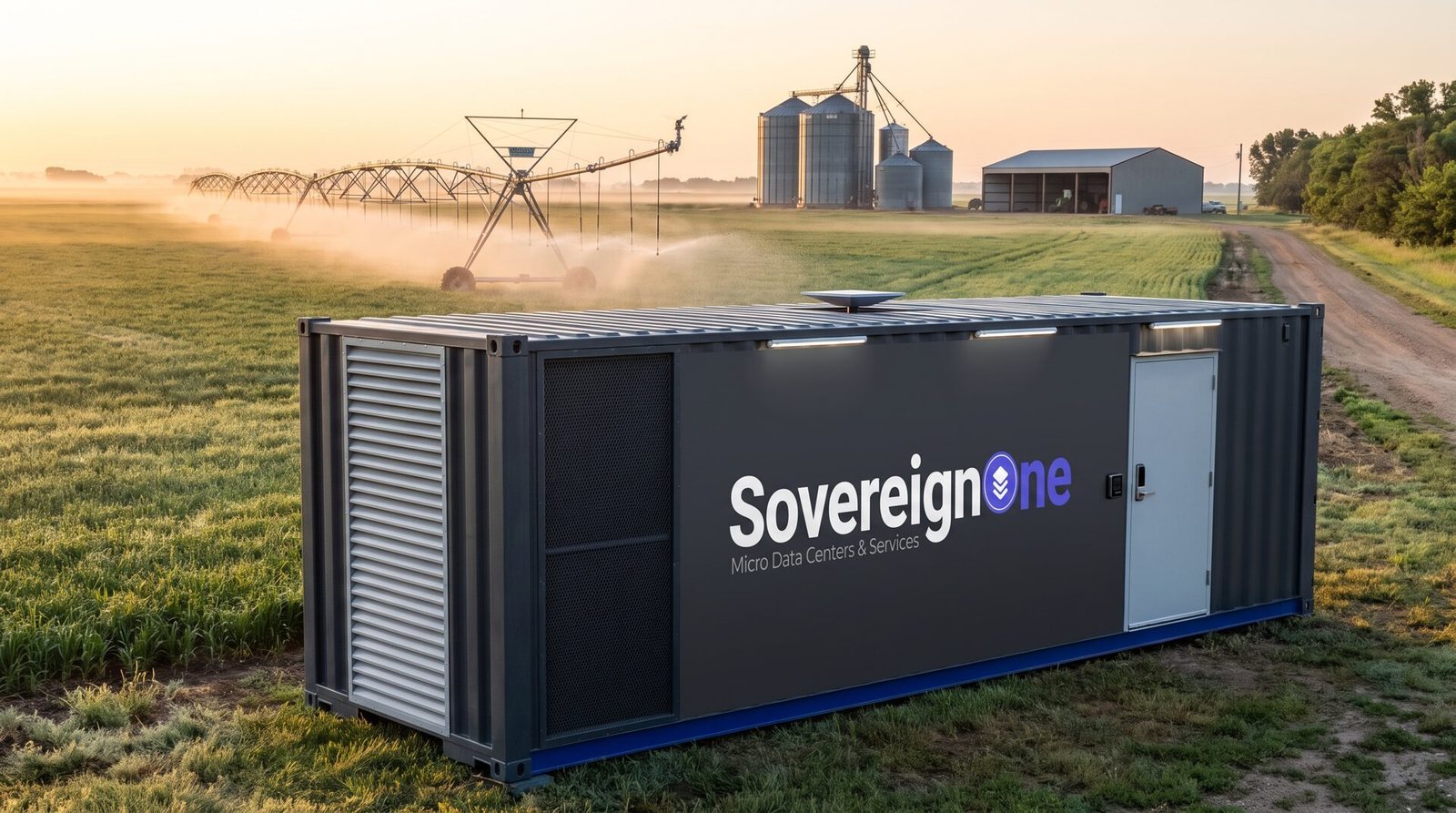
Drone and satellite imagery, yield monitors and in-field sensors generate volumes that a rural link cannot clear in a useful window — and the decisions they inform are measured in days, not months.
Drone and satellite analysis turned into field prescriptions on site.
Vision-based sorting and quality grading at the line.
Monitoring and logistics compute at the storage site.
Shared capacity serving several member operations.
Rural sites are where bandwidth is thinnest and buildings are scarcest. An agriculture modular data center arrives as its own facility, set on a pad and energised from the power already there.
Lengths shown are indicative. The configuration for any site is set during the survey, against the actual load, the power available and the conditions on site.
Agricultural data is large, seasonal and time-critical. An agriculture modular data center keeps imagery processing, yield modelling and equipment telemetry on site, so a decision about irrigation, application or harvest timing does not wait on an upload that may take longer than the window itself.
The five lengths cover a wide range of agriculture deployments without changing the underlying design: 7 ft with a single rack at a nominal 125 kW, 12 ft with two racks at 250 kW, 20 ft with five racks at 625 kW, 40 ft with ten racks at 1.25 MW, and 52 ft with fourteen racks at 1.75 MW. Every length shares the same cooling, power and security design, so an engineering review completed for one unit holds for the next.
Siting is a question of power and ground rather than construction. A conventional build runs two to five years from permit to energised; a SovereignOne unit runs four to six months from survey to live load. For agriculture, that is the difference between capacity arriving inside the planning cycle and arriving after it.
Cooling is where most of the saving sits. The design reduces power and water used for cooling by 30% against a conventional air-cooled hall. On constrained sites, available utility capacity rather than floor space is usually what limits a agriculture deployment, so that reduction often decides whether a site can host the load at all.
Operationally the unit behaves like any other facility on the site. It presents standard power and network interfaces, it is monitored the same way, and spares follow the original vendors’ support channels rather than a bespoke supply chain. Nothing inside the enclosure is unique to SovereignOne, which keeps sustainment of a agriculture modular data center ordinary.
The same enclosure supports drone and satellite imagery processing, yield and soil modelling, autonomous and guided equipment telemetry, livestock and environmental monitoring, and the grading, sorting and traceability workloads that run at processing sites.
Capacity is added the same way it was installed. A second unit is specified against the same design, set beside the first and joined into one continuous white space, so growth stays a procurement decision rather than a new construction project, and the site keeps a single operating model as it scales.
Each unit is integrated from established platforms — CDW, Vertiv, Penguin Solutions, Motivair, Dell, Supermicro, Connected Power, NVIDIA — rather than bespoke hardware. SovereignOne is a Liberation Technology Services company, and Liberation Technology Services Inc. is a WEXMAC prime contract holder.
Precision agriculture is built on the assumption that sensors, machinery and imagery can all reach something that will process them. On most farms that assumption does not hold. Cell coverage is patchy across a holding, drops out between fields, and is weakest in exactly the places the equipment is working.
An agriculture modular data center puts the processing on the holding itself. Soil and weather telemetry, machinery data, and drone or satellite imagery are handled where they are produced, so a decision about irrigation, application or harvest timing is not waiting on an upload that may take longer than the window it was meant to inform.
Sensors and connected machinery generate small messages constantly and need somewhere close to send them. With compute on site, that traffic terminates locally over the farm’s own network rather than depending on a carrier signal at the field edge — so the estate keeps collecting and acting on data through the gaps in coverage, and the link off the farm carries results rather than everything.
Agility is the point. The unit is sited on a pad, runs on the power already there, and can be specified at a single rack for one holding or larger where a cooperative, elevator or processing site serves many.
Yes. That is the case it is built for — the compute sits with the sensors rather than behind a link that may not be there when the data arrives.
Yes, processing data from field equipment and sensors on site, so decisions do not wait on a round trip.
No. The unit is set on a pad.
Send the site, the load and the timeline. We will come back with a length, a power plan and a delivery window.