
A logistics modular data center puts compute at the yard, the port or the distribution centre, so scanning, routing and vision workloads run at the node rather than several hops away.
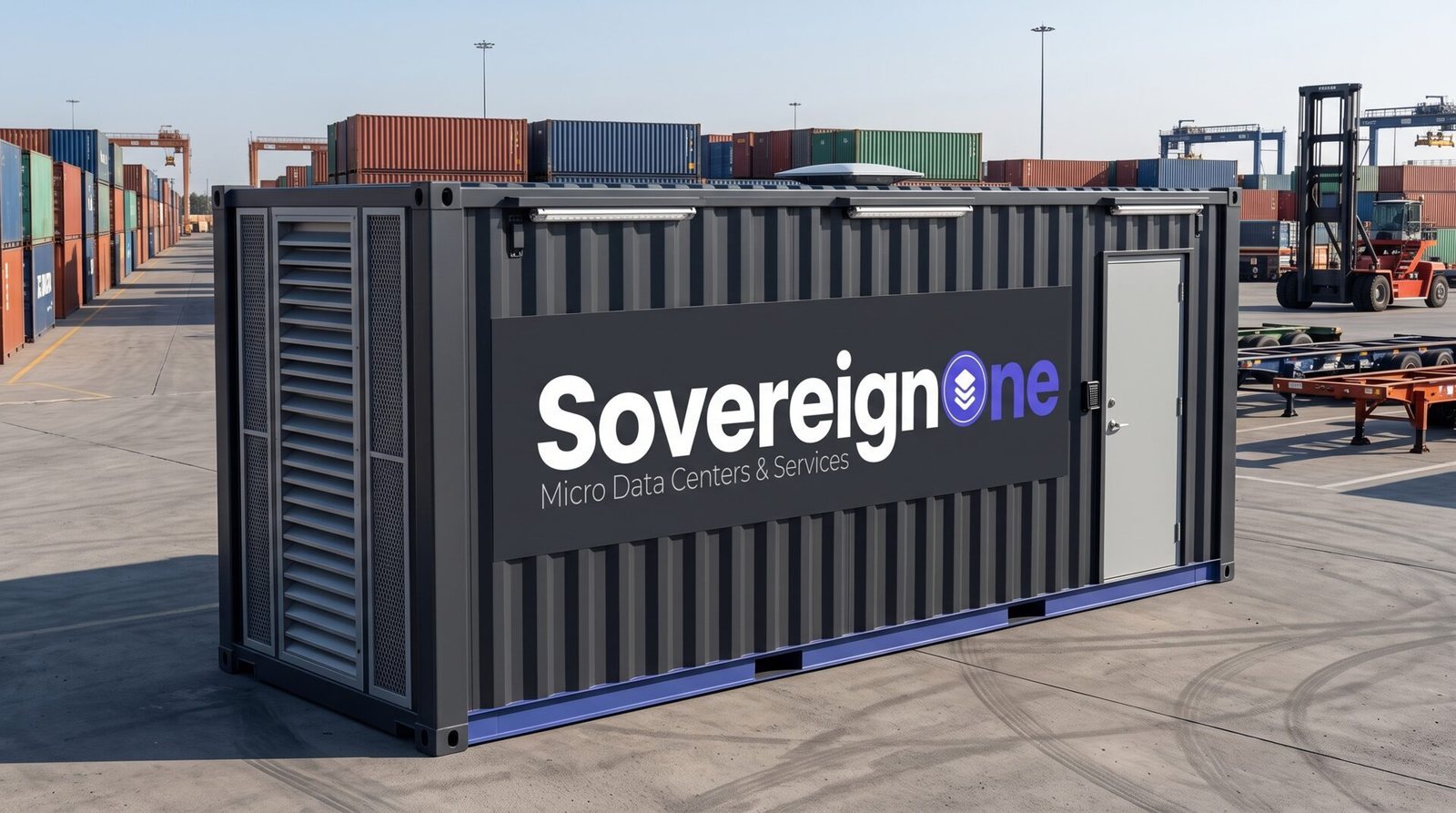
Gate OCR, crane automation and yard planning all generate imagery and telemetry continuously. Moving that to a corporate data centre adds a round trip to every decision and a bill to every frame.
Yard planning, crane automation and equipment telemetry.
Automatic container and plate recognition at the gate.
Wagon inspection, classification and movement planning.
Airside and cargo-handling compute close to the apron.
Distribution sites are built for throughput, not for server rooms. A logistics modular data center arrives as its own facility, set on a pad and energised from the power already there.
Lengths shown are indicative. The configuration for any site is set during the survey, against the actual load, the power available and the conditions on site.
Throughput depends on decisions made in seconds. A logistics modular data center keeps sortation vision, routing and yard management on site, so a misread label or a blocked dock is handled locally instead of waiting on a round trip to a distant region.
The five lengths cover a wide range of logistics deployments without changing the underlying design: 7 ft with a single rack at a nominal 125 kW, 12 ft with two racks at 250 kW, 20 ft with five racks at 625 kW, 40 ft with ten racks at 1.25 MW, and 52 ft with fourteen racks at 1.75 MW. Every length shares the same cooling, power and security design, so an engineering review completed for one unit holds for the next.
Siting is a question of power and ground rather than construction. A conventional build runs two to five years from permit to energised; a SovereignOne unit runs four to six months from survey to live load. For logistics, that is the difference between capacity arriving inside the planning cycle and arriving after it.
Cooling is where most of the saving sits. The design reduces power and water used for cooling by 30% against a conventional air-cooled hall. On constrained sites, available utility capacity rather than floor space is usually what limits a logistics deployment, so that reduction often decides whether a site can host the load at all.
Operationally the unit behaves like any other facility on the site. It presents standard power and network interfaces, it is monitored the same way, and spares follow the original vendors’ support channels rather than a bespoke supply chain. Nothing inside the enclosure is unique to SovereignOne, which keeps sustainment of a logistics modular data center ordinary.
The same enclosure supports parcel and pallet vision, automated sortation, yard and dock management, fleet telematics and route optimisation, and the warehouse management workloads that cannot pause when connectivity does.
Capacity is added the same way it was installed. A second unit is specified against the same design, set beside the first and joined into one continuous white space, so growth stays a procurement decision rather than a new construction project, and the site keeps a single operating model as it scales.
Each unit is integrated from established platforms — CDW, Vertiv, Penguin Solutions, Motivair, Dell, Supermicro, Connected Power, NVIDIA — rather than bespoke hardware. SovereignOne is a Liberation Technology Services company, and Liberation Technology Services Inc. is a WEXMAC prime contract holder.
A distribution operation cannot pause while a link recovers. Scanning, sortation, routing and yard moves all depend on systems answering immediately, and an architecture that sends every decision to a distant region makes throughput a function of someone else’s network.
Processing on site means the data the operation runs on is physically present. A misread label, a blocked dock or a rerouted trailer is handled at the node, in the moment, rather than waiting on a round trip — and when connectivity degrades, the site keeps running instead of stopping.
Resilience comes from having more than one place for the work to live. A unit on site carries the systems the building depends on day to day, while a second location — another facility in the network, or a central site — holds the redundant copy. Neither is a single point of failure, and the operation can fail over without depending on one link or one building staying up.
Peak volume is not static, and neither is automation. Capacity is added in known increments against the same design, so a site that adds sortation lines, more vision systems or a new shift pattern extends the estate it already has rather than re-architecting around a new facility.
Because the data is always there. Local processing does not depend on a link staying up, which matters when the operation cannot pause for one.
Yes, by adding units as volume grows, rather than by resizing a facility.
Running more than one unit supports both on-site and off-site redundancy, so a failure in one location does not stop processing.
Send the site, the load and the timeline. We will come back with a length, a power plan and a delivery window.