
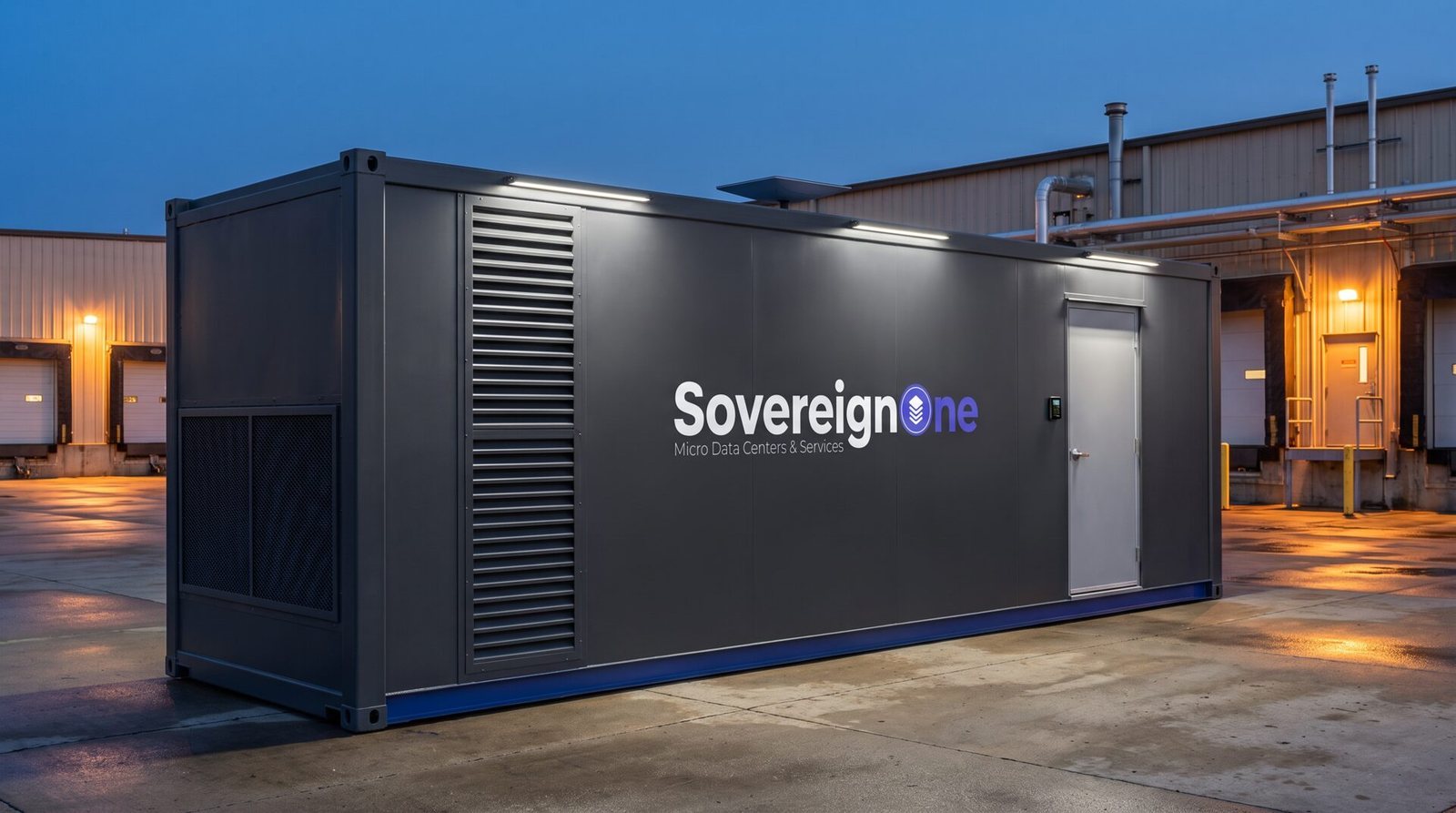
A manufacturing modular data center puts compute on the plant site, so machine vision, line telemetry and quality data are processed where they are produced rather than in a region several hops away.
Inspection that has to stop a line, divert a part or adjust a tool needs an answer inside the cycle time. That argument is settled by physics, not by procurement.
Inspection models running against camera arrays on the line.
Vibration and thermal analysis across plant equipment.
Simulation of the line running alongside the line itself.
A repeatable unit deployed to every site in the network.
Most plants have no spare floor space and no appetite for a construction programme beside a running line. A manufacturing modular data center arrives as its own facility and is energised from the power already on site.
Lengths shown are indicative. The configuration for any site is set during the survey, against the actual load, the power available and the conditions on site.
Production data is only useful while the line is still running. A manufacturing modular data center keeps inference, inspection and process control on site, so a defect is caught on the shift that produced it and control loops are not exposed to a link that may be slow or unavailable.
The five lengths cover a wide range of manufacturing deployments without changing the underlying design: 7 ft with a single rack at a nominal 125 kW, 12 ft with two racks at 250 kW, 20 ft with five racks at 625 kW, 40 ft with ten racks at 1.25 MW, and 52 ft with fourteen racks at 1.75 MW. Every length shares the same cooling, power and security design, so an engineering review completed for one unit holds for the next.
Siting is a question of power and ground rather than construction. A conventional build runs two to five years from permit to energised; a SovereignOne unit runs four to six months from survey to live load. For manufacturing, that is the difference between capacity arriving inside the planning cycle and arriving after it.
Cooling is where most of the saving sits. The design reduces power and water used for cooling by 30% against a conventional air-cooled hall. On constrained sites, available utility capacity rather than floor space is usually what limits a manufacturing deployment, so that reduction often decides whether a site can host the load at all.
Operationally the unit behaves like any other facility on the site. It presents standard power and network interfaces, it is monitored the same way, and spares follow the original vendors’ support channels rather than a bespoke supply chain. Nothing inside the enclosure is unique to SovereignOne, which keeps sustainment of a manufacturing modular data center ordinary.
The same enclosure supports machine vision and automated inspection, predictive maintenance on rotating equipment, process and yield optimisation, digital twin and simulation workloads, and the historian and MES workloads that cannot tolerate a round trip off site.
Capacity is added the same way it was installed. A second unit is specified against the same design, set beside the first and joined into one continuous white space, so growth stays a procurement decision rather than a new construction project, and the site keeps a single operating model as it scales.
Each unit is integrated from established platforms — CDW, Vertiv, Penguin Solutions, Motivair, Dell, Supermicro, Connected Power, NVIDIA — rather than bespoke hardware. SovereignOne is a Liberation Technology Services company, and Liberation Technology Services Inc. is a WEXMAC prime contract holder.
Automation on a plant floor is a control problem with a deadline. Robotic cells, vision inspection and the facility systems around them expect an answer inside a fixed window, and a control loop that leaves the site is a control loop exposed to every hop between the line and a distant region.
A manufacturing modular data center sits on the plant site, so robotics coordination, machine vision and the historian and MES workloads run next to the equipment producing the data. Inference happens where the part is, which is what lets a defect be caught on the shift that made it rather than reported after the fact.
The building generates as much telemetry as the line does — rotating equipment, compressed air, power, HVAC, environmental monitoring. Processing it on site keeps condition-based maintenance running on local data instead of competing with production traffic for the link off the plant.
Downtime on a running line is the expensive failure, so the systems that keep it moving should not depend on a single location. Capacity can be specified with a redundant unit on site, or paired with a second plant or central facility, so control and analytics fail over without the line waiting on one building or one connection.
Yes — close to the equipment, so control loops do not depend on a link to a distant facility.
Units deploy as multiples, so systems can be made redundant across them rather than concentrated in one place.
The unit is set outside on a pad and commissioned there, rather than built into the plant, so the work does not run through your production floor.
Send the site, the load and the timeline. We will come back with a length, a power plan and a delivery window.