
A mining modular data center puts compute at the mine site, the mill or the port, instead of moving fleet telemetry, drill and blast data and processing video across a link that was never sized for it.
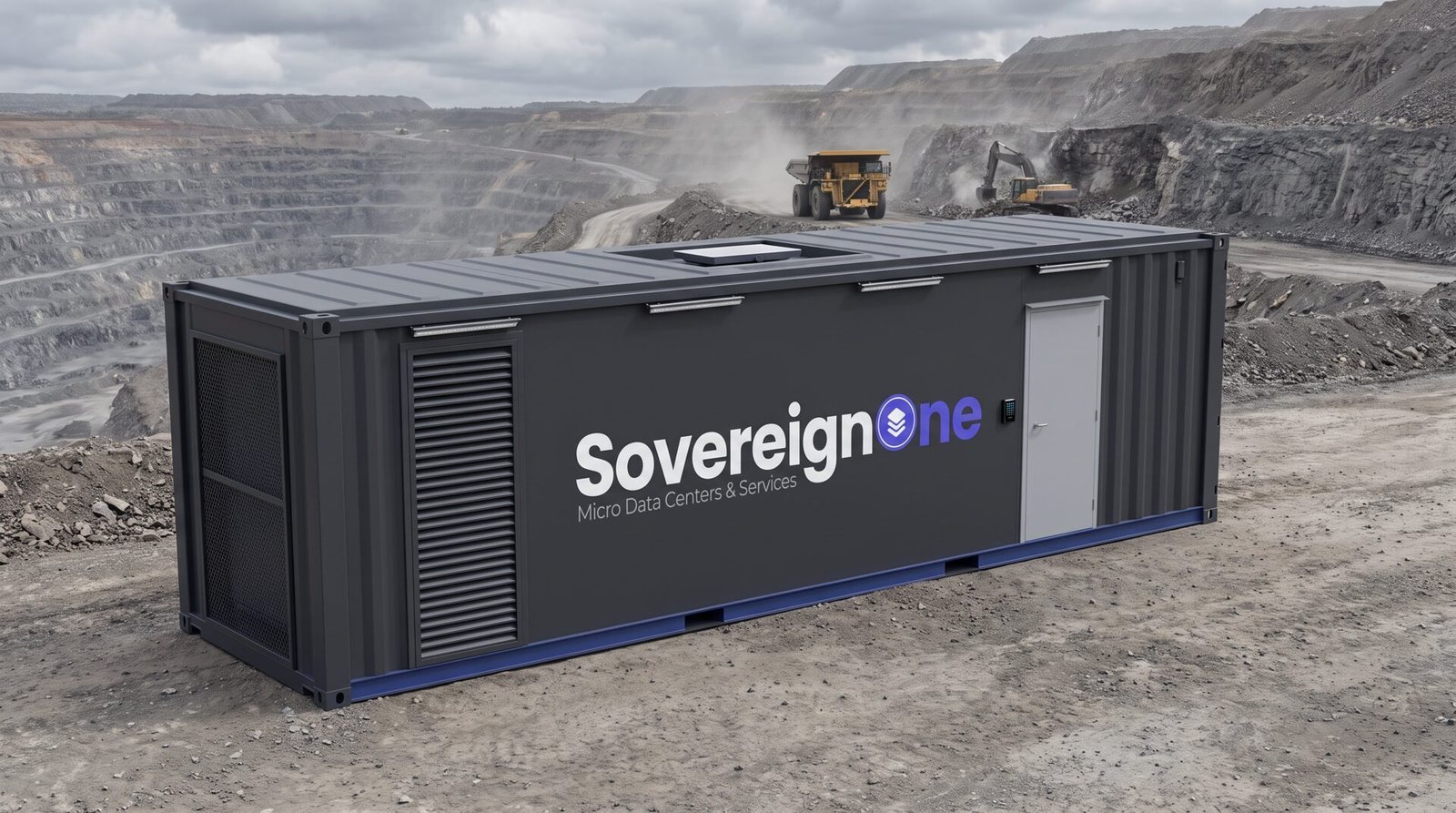
Mine sites run on their own generation and relocate as the operation advances. A fixed building is the wrong shape for both facts.
Low-latency compute for fleet control and collision avoidance.
Assay and grade-control processing at the mine site rather than off site.
Control and optimisation workloads beside the mill.
Compact capacity for survey work ahead of development.
Mine sites rarely have a spare building or a utility feed to grow into. A mining modular data center arrives as its own facility, set on a pad and energised from the power already there.
Lengths shown are indicative. The configuration for any site is set during the survey, against the actual load, the power available and the conditions on site.
Mines generate continuous data from haulage fleets, fixed plant and processing lines, and most of it loses value if it has to travel before it is used. A mining modular data center keeps fleet optimisation, ore characterisation and predictive maintenance on site, so decisions happen on shift rather than after it.
The five lengths cover a wide range of mining deployments without changing the underlying design: 7 ft with a single rack at a nominal 125 kW, 12 ft with two racks at 250 kW, 20 ft with five racks at 625 kW, 40 ft with ten racks at 1.25 MW, and 52 ft with fourteen racks at 1.75 MW. Every length shares the same cooling, power and security design, so an engineering review completed for one unit holds for the next.
Siting is a question of power and ground rather than construction. A conventional build runs two to five years from permit to energised; a SovereignOne unit runs four to six months from survey to live load. For mining, that is the difference between capacity arriving inside the planning cycle and arriving after it.
Cooling is where most of the saving sits. The design reduces power and water used for cooling by 30% against a conventional air-cooled hall. On constrained sites, available utility capacity rather than floor space is usually what limits a mining deployment, so that reduction often decides whether a site can host the load at all.
Operationally the unit behaves like any other facility on the site. It presents standard power and network interfaces, it is monitored the same way, and spares follow the original vendors’ support channels rather than a bespoke supply chain. Nothing inside the enclosure is unique to SovereignOne, which keeps sustainment of a mining modular data center ordinary.
The same enclosure supports autonomous and semi-autonomous haulage, drill and blast analysis, mill and concentrator optimisation, tailings and environmental monitoring, and condition-based maintenance on fixed plant — anywhere the work is produced faster than it can be moved.
Each unit is integrated from established platforms — CDW, Vertiv, Penguin Solutions, Motivair, Dell, Supermicro, Connected Power, NVIDIA — rather than bespoke hardware. SovereignOne is a Liberation Technology Services company, and Liberation Technology Services Inc. is a WEXMAC prime contract holder.
Capacity is added the same way it was installed. A second unit is specified against the same design, set beside the first and joined into one continuous white space, so growth stays a procurement decision rather than a new construction project, and the site keeps a single operating model as it scales.
The tools that make a modern mine productive — autonomous haulage, drill guidance, ore characterisation, fleet optimisation, vision systems across fixed plant — all assume compute close enough to answer in seconds. The usual way to get there is to trench fibre to a site that may be hours from the nearest substation, on ground that changes as the pit advances.
A mining modular data center puts the capability on the lease instead of at the end of a link. The site gets the compute the tooling needs without a trenching programme, a carrier build or a capital case for infrastructure that has to be re-run when the footprint moves.
Remote sites lose connectivity, and the systems that matter most are the ones that cannot pause when they do. Processing on site means haulage coordination, drill and blast analysis and mill optimisation keep running on local data, and the link off the lease carries results and reporting rather than everything the site produces.
Because the unit arrives as its own facility and runs on the power already there, it suits ground where there is no building to spare and no utility feed to grow into — and it can be relocated as the operation does.
Yes. The constraint at remote sites is usually connectivity rather than compute, and processing the data where it is produced removes it.
No — avoiding that cost is much of the point. The unit brings the processing to the site instead of carrying the data to the processing.
The unit is a container on a pad, not a building. It can be lifted and set again as the operation moves.
At a standoff from the active working area — near the site offices, the mill or the gate — rather than at the face. Local processing only needs to be on the site network, not next to the equipment, so the unit is placed where it is straightforward to permit, power and service.
Send the site, the load and the timeline. We will come back with a length, a power plan and a delivery window.